Roda-Ledger
Roda-Ledger is a high-performance, crash-safe financial ledger engine. It handles the hard parts of financial infrastructure — strict transaction ordering, atomicity, durability, and crash recovery — so you can focus on your business logic.
It is built for engineers who need a ledger they can trust. Not a general-purpose database stretched to fit financial use cases. Not a message queue masquerading as a transaction log. A purpose-built ledger engine, designed from the ground up for correctness and throughput.
It is also designed to get out of your way. Common operations — deposits, withdrawals, transfers — work out of the box. Custom multi-account logic is expressed through registered WASM functions without touching the engine. How much durability you need is your call, per submission: fire and forget for maximum throughput, or wait for disk confirmation when it matters. Run it as a Docker service in minutes, or embed it as a library. The ledger adapts to your use case, not the other way around.
5.7 million transactions per second. Sub-microsecond latency. WAL-backed durability. Zero torn writes.
Quick Start
Get a ledger running in under a minute.
1. Start the server
docker run -p 50051:50051 -v $(pwd)/data:/app/data tislib/roda-ledger:latest
That’s it. The ledger is running, persisting data to ./data, and listening for gRPC connections on port 50051.
2. Submit a deposit
grpcurl -plaintext -d '{"deposit": {"account": 1, "amount": "1000", "user_ref": "123"}}' \
  localhost:50051 roda.ledger.v1.Ledger/SubmitOperation
3. Check the balance
grpcurl -plaintext -d '{"account_id": 1}' \
  localhost:50051 roda.ledger.v1.Ledger/GetBalance
You should see a balance of 1000 for account 1.
Stop the container and start it again — the balance is still there. That is the durability guarantee in action.
Where to Go Next
Roda-Ledger’s documentation is organized into four levels. Start at the top and go as deep as your use case requires.
| Level | Document | What it covers |
|---|---|---|
| 1 | Concepts | Mental model, guarantees, invariants. Read this first. |
| 2 | API | Operations, wait levels, gRPC reference. |
| 3 | Architecture | Pipeline design, stage internals, recovery. |
| 4 | WASM Runtime | Programmable functions: ABI, registration, recovery. |
If you want to understand what roda-ledger guarantees and why, start with Concepts.
If you want to integrate it into your system, start with API.
Concepts
This document establishes the mental model and vocabulary that all other roda-ledger documentation builds on. Read it before anything else. No implementation details are discussed here — only what the system is, what it guarantees, and what it does not do.
What is a Ledger
A ledger is an append-only record of financial facts. In roda-ledger, transactions are the source of truth. Balances are derived state — they are computed by applying all transactions that have touched an account, in order. A balance is never stored as a primary fact; it is always the result of replaying history.
This has a concrete implication: if you lose your balances but keep your transactions, you lose nothing. If you lose your transactions, no balance snapshot can recover them. The log is the ledger.
Accounts and Balances
An account is an identifier — a u64 that represents a participant in the ledger. Accounts are not created explicitly; they come into existence the first time a transaction references them.
A balance is the current state of an account, represented as an i64. Balances can be positive or negative. By default, roda-ledger protects accounts from going below zero — a transaction that would produce a negative balance is rejected. This protection can be intentionally bypassed via WASM-defined functions that explicitly check get_balance themselves (for example, to model overdraft accounts or internal system accounts).
Account 0 is the system account. It serves as the source and sink for all money entering or leaving the ledger. A Deposit produces a debit on the user account (balance goes up) and a credit on account 0; a Withdrawal produces a credit on the user account (balance goes down) and a debit on account 0. The convention used throughout the engine and the WASM host API is debit adds, credit subtracts — see the WASM Runtime guide for the host-call contract. This is not a stylistic choice — it is required by the zero-sum invariant described below.
Operations and Transactions
These two terms are distinct and the distinction matters.
An operation is the client’s intent. roda-ledger provides four operation types:
- Deposit — debits the user account (balance up), credits account 0 (the source)
- Withdrawal — credits the user account (balance down), debits account 0 (the sink)
- Transfer — moves an amount from one account to another (credit on the sender, debit on the receiver). If
from == to, the operation is a no-op — sequenced and recorded but emits noTxEntryrecords. - Function — invokes a previously registered WebAssembly module by name, with up to eight
i64parameters. The module produces credits and debits via host calls and runs atomically as a single transaction. This is the programmable ledger entry point and the only extension surface: any multi-account, multi-step logic that does not fit the named types is expressed as a registered function.
Every operation carries a user_ref — a caller-supplied value that serves two purposes: an idempotency key to prevent duplicate processing, and a reference stored alongside the transaction for correlation or auditing. Idempotency is described in detail below.
The client submits operations. It never writes transactions directly.
A transaction is the ledger’s immutable record of what happened. When an operation is accepted and executed, roda-ledger creates a transaction — a permanent, ordered fact in the log. Transactions are never modified, never deleted, and never reordered. The caller can query a transaction directly to check its status or inspect its details.
When querying a transaction, the caller sees entries — the individual credits and debits the Transactor produced from the original operation — not the operation itself. A Transfer becomes two entries: a credit on the sender and a debit on the receiver (recall: credit subtracts, debit adds). A Function becomes one entry per credit / debit host call it issued. The operation is the intent; the entries are the facts.
The client thinks in operations. The ledger thinks in transactions. The Transactor translates between the two.
Atomicity
A transaction is the atomicity boundary for failure. All steps within a single transaction either all succeed or all fail — if any condition fails at any point during execution (a balance check, a custom rule, or the zero-sum invariant), the entire transaction is rolled back, no balance is updated, and the caller is notified. The Transactor — the single deterministic writer at the heart of roda-ledger — enforces this for every operation type, including registered WebAssembly functions: a function that traps, returns a non-zero status, or emits an unbalanced credit/debit set is rolled back exactly the same way a failed Transfer is.
No torn writes. Each individual internal credit or debit is a single atomic store. A concurrent reader will never observe a partially-written balance for any single account. Every balance a reader sees is always a complete, valid value.
Intermediate state is visible across accounts. Within a multi-step operation — a Transfer, or a Function issuing several credit / debit host calls — the Transactor applies each step in sequence. A concurrent reader can observe some of these stores before others have landed — for example, seeing a Credit applied to one account before the corresponding Debit on another has landed. This is by design. The last_tx_id returned by get_balance is the signal that a transaction is fully settled: it is only updated after all steps in the transaction are complete. If a caller needs to know that a specific transaction is fully reflected across all accounts, they should wait for last_tx_id to advance past their transaction ID, or use submit_wait(snapshot) for a linearizable read.
The Zero-Sum Invariant
Every transaction must net to zero. The sum of all credits in a transaction must equal the sum of all debits. roda-ledger enforces this invariant on every transaction — a transaction that violates it is rejected before any balance is updated.
Because every individual transaction nets to zero, the sum of all balances across all accounts in the ledger is always zero. This is not a configuration option — it is an emergent property of the per-transaction invariant. Money is never created or destroyed inside the ledger. It only moves.
This is why account 0 exists. When money enters the system (a deposit), it must come from somewhere — account 0 is credited (its balance goes down). When money leaves the system (a withdrawal), it must go somewhere — account 0 is debited (its balance goes up). The ledger always balances.
Execution Model
The Transactor is a single, deterministic writer. There is no concurrency within transaction execution — one transaction at a time, in strict order. This is not a limitation. It is the source of correctness.
Because only one transaction executes at a time, there are no races, no conflicts, and no need for locks or conflict resolution. The Transactor maintains a hot in-memory cache of all account balances. Every write path — every operation submitted to the ledger — executes against this cache, which always reflects the latest committed state. The write path is always linearizable: no transaction ever makes a decision based on stale data.
The throughput of roda-ledger does not come from parallelizing execution. It comes from the pipeline that surrounds the Transactor, which allows sequencing, durability, and snapshotting to proceed concurrently with each other, without blocking the Transactor.
Staged Guarantees
A transaction does not go from submitted to done in a single step. It moves through a pipeline of stages, and each stage adds a specific guarantee. The caller chooses which stage to wait for.
Stage 1 — Sequencer The transaction receives a unique, monotonic ID and a permanent position in the global order. From this point, its place in history is fixed.
Stage 2 — Transactor The transaction is executed. Business logic runs, balances are updated in the Transactor’s in-memory cache, and the result (committed or rejected) is known. After this stage, the transaction has happened — but only in memory.
Stage 3 — WAL Storer The transaction is written to the Write-Ahead Log on disk. After this stage, the transaction survives a process crash or power loss. This is the durability boundary.
Stage 4 — Snapshotter
The updated balances are written to the snapshot, making them visible to readers via get_balance. After this stage, reads reflect this transaction and all transactions before it.
The gap between Stage 3 and Stage 4 is typically tens to hundreds of nanoseconds — the Snapshotter runs continuously as part of the pipeline and is not a slow checkpoint process.
The significant gap is between Stage 2 and Stage 3. WAL writes are batched dynamically: the WAL Writer drains everything currently available, writes it, and only then yields to fdatasync (driven by an independent WAL Committer thread). Throughput and latency of this stage are bounded by sequential disk write speed.
Consistency Model
roda-ledger offers two consistency levels, and the caller controls which one they get.
Serializability — always, on the write path Every transaction is executed by the single Transactor against the latest in-memory state. Execution is strictly ordered. This gives serializability by default — the result of any set of concurrent submissions is equivalent to some serial execution.
Linearizability — on the read path, opt-in
By default, get_balance reads from the snapshot, which may be a few nanoseconds behind the latest committed transaction. The response includes last_tx_id — the ID of the most recent transaction reflected in the returned balance. The caller can use this to reason about freshness without blocking.
If the caller needs a linearizable read — a guarantee that the balance reflects all transactions up to and including a specific one — they submit with WaitLevel::OnSnapshot (gRPC: WAIT_LEVEL_SNAPSHOT). This blocks until the Snapshotter has processed the transaction, after which get_balance is guaranteed to reflect it and everything before it.
To summarize:
| Path | Consistency | How |
|---|---|---|
| Write | Always linearizable | Single Transactor, in-memory latest state |
| Read (default) | Eventually consistent | get_balance returns balance + last_snapshot_tx_id |
| Read (explicit wait) | Linearizable | Submit with WaitLevel::OnSnapshot, then get_balance |
Idempotency and the Active Window
Duplicate protection is always on — it cannot be disabled. When user_ref > 0, the ledger guarantees that submitting the same user_ref twice within the active window produces a single committed transaction. The second submission is recorded as a duplicate, linked to the original, and rejected with DUPLICATE — the caller always recovers the original tx_id.
The active window is the range of the last N transactions, where N equals the configured segment transaction count (transaction_count_per_segment). This is the same boundary that controls WAL segment rotation. Because the deduplication cache uses a flip-flop mechanism (active + previous), the effective coverage is N to 2N transactions — at least one full segment worth, at most two.
The window is defined by transaction count, not wall-clock time. This makes idempotency guarantees deterministic regardless of throughput or load spikes — the same number of transactions always provides the same protection, whether they arrive in one second or one hour.
user_ref = 0 opts out of the idempotency check for that individual transaction. This is the mechanism, not a global toggle — there is no configuration to disable deduplication system-wide.
Flexibility
roda-ledger is designed around two dimensions of flexibility that set it apart from opinionated ledger systems.
Programmable ledger via WebAssembly. Beyond the built-in Deposit, Withdrawal, and Transfer operation types, the Function operation type is the single extension point for arbitrary multi-account logic. The caller uploads a compiled WebAssembly module, registers it under a name (a durable operation in its own right — see below), and from then on invokes it by name with up to eight i64 parameters. The runtime exposes only three host calls — credit, debit, get_balance — so the module can move value and inspect balances but cannot break out of the ledger’s invariants. This covers any financial logic that does not fit the named types: split payments, fee deductions, multi-leg settlements, or domain-specific balance rules. New transaction types can be added at runtime without recompiling or redeploying the engine, while keeping the same correctness, durability, and audit guarantees as the built-in operations.
Choose your guarantee level. The staged pipeline exposes a dial between performance and consistency. The caller chooses how much to wait per submission:
SubmitOperation(gRPC) /submit(Rust) — returns a transaction ID immediately, waits for nothing. Maximum throughput.WaitLevel::Computed— waits for execution. The caller knows whether the transaction committed or was rejected.WaitLevel::Committed— waits for durability. The transaction is on disk and survives a crash.WaitLevel::OnSnapshot— waits for the balance to be visible. Guarantees linearizable reads viaget_balance.
The caller makes this choice per submission based on what their use case requires. See the API for the exact gRPC and Rust call shapes.
Atomic Function Execution
A Function operation is, from the ledger’s perspective, indistinguishable from any other transaction once committed. From the perspective of the programmer who wrote the function, the contract is precise and worth stating explicitly:
One execution = one transaction. A single call to the function’s exported execute symbol corresponds to exactly one transaction. The function may issue any number of credit / debit calls during that execution; together they form one atomic unit.
All-or-nothing. The Transactor accumulates every credit and debit the function emits in an isolated host-side context. Nothing is applied to the live balance cache until the function has fully returned and its credits balance its debits. If the function returns a non-zero status, traps, or violates the zero-sum invariant, the entire batch of host calls is discarded and no balance changes — exactly as if a built-in operation had failed mid-step.
No partial visibility. Because the function runs on the single Transactor thread, intermediate state from a partially-executed function is never visible to readers, other functions, or other transactions. Other transactions see the function’s effects all at once, at the same moment they see the last_tx_id advance past it.
Reusable, named, versioned. A Function is registered once and invoked many times by name. Every register or override bumps the version by one; the CRC32C of the executing binary is recorded in every transaction it produces, so any past entry can be traced back to the exact code that wrote it.
Durable registration. RegisterFunction is itself transactional. The call only returns after the binary is on disk, a FunctionRegistered record is committed to the WAL, and the handler is loaded into the live runtime. A subsequent Operation::Function is therefore guaranteed to see the new version. After a crash, recovery rebuilds the registry from a paired function snapshot plus the FunctionRegistered records that follow it — the live runtime always matches what the WAL says it should be.
Determinism by construction. The host API does not expose clocks, randomness, file or network I/O, threads, or atomics. Every legal function is a pure mapping from (params, observed balances) → (status, credits, debits). This is what makes the runtime safe for future Raft replication: the leader executes the function, and followers apply the WAL entries it produced without ever re-running the WASM code.
In short, the Function operation gives the caller a way to express new transaction shapes — fee splits, multi-leg settlements, conditional transfers, accounting templates — that behave as if they had been built into the engine from day one.
What Roda-Ledger Is Not
Understanding the boundaries is as important as understanding the capabilities.
Not a general-purpose database. There is no query language, no secondary indexes, no ad-hoc reads beyond balance lookup by account ID or transaction ID.
Not an authorization layer. roda-ledger does not authenticate callers or enforce access control. This is the responsibility of the layer above it.
Not a distributed system today. roda-ledger is a single-node engine. There is no replication, no leader election, no multi-node coordination. This is a current limitation, not a design principle — Raft-based multi-node replication is planned.
What it does have today. A gRPC interface and a Docker image. roda-ledger is not only an embedded library — it can run as a standalone service.
Planned additions. Raft-based multi-node replication, mTLS authentication, and per-function CPU / memory metering for the WASM runtime.
API
This document covers the full API surface of roda-ledger. Every operation is shown in both interfaces — gRPC for standalone server usage and Rust library for embedded usage. The concepts are identical; only the syntax differs.
For a full understanding of what operations, transactions, and wait levels mean, read Concepts first.
Setup
gRPC Server
Start the server with Docker:
docker run -p 50051:50051 -v $(pwd)/data:/app/data tislib/roda-ledger:latest
To customize the server, mount a TOML config file:
docker run -p 50051:50051 \
  -v $(pwd)/data:/app/data \
  -v $(pwd)/config.toml:/app/config.toml \
  tislib/roda-ledger:latest
config.toml — full reference:
[server]
host                  = "0.0.0.0"
port                  = 50051
max_connections       = 1000
max_message_size_bytes = 4194304  # 4MB

[ledger]
max_accounts    = 1000000
wait_strategy   = "balanced"   # low_latency | balanced | low_cpu

[ledger.storage]
data_dir                       = "/data"
transaction_count_per_segment  = 10000000  # 10M transactions per segment
snapshot_frequency             = 2         # take a snapshot every N sealed WAL segments
wait_strategy options:
| Mode | Behavior | Use when |
|---|---|---|
low_latency | Spins indefinitely under backpressure | Latency is critical, CPU is dedicated |
balanced | Spins briefly, then yields, then parks | Default — good for most workloads |
low_cpu | Parks quickly under backpressure | CPU efficiency matters more than latency |
Rust Library
Add to Cargo.toml:
[dependencies]
roda-ledger = { git = "https://github.com/tislib/roda-ledger" }
Initialize and start the ledger:
#![allow(unused)]
fn main() {
use roda_ledger::ledger::{Ledger, LedgerConfig};
use roda_ledger::storage::StorageConfig;

let config = LedgerConfig {
    max_accounts: 1_000_000,
    wait_strategy: WaitStrategy::Balanced,
    storage: StorageConfig {
        data_dir: "./data".to_string(),
        transaction_count_per_segment: 10_000_000,
        snapshot_frequency: 2,
        temporary: false,
    },
    ..LedgerConfig::default()
};

let mut ledger = Ledger::new(config);
ledger.start()?;
}
The ledger recovers its state automatically on start — it finds the latest snapshot, loads it, and replays any WAL segments that followed. No manual recovery step is needed.
Submitting Operations
Fire and Forget
Submit an operation and get a transaction_id back immediately. The operation is sequenced but not yet executed.
gRPC:
# Deposit
grpcurl -plaintext -d '{
  "deposit": {"account": 1, "amount": "1000", "user_ref": "42"}
}' localhost:50051 roda.ledger.v1.Ledger/SubmitOperation

# Withdrawal
grpcurl -plaintext -d '{
  "withdrawal": {"account": 1, "amount": "500", "user_ref": "43"}
}' localhost:50051 roda.ledger.v1.Ledger/SubmitOperation

# Transfer
grpcurl -plaintext -d '{
  "transfer": {"from": 1, "to": 2, "amount": "300", "user_ref": "44"}
}' localhost:50051 roda.ledger.v1.Ledger/SubmitOperation
Response:
{"transactionId": "42"}
Rust library:
#![allow(unused)]
fn main() {
use roda_ledger::transaction::Operation;

let tx_id = ledger.submit(Operation::Deposit {
    account: 1,
    amount: 1000,
    user_ref: 42,
});

let tx_id = ledger.submit(Operation::Withdrawal {
    account: 1,
    amount: 500,
    user_ref: 43,
});

let tx_id = ledger.submit(Operation::Transfer {
    from: 1,
    to: 2,
    amount: 300,
    user_ref: 44,
});
}
Operation Types
Deposit — credits a user account. Account 0 (the system account) is debited automatically to satisfy the zero-sum invariant. Deposits never fail due to insufficient funds.
Withdrawal — debits a user account. Fails with INSUFFICIENT_FUNDS if the account balance is below the requested amount. Account 0 is credited automatically.
Transfer — moves funds between two accounts atomically. Fails with INSUFFICIENT_FUNDS if the source account balance is insufficient. If from == to, the operation succeeds immediately as a no-op.
Function — invokes a registered WASM function by name with up to 8 i64 parameters. See WASM Runtime for the full guide on writing, registering, versioning, and invoking functions.
The user_ref Field
Every operation carries a user_ref — a uint64 supplied by the caller. It serves two purposes:
- Idempotency key — when
user_ref > 0, if the sameuser_refappears within the active window — the deduplication cache uses a flip-flop (active + previous) keyed offtransaction_count_per_segment, giving an effective window of N to 2N transactions — the second submission is detected as a duplicate. It is sequenced and recorded, but linked to the original via aTxLinkRecord { kind: DUPLICATE }rather than re-executed. This prevents double-processing on client retries. Deduplication is always on and cannot be disabled. Passuser_ref = 0to opt out of the idempotency check for individual transactions. - Correlation reference — stored in the WAL alongside the transaction. Use it to link to your own database record — an order ID, payment ID, or any external reference.
Custom Operations (WASM Function)
Arbitrary multi-account, multi-step atomic logic is expressed as a registered WASM function and invoked via Operation::Function. The function can call the ledger.credit / ledger.debit / ledger.get_balance host imports; the zero-sum invariant is enforced after it returns, identically to built-in operations.
See the WASM Runtime guide for the full story: writing functions in Rust / AssemblyScript / WAT, registering them over gRPC or the Rust library, versioning, recovery, and performance numbers.
Submit and Wait
Block until the operation reaches a specific pipeline stage. Returns the full result including whether the transaction was rejected and why.
gRPC:
grpcurl -plaintext -d '{
  "deposit": {"account": 1, "amount": "1000", "user_ref": "46"},
  "wait_level": "WAIT_LEVEL_SNAPSHOT"
}' localhost:50051 roda.ledger.v1.Ledger/SubmitAndWait
Response:
{"transactionId": "43", "failReason": 0}
Rust library:
#![allow(unused)]
fn main() {
use roda_ledger::transaction::WaitLevel;

let result = ledger.submit_and_wait(
    Operation::Deposit { account: 1, amount: 1000, user_ref: 46 },
    WaitLevel::OnSnapshot,
);

if result.fail_reason.is_none() {
    println!("committed: tx {}", result.tx_id);
}
}
Wait levels:
| Level | gRPC | Library |
|---|---|---|
| Computed | WAIT_LEVEL_COMPUTED | WaitLevel::Computed |
| Committed | WAIT_LEVEL_COMMITTED | WaitLevel::Committed |
| On Snapshot | WAIT_LEVEL_SNAPSHOT | WaitLevel::OnSnapshot |
WAIT_LEVEL_COMPUTED — The Transactor has executed the operation. Validation has run. If the operation violated any constraint (insufficient funds, zero-sum violation, etc.), fail_reason is set and the transaction is permanently rejected. If fail_reason = 0, the transaction is accepted and balance changes are live in memory — but not yet durable. A crash at this point would lose the transaction.
WAIT_LEVEL_COMMITTED — The WAL Storer has flushed the transaction to disk. Durability is guaranteed. The transaction will survive a crash and be replayed on restart. Balance changes are not yet visible via get_balance.
WAIT_LEVEL_SNAPSHOT — The Snapshotter has applied the transaction to the balance cache. get_balance now reflects this transaction and all transactions before it. This is the linearizable read guarantee — any get_balance call after this point will see a consistent, fully settled balance.
To get a transaction ID without waiting for anything, use SubmitOperation / submit instead.
Batch Operations
Submit multiple operations in a single round trip. Each operation is independent — failure of one does not affect others. There is no atomicity guarantee across operations in a batch.
gRPC:
grpcurl -plaintext -d '{
  "operations": [
    {"deposit":  {"account": 1, "amount": "1000", "user_ref": "50"}},
    {"deposit":  {"account": 2, "amount": "2000", "user_ref": "51"}},
    {"transfer": {"from": 1, "to": 2, "amount": "500", "user_ref": "52"}}
  ]
}' localhost:50051 roda.ledger.v1.Ledger/SubmitBatch

# With wait:
grpcurl -plaintext -d '{
  "operations": [
    {"deposit": {"account": 1, "amount": "1000", "user_ref": "53"},
     "wait_level": "WAIT_LEVEL_COMMITTED"}
  ]
}' localhost:50051 roda.ledger.v1.Ledger/SubmitBatchAndWait
Rust library:
#![allow(unused)]
fn main() {
let ops = vec![
    Operation::Deposit { account: 1, amount: 1000, user_ref: 50 },
    Operation::Deposit { account: 2, amount: 2000, user_ref: 51 },
    Operation::Transfer { from: 1, to: 2, amount: 500, user_ref: 52 },
];

let results = ledger.submit_batch_and_wait(ops, WaitLevel::Committed);

for result in results {
    println!("tx {}: {:?}", result.tx_id, result.fail_reason);
}
}
Operations within a batch are sequenced in the order provided. However, other clients’ transactions may be interleaved between them — there is no reservation of a contiguous block in the global order.
Prefer batch submission over repeated single calls for high-throughput ingestion — it reduces round trips significantly.
Transaction Status
Poll the pipeline stage of a transaction by ID.
gRPC:
# Single
grpcurl -plaintext -d '{"transaction_id": "42"}' \
  localhost:50051 roda.ledger.v1.Ledger/GetTransactionStatus

# Batch
grpcurl -plaintext -d '{"transaction_ids": ["42", "43", "44"]}' \
  localhost:50051 roda.ledger.v1.Ledger/GetTransactionStatuses
Rust library:
#![allow(unused)]
fn main() {
let status = ledger.get_transaction_status(tx_id);
}
Transaction status values:
| Status | Meaning |
|---|---|
PENDING | Sequenced, not yet executed. Balance unchanged. Not durable. |
COMPUTED | Executed by Transactor. Balance updated in memory. Not yet durable. |
COMMITTED | Flushed to WAL. Durable. Survives a crash. get_balance does not yet reflect it. |
ON_SNAPSHOT | Applied to balance cache. get_balance reflects it. Final successful state. |
ERROR | Rejected. No balance changes. Check fail_reason for the cause. |
Rejection codes (fail_reason):
| Code | Name | Meaning |
|---|---|---|
0 | NONE | Success |
1 | INSUFFICIENT_FUNDS | Account balance too low for the requested operation |
2 | ACCOUNT_NOT_FOUND | Referenced account does not exist |
3 | ZERO_SUM_VIOLATION | Credits and debits in the transaction do not net to zero |
4 | ENTRY_LIMIT_EXCEEDED | Transaction emitted more than 255 entries (per-transaction limit) |
5 | INVALID_OPERATION | Operation is malformed or contains invalid parameters |
6 | ACCOUNT_LIMIT_EXCEEDED | Account ID exceeds max_accounts configuration |
7 | DUPLICATE | user_ref was seen within the dedup window — linked to the original transaction |
8–127 | — | Reserved for future standard reasons |
128–255 | — | User-defined custom reasons |
Reading Balances
Single Account
gRPC:
grpcurl -plaintext -d '{"account_id": 1}' \
  localhost:50051 roda.ledger.v1.Ledger/GetBalance
Response:
{"balance": "1500", "lastSnapshotTxId": "42"}
Rust library:
#![allow(unused)]
fn main() {
let balance = ledger.get_balance(1);
// balance.balance: i64
// balance.last_snapshot_tx_id: u64
}
Multiple Accounts
gRPC:
grpcurl -plaintext -d '{"account_ids": [1, 2, 3]}' \
  localhost:50051 roda.ledger.v1.Ledger/GetBalances
Rust library:
#![allow(unused)]
fn main() {
// call get_balance per account
}
Linearizable Reads
get_balance reflects all transactions that have reached ON_SNAPSHOT. By default this lags behind committed transactions by nanoseconds — almost always negligible.
If you need a guaranteed linearizable read after a specific write — the balance must reflect your transaction and everything before it — you have two options:
Option 1 — wait at submit time:
# gRPC
grpcurl -plaintext -d '{
  "deposit": {"account": 1, "amount": "1000", "user_ref": "55"},
  "wait_level": "WAIT_LEVEL_SNAPSHOT"
}' localhost:50051 roda.ledger.v1.Ledger/SubmitAndWait
# then call GetBalance — guaranteed to reflect your transaction
#![allow(unused)]
fn main() {
// Library
ledger.submit_and_wait(op, WaitLevel::OnSnapshot);
let balance = ledger.get_balance(1); // linearizable
}
Option 2 — poll last_snapshot_tx_id:
#![allow(unused)]
fn main() {
let tx_id = ledger.submit(op);
loop {
let balance = ledger.get_balance(1);
if balance.last_snapshot_tx_id >= tx_id {
// balance is now linearizable with respect to your transaction
break;
}
}
}
Pipeline Index
Observe the current progress of each pipeline stage. Useful for health checks, lag monitoring, and determining when a bulk load is complete.
gRPC:
grpcurl -plaintext -d '{}' \
  localhost:50051 roda.ledger.v1.Ledger/GetPipelineIndex
Response:
{
  "computedIndex": "10500",
  "committedIndex": "10498",
  "snapshotIndex": "10496"
}
Rust library:
#![allow(unused)]
fn main() {
let computed   = ledger.last_compute_id();   // processed by Transactor
let committed  = ledger.last_commit_id();  // flushed to WAL
let snapshotted = ledger.last_snapshot_id();  // applied to balance cache
}
Common patterns:
- Health check — all three indexes should be advancing. A stalled index indicates a stuck pipeline stage.
- Commit lag —
computed_index - committed_index. High lag means WAL writes are falling behind. - Snapshot lag —
committed_index - snapshot_index. Should be near zero under normal load. - Bulk load completion — submit all operations, then poll until
snapshot_index >= last_tx_id.
Transaction Details
Retrieve the full record of a transaction — its entries and any links to related transactions.
gRPC:
grpcurl -plaintext -d '{"tx_id": "42"}' \
  localhost:50051 roda.ledger.v1.Ledger/GetTransaction
Response:
{
  "txId": "42",
  "entries": [
    {"accountId": "1", "amount": "1000", "kind": "DEBIT",  "computedBalance": "1000"},
    {"accountId": "0", "amount": "1000", "kind": "CREDIT", "computedBalance": "-1000"}
  ],
  "links": []
}
Each entry shows the account, amount, direction (CREDIT or DEBIT), and the balance of that account immediately after the entry was applied.
Links connect related transactions:
| Link kind | Meaning |
|---|---|
DUPLICATE | This transaction is a duplicate of the linked one (same user_ref within dedup window) |
REVERSAL | This transaction reverses the linked one |
Account History
Retrieve the transaction history for an account, newest first, with pagination.
gRPC:
# First page
grpcurl -plaintext -d '{"account_id": 1, "from_tx_id": 0, "limit": 20}' \
  localhost:50051 roda.ledger.v1.Ledger/GetAccountHistory

# Next page — pass next_tx_id from previous response
grpcurl -plaintext -d '{"account_id": 1, "from_tx_id": "38", "limit": 20}' \
  localhost:50051 roda.ledger.v1.Ledger/GetAccountHistory
Response:
{
  "entries": [
    {"accountId": "1", "amount": "500", "kind": "CREDIT", "computedBalance": "500"},
    ...
  ],
  "nextTxId": "38"
}
next_tx_id = 0 means there are no more entries. Pass from_tx_id = 0 to start from the latest transaction. Default limit is 20, maximum is 1000.
Use cases: account statements, balance verification, dispute resolution, reconciliation.
Library Extras
These methods are available in the Rust library only and have no gRPC equivalent.
wait_for_transaction(tx_id) — blocks until the given transaction reaches ON_SNAPSHOT. Times out after 10 seconds.
wait_for_transaction_until(tx_id, duration) — same as above with a custom timeout.
wait_for_transaction_level(tx_id, level) — blocks until the given transaction reaches the specified WaitLevel. Returns immediately on rejection regardless of wait level.
wait_for_pass() — blocks until the last submitted transaction reaches ON_SNAPSHOT. Useful after a bulk load to confirm everything is visible.
get_rejected_count() — returns the total number of rejected transactions since startup. Useful for metrics and health monitoring.
query(request) / query_block(request) — low-level access to the Snapshot stage query queue. query is non-blocking; query_block blocks until the Snapshot stage processes the request. Used for advanced read patterns not covered by get_balance.
Architecture
This document explains the design of roda-ledger — what each part does, why it exists, and the reasoning behind key tradeoffs.
If you haven’t already, read Concepts first — it defines the terminology and guarantees this document builds on.
Design philosophy
roda-ledger is built around two problems that pull in opposite directions: correctness and throughput.
Correctness requires strict ordering and a single source of truth — concurrent writers create races, conflicts, and partial states that are catastrophic in a financial system. Throughput requires parallelism — sequential processing leaves hardware idle.
The solution is a staged pipeline. Each stage does one job on its own thread. The Transactor’s record stream flows to the read stages through a single lock-free transaction ring; the submit and query paths use lock-free SPSC queues. There is no shared mutable state between stages.
The key insight: parallelism around execution, not within it. The Transactor executes one transaction at a time — this is the source of all correctness guarantees. But while the Transactor executes transaction N, the WAL is persisting N-1, and the Snapshotter is making N-2 visible to readers. All stages run concurrently without ever coordinating.
Design principles
Three named principles recur throughout the design and are referenced by name in code and ADRs. P1 and P2 were introduced in ADR-022; P3 in ADR-023.
P1 — WAL entry types are concrete and self-defining. Each WAL entry type does exactly one concrete thing, and its named fields fully and unambiguously define it: no nested discriminators, no op-codes reinterpreting fields, no overloaded or union fields. A replayer, auditor, or human understands a record from its kind and fields alone. Every 40-byte WAL record follows it — including the programmable-state KvEntry (ADR-023), which records a plain key→value mutation; which in-memory store it feeds is a transactor concern that never reaches the log.
P2 — Balances are eventually consistent on the read side. The online read view (the Snapshotter’s balance cache) may lag and need not be strictly ordered or point-in-time. This prioritises the snapshot write path and permits relaxed memory ordering and client-side caching. The durable WAL and sealed snapshot files remain the strongly-consistent source of truth.
P3 — The WAL and Snapshot are self-sufficient; derived computation lives in the consumer, not the Ledger. The durable WAL is self-explanatory by design, and together with the Snapshot it carries enough to understand and surface any detail about the data with no external context — P1 carried from the single record to the whole. The Ledger therefore serves complete, typed reads of stored state — balances, entries, history, programmable state — but builds no custom, analytical, or aggregate queries: there is no plan and no need for an in-engine query language or programmable read path under the current design. Any later analytical or derived view is the consuming system’s job — it reads the self-describing WAL/Snapshot and computes downstream. Holding computation outside the Ledger is what preserves the single-writer correctness and throughput this document is built on.
Pipeline overview
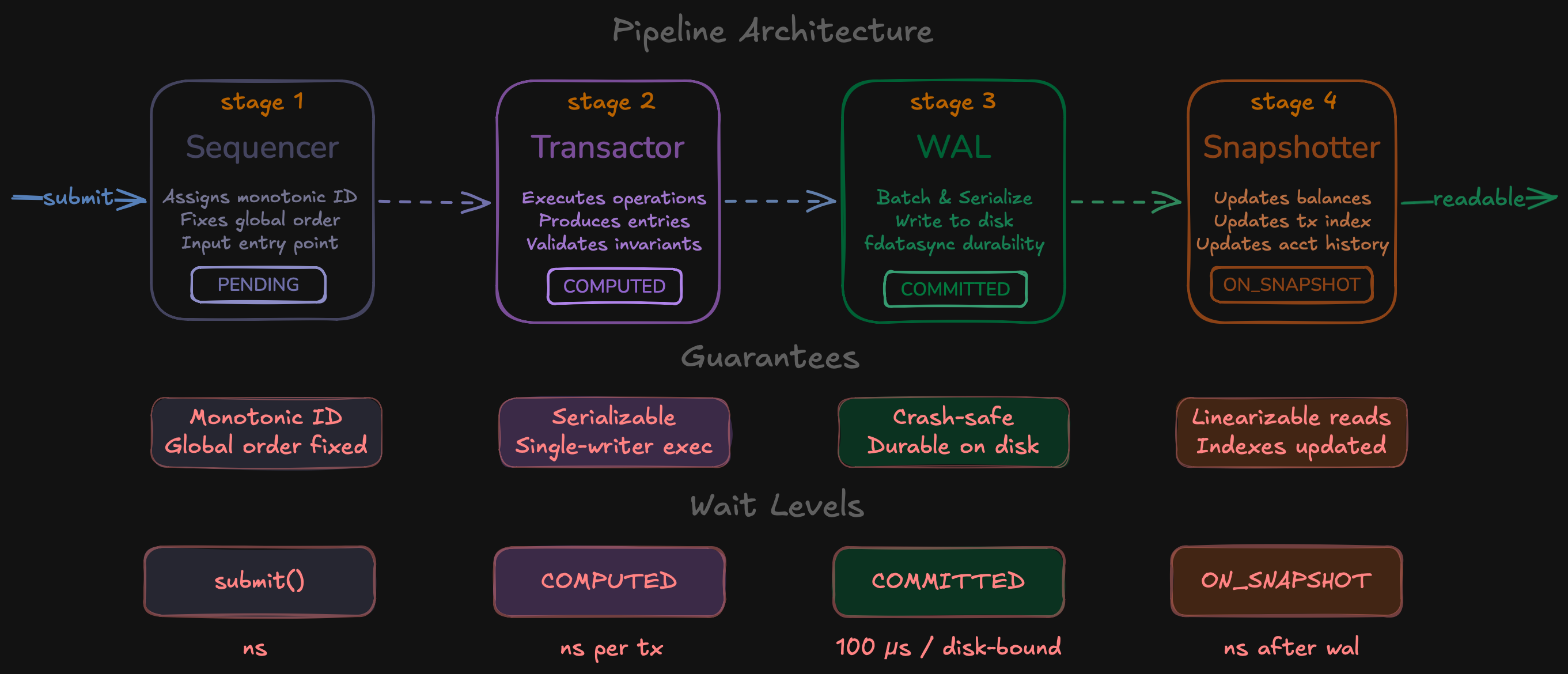
A transaction moves through four stages, each adding a guarantee:
| Stage | Guarantee | Status |
|---|---|---|
| Sequencer | Monotonic ID, permanent global order | PENDING |
| Transactor | Executed, serializable, result known | COMPUTED |
| WAL | Durable on disk, crash-safe | COMMITTED |
| Snapshotter | Balances and indexes visible | ON_SNAPSHOT |
The caller chooses which stage to wait for — see API for wait level details.
Transaction logical view
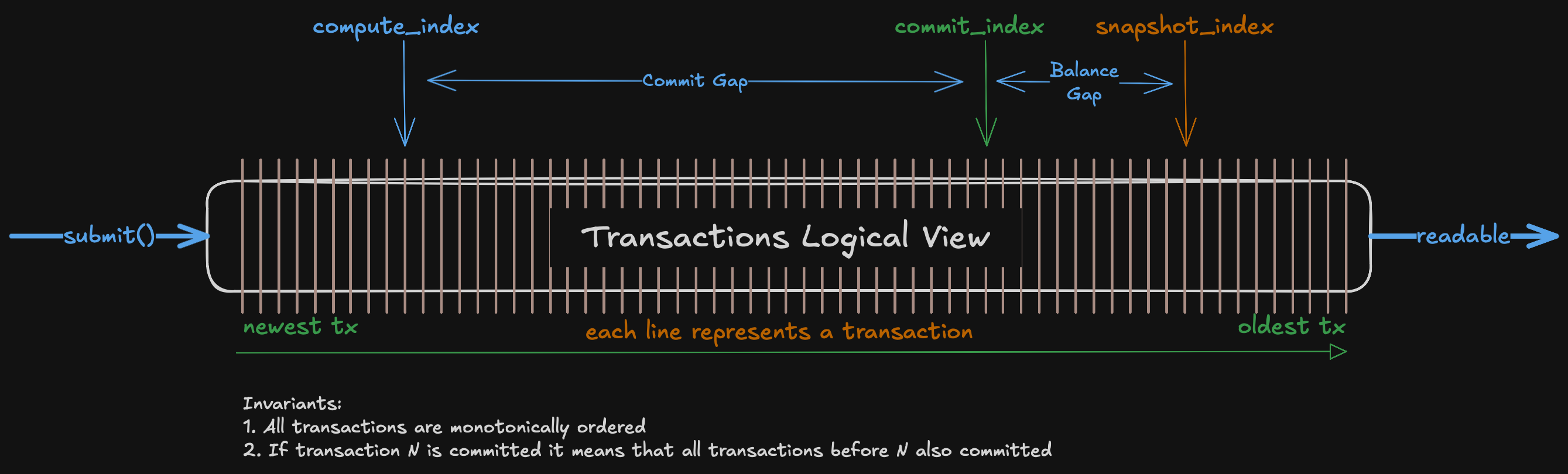
Every transaction occupies a fixed position in a globally ordered sequence. Three pipeline indexes divide that sequence into zones at any given moment:
compute_index— the furthest transaction the Transactor has executed. Everything to its right is accepted, in memory, serializable. Not yet durable.commit_index— the furthest transaction flushed to disk. Everything to its right is durable and crash-safe. The Commit Gap betweencompute_indexandcommit_indexrepresents transactions that would be lost on a crash — bounded by the WAL’s batch flush cycle (~100s µs).snapshot_index— the furthest transaction visible toget_balance. Everything to its right is readable and linearizable. The Balance Gap betweencommit_indexandsnapshot_indexis typically nanoseconds.
Two invariants hold at all times:
- All transactions are monotonically ordered — no gaps, no reordering.
- If transaction N is committed, all transactions before N are also committed. The indexes only move forward.
These invariants are what make per-call wait levels meaningful. When you call submit_wait(wal), you are waiting for commit_index to pass your transaction ID — and you know with certainty that everything before it is also durable.
The Sequencer
The Sequencer is the entry point. It assigns a unique, monotonically increasing ID to every transaction and fixes its position in the global order. This decision is permanent — no later stage can change it.
The Sequencer has no dedicated thread. It runs on the caller’s thread at submit time — nothing more than an atomic increment and a queue push.
The Transactor
The Transactor is a single-threaded, deterministic execution engine. It processes one transaction at a time, in strict sequence order.
Why single-threaded? A single writer eliminates races and conflicts entirely. Correctness is guaranteed by construction, not by coordination.
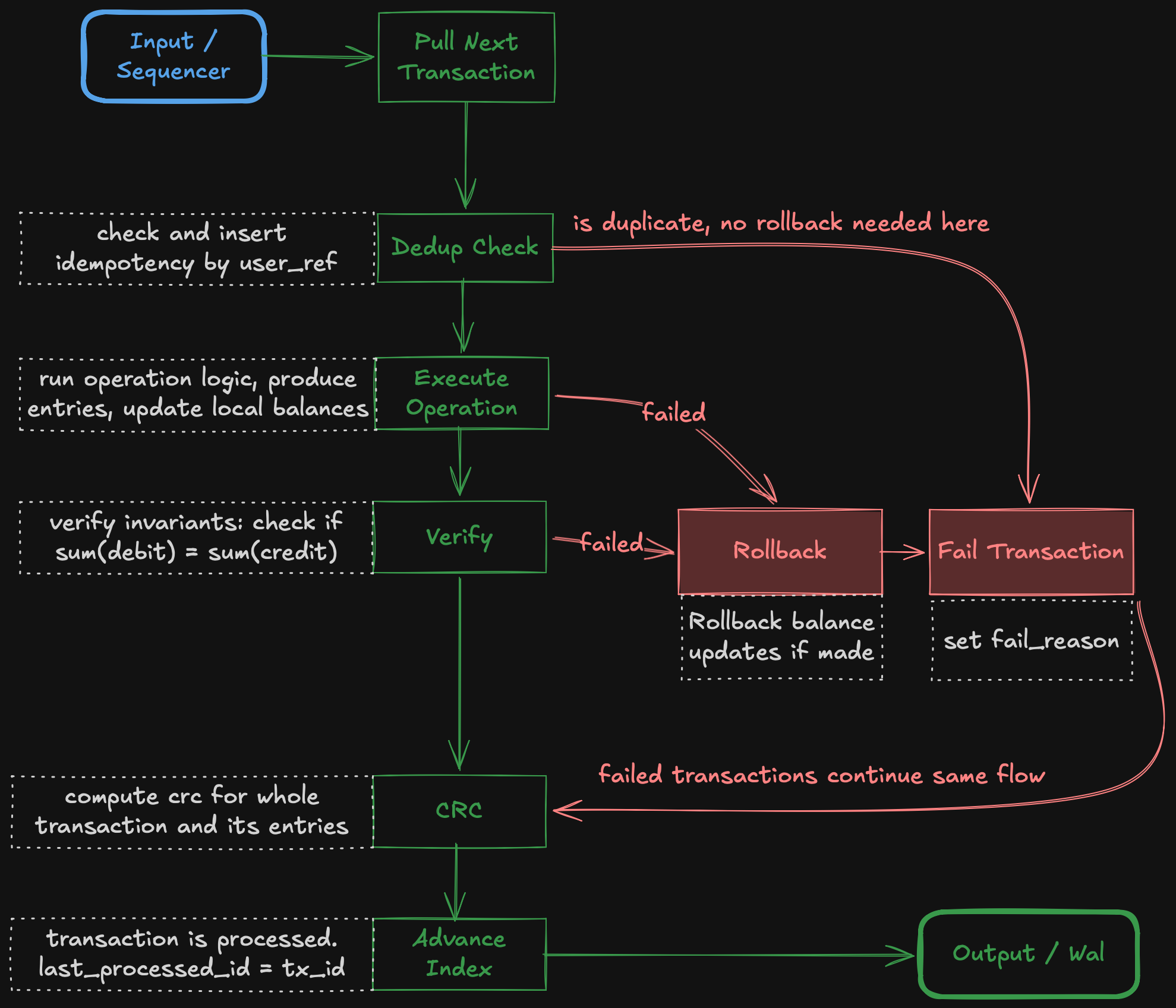
For each transaction the Transactor: checks deduplication by user_ref, executes the operation (producing credit/debit entries and updating the balance cache live), and writes those entries directly into the transaction ring’s uncommitted region — slots it owns exclusively that no reader can see yet. It verifies the zero-sum invariant by walking its own uncommitted slots, folds a running CRC over the entries as they are written, then assembles the transaction’s metadata — its commit record — and publishes the whole transaction atomically by advancing the ring’s write frontier. Failed transactions — duplicates, execution errors, invariant violations — discard the uncommitted entries and publish a lone trailing metadata record, so the audit trail stays complete and readers only ever observe whole, validated transactions.
The balance cache always reflects the latest state. This is why the write path is always linearizable — the Transactor never makes a decision based on stale data.
For built-in operations (Deposit, Withdrawal, Transfer) the Transactor runs native Rust code. For an Operation::Function, the Transactor delegates to the embedded WASM Runtime described below. Either path produces the same TxEntry records, is bounded by the same zero-sum check, and uses the same rollback machinery — there is no second code path for durability or recovery.
The WASM Runtime — programmable execution inside the Transactor
The WASM Runtime is not a separate pipeline stage. It is a component inside the Transactor that handles Operation::Function the same way native code handles Operation::Transfer. This placement is deliberate: a function execution must inherit every guarantee the Transactor already provides — single-writer ordering, zero-sum enforcement, atomic rollback, deduplication — without any new coordination.
Where it sits in the pipeline
Sequencer → Transactor ─┬─ native execution path  ─┐
                        │                          ├─→ TxEntry stream → WAL → Snapshotter
                        └─ WasmRuntime.invoke()   ─┘
A Function operation flows through Sequencer → WAL → Snapshotter exactly like any other operation. The only difference is how the Transactor produces its entries: by calling into a sandboxed WebAssembly handler that issues credit / debit host calls, instead of running a hard-coded Rust branch.
Components
WasmRuntime— one per ledger, wrapping a single sharedwasmtime::EngineandLinker. Lives behind anArc<WasmRuntime>and is cheap to clone.- Per-Transactor caller cache — a
HashMap<name, CachedHandler>owned by the Transactor thread. No locks on the hot path; the cache stores theupdate_seqof the registry it was verified against and revalidates lazily when a registration changes. - Shared registry — a small lock-protected map of
name → (version, crc32c, compiled module). Only touched on registration, unregistration, and cache miss / revalidation — never on every transaction. - Host-side execution context — a per-Transactor
TransactorStatethat captures the host calls a function emits during a singleexecute()invocation. Credits and debits accumulate here, not in WASM-visible globals, so no state leaks across calls.
Atomic execution flow
For an Operation::Function { name, params, user_ref } the Transactor:
- Performs the standard
user_refdeduplication check. - Resolves
nameagainst the caller cache, falling back to the shared registry on miss; verifiesupdate_seqto detect a concurrent registration. - Opens an isolated host-side execution context — credits and debits emitted from now on are recorded against this transaction only.
- Calls
TypedFunc::call(execute, params)on the cached handler. The function may issue any number ofcredit/debit/get_balancehost calls; each is captured into the execution context. - On any trap, host error, or non-zero return code: discards every captured credit/debit, marks the transaction failed with the appropriate status (the user-defined
u8for128..=255, a standard reason otherwise), and writes aTxMetadatarecord so auditors can see exactly which function and which return code rejected the transaction. - On a
0return: verifiessum(credits) == sum(debits). Failure here yieldsZERO_SUM_VIOLATIONand the same rollback. Success commits the captured entries to the live balance cache and emits them as ordinaryTxEntryrecords. - Tags the resulting
TxMetadatawithb"fnw\n" ++ crc32c[0..4]so every committed transaction permanently identifies the exact binary that produced it.
Stages 5–7 are the atomicity boundary. Nothing is published to the transaction ring until the function has either fully succeeded and balanced, or been fully rolled back. The WAL stage and the Snapshotter that follow it are unchanged — they cannot tell a function-produced entry stream from a native one.
Why this fits the pipeline
- Single-writer correctness. A function executes on the Transactor thread, in strict sequence, with the same in-memory balance cache native operations use. Two functions cannot race; a function cannot race with a native operation.
- No new persistence path. Function-produced entries are normal
TxEntryrecords. WAL segmentation, sealing, snapshotting, and replay treat them identically to entries from aTransfer. - No new failure mode. A WASM trap, an unbalanced credit/debit set, or a domain-specific reject all use the existing transaction-rollback machinery.
- Determinism for replication. The host API is intentionally narrow: no clocks, no randomness, no I/O, no atomics, no threads. The leader executes a function; any future Raft follower can apply the resulting WAL entries directly without re-running the WASM code.
Registration as a first-class WAL event
Registering or unregistering a function is itself a durable transaction in the pipeline:
- The submitted binary is validated (signature, size, exports) before any disk write.
- The binary is written atomically (
tmp + rename) todata/functions/{name}_v{N}.wasm. Unregister writes a 0-byte file under the next version — the audit trail is preserved. - A
FunctionRegisteredWAL record (name,version,crc32c) is committed to the active segment. - The handler is compiled and installed in the live
WasmRuntime. - Only after all four steps does
RegisterFunctionreturn.
Periodic snapshots emit a paired function_snapshot_{N}.bin next to the balance snapshot_{N}.bin, on the same snapshot_frequency trigger. Recovery loads the function snapshot first, replays FunctionRegistered records from the WAL after it (crc32c != 0 → load, crc32c == 0 → unload), and only then resumes processing transactions. A missing or corrupted binary aborts startup — the runtime never serves traffic against a registry that diverges from the WAL.
Performance shape
- The hot path adds one
HashMap::get, oneTypedFunc::call, and one host-import crossing percredit/debit. - Compiled modules are cached per
(name, crc); instantiation cost is paid once per registration, not per call. - Cache invalidation is per-name — registering
foodoes not evict the cached entry forbar. - At the Transactor level, WASM execution adds ~200 ns per operation over the native path. At the pipeline level, this is invisible: the WAL
fdatasynccost dominates and end-to-end TPS forFunctionandDepositare within a percent of each other.
Detailed ABI, host API, validation rules, and recovery semantics live in WASM Runtime and ADR-014.
The WAL
The WAL stage makes transactions durable. A transaction executed by the Transactor exists only in memory — the WAL writes it to disk before it can be considered safe.
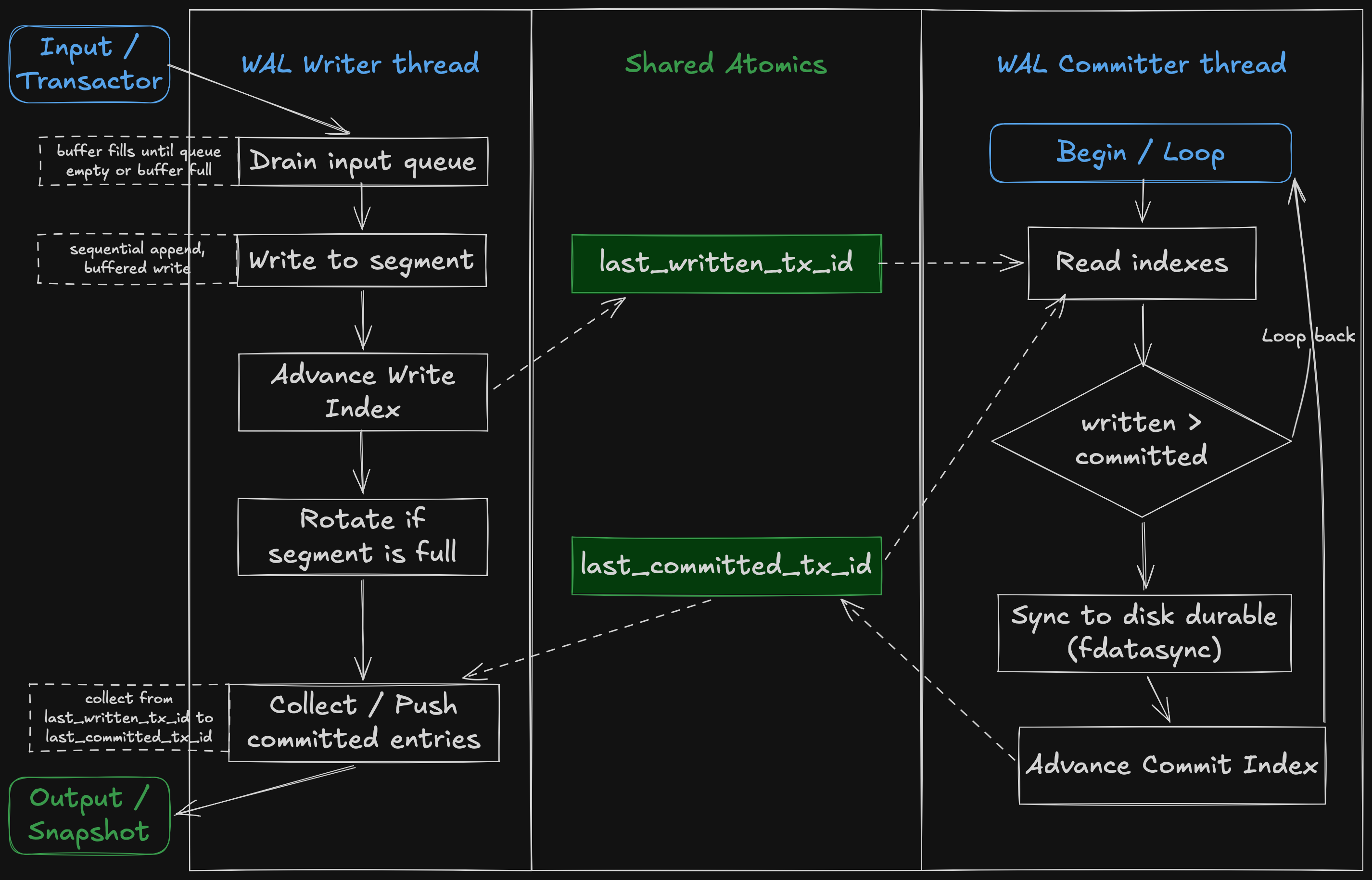
The WAL runs as two concurrent threads communicating through shared atomics:
- WAL Writer — reads published records from the transaction ring, writes them to the active segment file, advances
last_written_tx_id, and rotates segments when full. - WAL Committer — runs independently, calls
fdatasyncwheneverlast_written_tx_id > last_committed_tx_id, then advanceslast_committed_tx_id(which the pipeline exposes ascommit_index).
The Writer never blocks waiting for fdatasync — it continues writing while the Committer syncs. The WAL forwards nothing: the Snapshotter reads the same ring independently and gates itself on commit_index, so a transaction becomes visible to readers only after it is durable. This decoupling is why the WAL sustains high write throughput despite the inherent latency of fdatasync (~100s µs, disk-bound).
The WAL is segmented — divided into files based on transaction count (transaction_count_per_segment). When the transaction count in the active segment reaches the configured limit, the Writer rotates to a new one. Segment files are dynamically sized on disk — a segment with many complex (multi-entry) transactions will be larger than one with simple deposits — but the transaction count per segment is always fixed and predictable. Sealed segments are complete, consistent units used for recovery.
Segment lifecycle
A segment moves through three states:
| State | File on disk | Description |
|---|---|---|
ACTIVE | wal.bin | Currently being written. One at a time. |
CLOSED | wal_NNNNNN.bin | WAL Writer rotated away. Immutable, awaiting Seal. |
SEALED | wal_NNNNNN.bin + .crc + .seal | Verified, safe for recovery. May have snapshot. |
ACTIVE → CLOSED: transaction count threshold hit → WAL Writer fdatasyncs, renames wal.bin to wal_NNNNNN.bin, opens new wal.bin.
CLOSED → SEALED: Seal process picks it up on a timer, computes CRC32, writes .crc and .seal sidecar files.
Segment anatomy
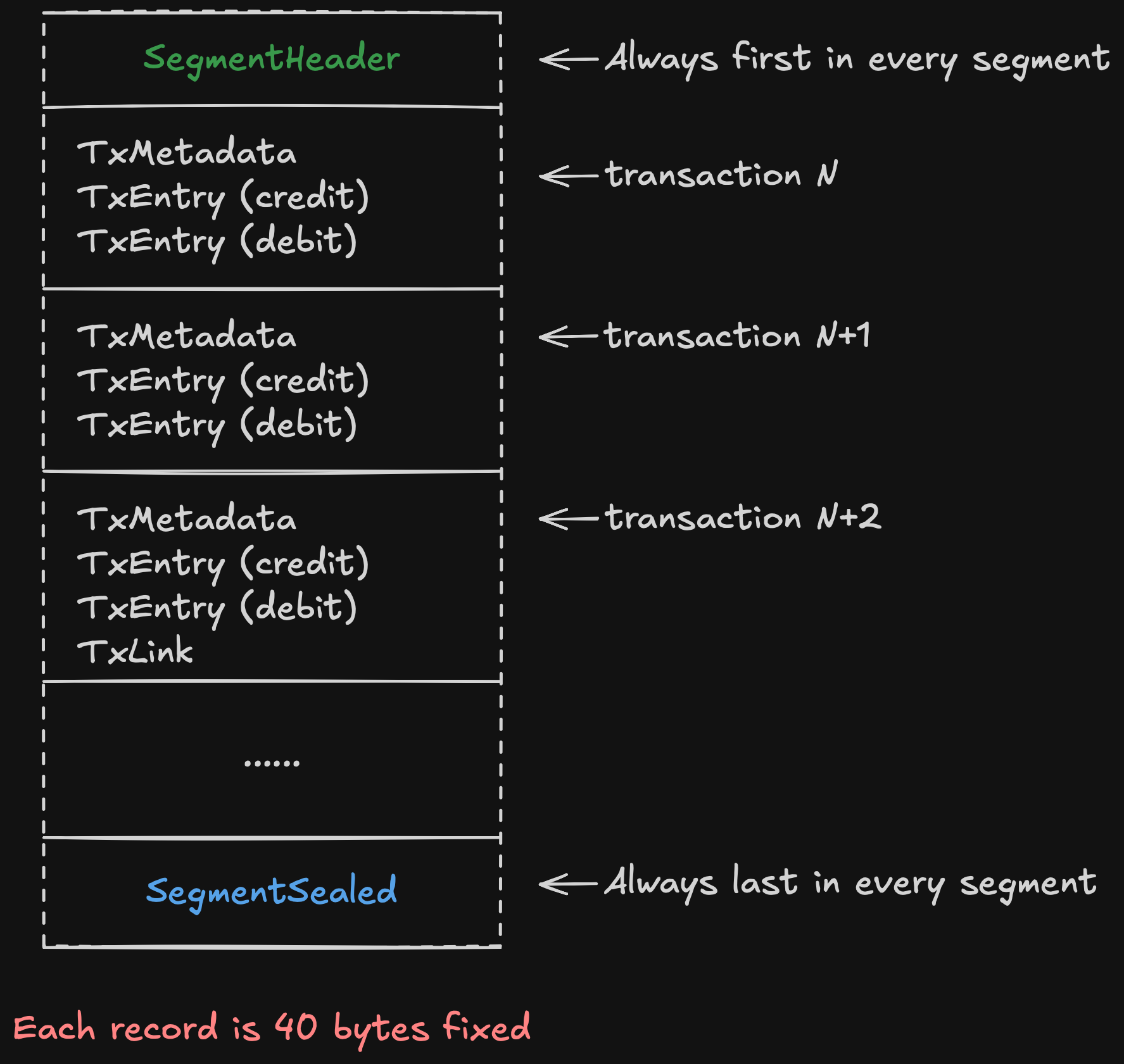
Every WAL record is exactly 40 bytes — fixed size, no variable-length scanning. This makes recovery fast and deterministic. A transaction is a contiguous group of records: its entries followed by a single trailing TxMetadata that acts as the commit record — a transaction exists exactly when its metadata has been written. Segments are a pure physical partition of one logical stream, so a transaction may span a segment boundary (its entries in one segment, the trailing metadata in the next). See ADR-020.
Seal process
The Seal process runs on a configurable timer. For each unsealed segment it: loads the WAL data, seals it (CRC + sidecar files), builds on-disk tx and account indexes, updates its local balance buffer, and conditionally writes a snapshot file.
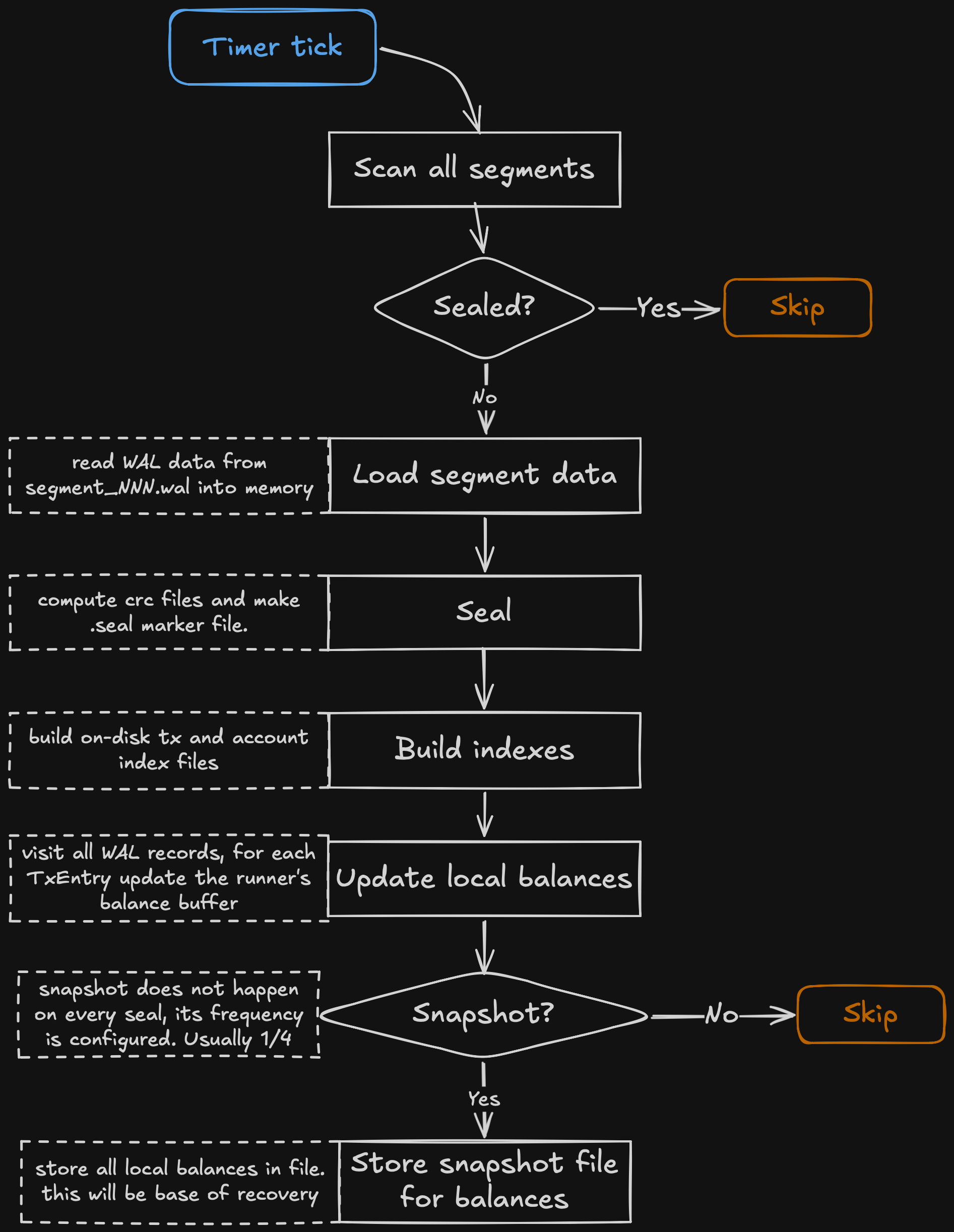
Snapshots are not written on every seal — only every snapshot_frequency segments (default: 2). The snapshot captures all non-zero balances at that point and is the base for recovery.
Active Window, Idempotency, and Hot Indexes
The active window is the central sizing concept in roda-ledger. It is defined as the last N transactions where N = transaction_count_per_segment. Three subsystems are derived from this single value:
Segment rotation
WAL segment rotation triggers when the transaction count in the active segment reaches transaction_count_per_segment. This makes the active window predictable — operators always know exactly how many transactions fit in the active segment, regardless of transaction complexity or entry counts.
Idempotency (deduplication)
The Transactor maintains a flip-flop deduplication cache — two HashMaps (active and previous) mapping user_ref → tx_id. When tx_id crosses a segment boundary, the maps flip: active becomes previous, and a new active begins. This gives an effective deduplication window of N to 2N transactions.
The flip is driven by transaction ID, not wall-clock time. Under a burst of 1M transactions per second the window covers the same number of transactions as under 100 transactions per second. Idempotency guarantees are deterministic.
Deduplication is always on — there is no config toggle. user_ref = 0 skips the check on a per-transaction basis, but the cache is always active.
Hot indexes
The Snapshotter maintains two circular indexes for serving GetTransaction and GetAccountHistory queries on recent data, hot index is keeping last N transactions where N is active window size.
The Snapshotter
The Snapshotter applies committed entries to the readable state — the balance cache, transaction index, and account history index.
Why a separate stage? The Transactor’s balance cache is write-side truth, private and optimized for writes. The Snapshotter maintains read-side truth. Separating them means readers never block writers.
The Snapshotter draws from two independent sources:
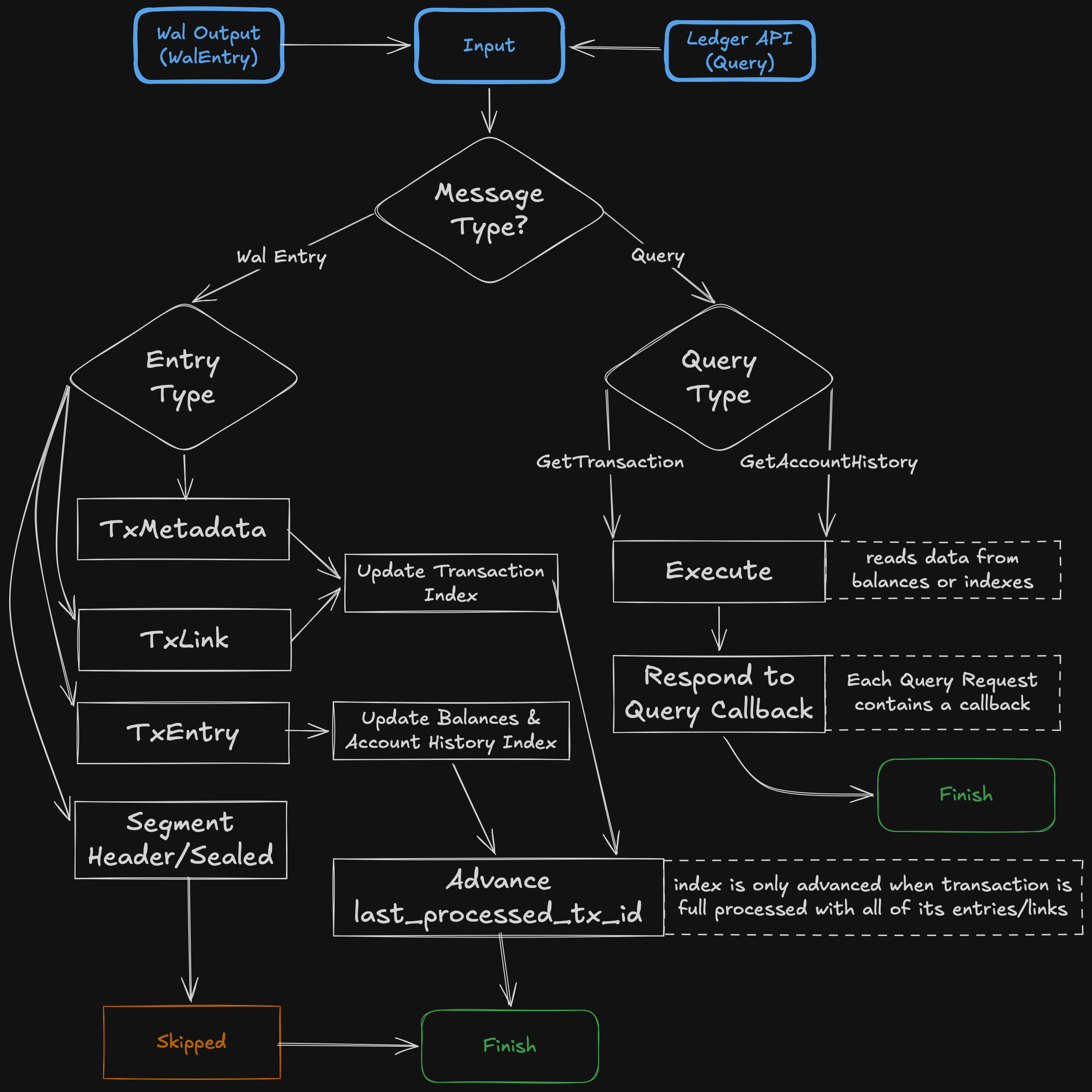
- The transaction ring — it reads published records, buffering a transaction’s entries until the trailing metadata arrives and its
tx_idis at or belowcommit_index(the durability gate). Only then does it apply the entries to the indexes and balance cache together, advancesnapshot_index, and — as the ring’s sole releaser — reclaim the consumed slots. Readers therefore never see a partially-applied or not-yet-durable transaction. - A query-only queue —
GetTransaction/GetAccountHistoryrequests execute inline against current state and call the response callback.
The Snapshotter does no computation — balances are pre-computed by the Transactor and stored in entries. The gap between COMMITTED and ON_SNAPSHOT is typically nanoseconds.
The transaction ring
The Transactor, WAL, and Snapshotter share a single lock-free transaction ring — the one transport for the record stream, replacing the former transactor→WAL and WAL→snapshot queues (ADR-019).
- One producer. The Transactor appends records into ring slots and publishes them. It also builds each transaction in place in the uncommitted region, so the ring doubles as its per-transaction scratch space — no separate staging buffer.
- Independent copy-out readers. The WAL and Snapshotter each track their own absolute cursor and copy records out at their own pace. A slot may be reused once released, so readers copy rather than borrow.
- One releaser, durability-gated. The Snapshotter is the only party that advances the reclamation point, and only up to the durability watermark. A slot is reused only after the record it held is durable on disk and consumed by every reader — making “never overwrite an undurable record” a structural property of the transport.
Positions are absolute, monotonically increasing indices (mapped to physical slots on access), so progress and ordering stay unambiguous across wraps. Because a transaction is published atomically, the ring capacity (ring_size) must be at least the largest possible single transaction.
Inter-stage communication
The record stream rides the transaction ring described above; the submit and query paths use lock-free SPSC queues (sequencer → transactor, and the Snapshotter’s query queue) — one producer, one consumer, no locks. Each stage owns its data completely.
Backpressure propagates naturally. The Snapshotter releases ring slots only up to the durability watermark, so if durability or indexing stalls, the ring fills and the Transactor stops finding free slots; that stalls the Transactor, which fills the sequencer → transactor queue, which eventually stalls submit(). No explicit flow control is needed, and the producer never blocks inside the ring — it retries under the shared wait strategy.
The wait strategy under backpressure is controlled by the wait_strategy config field (see API → Setup): low_latency (spin forever), balanced (spin → yield → park), low_cpu (park quickly).
Recovery
On startup, roda-ledger restores state automatically before accepting transactions:
- Find the latest snapshot — gives all balances at a known transaction ID
- Load those balances
- Replay WAL segments that postdate the snapshot
- Resume from the exact point where the ledger left off
Because every committed transaction is in the WAL, and the WAL is always replayed on recovery, a committed transaction is never lost. Replay buffers a transaction’s entries until its trailing metadata closes and validates the group — carrying the buffer across segment seams for a transaction that spans a boundary — while a torn tail of the active segment is truncated back to its last metadata boundary. Recovery time is bounded by snapshot frequency — more frequent snapshots mean less WAL to replay.
Design boundaries
Single node. All pipeline stages run on one machine. Raft-based multi-node replication is planned — the segmented, append-only WAL is a natural fit for log replication.
Pre-allocated account space. Balances are stored in a structure sized to max_accounts. O(1) reads and writes always, but memory is committed at startup — a capacity planning decision.
Disk-bound durability throughput. fdatasync latency determines COMMITTED throughput. On NVMe this is hundreds of µs per batch. COMPUTED throughput (in-memory only) reaches millions of transactions per second.
Single-writer ceiling. The Transactor is the upper bound on execution throughput. In practice the WAL is almost always the bottleneck — but on fast enough storage, the single-threaded Transactor becomes the limit.
WASM Runtime — Programmable Ledger
roda-ledger lets you extend the transaction set at runtime with sandboxed WebAssembly functions. A registered function becomes a first-class Operation::Function: it is sequenced, executed atomically by the Transactor, and produces normal TxEntry records in the WAL alongside every other transaction.
This document covers everything about writing, registering, invoking, and operating programmable functions: ABI, lifecycle, storage layout, recovery guarantees, and gRPC surface.
The design is specified in ADR-014.
Table of contents
- When to use it
- Function ABI
- Host API
- Return values & rollback
- Writing a function
- Registering a function
- Invoking a function
- Listing & unregistering
- Versioning
- Storage layout on disk
- Durability & recovery
- Determinism & isolation
- Performance
- Limits & validation
- Troubleshooting
When to use it
Use a function when the built-in operations aren’t enough:
- Fee splits — deduct a fee to one account, forward the net to another, in one atomic transaction.
- Multi-leg settlements — move value between three or more accounts with custom rules (e.g. escrow release + platform cut + counterparty payout).
- Conditional logic — decline the transaction when a business rule fails (insufficient collateral, failed KYC flag, overdraft policy).
- Accounting templates — reusable “compliance check”, “tax withholding”, “loyalty accrual” rules shared across submitters.
If your operation is expressible as one of Deposit, Withdrawal, or Transfer, use those — they are faster and need no registration step.
Function ABI
Every registered function must export one symbol named execute with a fixed signature:
execute(i64, i64, i64, i64, i64, i64, i64, i64) -> i32
- Exactly 8
i64positional parameters. Unused slots are conventionally passed as0. - Exactly 1
i32return value, interpreted as au8status code:0— success (the transaction’s host-side credits / debits are committed);1..=127— standard failure reasons (defined by the ledger, full rollback);128..=255— user-defined custom reasons (full rollback).
The fixed arity eliminates any need for linear memory pointer / length passing: account ids, amounts, rates, flags, timestamps all fit into 8 i64 slots.
Host API
A function can only call three host imports. All three live in the ledger module:
(import "ledger" "credit"      (func (param i64 i64)))
(import "ledger" "debit"       (func (param i64 i64)))
(import "ledger" "get_balance" (func (param i64) (result i64)))
| Host call | Signature | Effect |
|---|---|---|
credit(account_id, amount) | (u64, u64) -> () | Decreases account_id’s balance by amount. Cannot fail individually. |
debit(account_id, amount) | (u64, u64) -> () | Increases account_id’s balance by amount. Cannot fail individually. |
get_balance(account_id) | (u64) -> i64 | Reads the current balance (signed). |
Convention in roda-ledger: credit subtracts, debit adds. A Transfer { from, to, amount } is credit(from, amount) + debit(to, amount) — credits move value out of an account, debits move value in. Same convention applies to WASM functions.
Zero-sum invariant. The ledger verifies sum(credits) == sum(debits) after the function returns. If the function emits an unbalanced set of credits / debits, the transaction is rejected and rolled back with Status::ZERO_SUM_VIOLATION.
Overdraft policy. Host credits / debits never fail individually, and the ledger does not enforce negative-balance checks inside functions. If you need overdraft protection, call get_balance and return a non-zero status to trigger rollback:
#![allow(unused)]
fn main() {
if get_balance(sender) < amount as i64 {
    return 1; // INSUFFICIENT_FUNDS
}
}
No randomness, no wall clock, no I/O, no WASM threads, no atomics. The ABI is deliberately small so every execution is deterministic.
Return values & rollback
The execute return value is the transaction’s final status:
0— the host-side credits and debits become part of the WAL transaction; the zero-sum invariant is verified; if it holds, the transaction commits.- any non-zero value — the transaction is fully rolled back: every credit / debit the function applied is reversed in the same way a failed built-in operation would be. The
TxMetadatarecord is still written, tagged with the function’s CRC32C, and itsstatusfield carries the returnedu8so auditors can distinguish unsuccessful named operations by exact reason.
Host failures (linking, instantiation, traps) surface as Status::INVALID_OPERATION (numeric 5).
Standard status values used by the ledger:
| Value | Name |
|---|---|
0 | NONE (success) |
1 | INSUFFICIENT_FUNDS |
2 | ACCOUNT_NOT_FOUND |
3 | ZERO_SUM_VIOLATION |
4 | ENTRY_LIMIT_EXCEEDED |
5 | INVALID_OPERATION |
6 | ACCOUNT_LIMIT_EXCEEDED |
7 | DUPLICATE |
8..=127 | reserved for future standard reasons |
128..=255 | user-defined |
Returning 128..=255 is how functions report domain-specific errors without polluting the standard status namespace.
Writing a function
Rust
# Cargo.toml
[lib]
crate-type = ["cdylib"]

[profile.release]
opt-level = "z"
lto = true
strip = true
#![allow(unused)]
fn main() {
// src/lib.rs
#[link(wasm_import_module = "ledger")]
unsafe extern "C" {
    fn credit(account_id: u64, amount: u64);
    fn debit(account_id: u64, amount: u64);
    fn get_balance(account_id: u64) -> i64;
}

/// Transfer `amount` from `from` to `to`, taking a `fee_bps` (basis
/// points) fee into `fee_acct`.
///
/// Params:
///   param0: sender
///   param1: receiver
///   param2: fee_acct
///   param3: amount
///   param4: fee_bps (e.g. 50 = 0.5%)
#[unsafe(no_mangle)]
pub extern "C" fn execute(
    param0: i64, param1: i64, param2: i64, param3: i64,
    param4: i64, _p5: i64, _p6: i64, _p7: i64,
) -> i32 {
    let sender   = param0 as u64;
    let receiver = param1 as u64;
    let fee_acct = param2 as u64;
    let amount   = param3 as u64;
    let fee_bps  = param4 as u64;
    let fee      = amount * fee_bps / 10_000;

    unsafe {
        if get_balance(sender) < (amount + fee) as i64 {
            return 1; // INSUFFICIENT_FUNDS
        }
        credit(sender, amount + fee);
        debit(receiver, amount);
        debit(fee_acct, fee);
    }
    0
}
}
Compile:
cargo build --target wasm32-unknown-unknown --release
# produces target/wasm32-unknown-unknown/release/<crate>.wasm
AssemblyScript
// assembly/index.ts
@external("ledger", "credit")
declare function credit(account_id: u64, amount: u64): void;

@external("ledger", "debit")
declare function debit(account_id: u64, amount: u64): void;

@external("ledger", "get_balance")
declare function get_balance(account_id: u64): i64;

export function execute(
    param0: i64, param1: i64, param2: i64, param3: i64,
    param4: i64, _p5: i64, _p6: i64, _p7: i64,
): i32 {
    const sender   = <u64>param0;
    const receiver = <u64>param1;
    const feeAcct  = <u64>param2;
    const amount   = <u64>param3;
    const feeBps   = <u64>param4;
    const fee      = amount * feeBps / 10_000;

    if (get_balance(<i64>sender) < <i64>(amount + fee)) {
        return 1; // INSUFFICIENT_FUNDS
    }
    credit(sender, amount + fee);
    debit(receiver, amount);
    debit(feeAcct, fee);
    return 0;
}
Compile:
asc assembly/index.ts -o build/function.wasm --optimize --runtime stub
Hand-written WAT
Useful for minimal-size tests and examples. Every WAT snippet in the test suite follows this template:
(module
  (import "ledger" "credit" (func $credit (param i64 i64)))
  (import "ledger" "debit"  (func $debit  (param i64 i64)))
  (import "ledger" "get_balance" (func $get_balance (param i64) (result i64)))

  (func (export "execute")
    (param i64 i64 i64 i64 i64 i64 i64 i64) (result i32)

    ;; credit(param0, param1)
    local.get 0 local.get 1 call $credit

    ;; debit(param2, param1)
    local.get 2 local.get 1 call $debit

    i32.const 0))
Compile via the wat crate (already a dependency in test / bench paths):
#![allow(unused)]
fn main() {
let bytes = wat::parse_str(WAT)?;
}
Registering a function
Registration is atomic and durable: it returns only after the WAL record has been committed and the handler is loaded into the live runtime. The next Operation::Function { name } is guaranteed to see it.
gRPC
rpc RegisterFunction(RegisterFunctionRequest) returns (RegisterFunctionResponse);
rpc UnregisterFunction(UnregisterFunctionRequest) returns (UnregisterFunctionResponse);
rpc ListFunctions(ListFunctionsRequest)         returns (ListFunctionsResponse);

message RegisterFunctionRequest {
    string name              = 1; // snake_case, max 32 bytes
    bytes  binary            = 2; // WASM binary, max 4 MB
    bool   override_existing = 3; // false → ALREADY_EXISTS if name is taken
}

message RegisterFunctionResponse {
    uint32 version = 1; // monotonic per name, starts at 1
    uint32 crc32c  = 2; // CRC32C of the binary
}
Example with grpcurl:
grpcurl -d "$(jq -n --arg bin "$(base64 -w0 function.wasm)" \
  '{name:"fee_transfer", binary:$bin, override_existing:false}')" \
  -plaintext localhost:50051 \
  roda.ledger.v1.Ledger/RegisterFunction
Rust library
#![allow(unused)]
fn main() {
use roda_ledger::client::LedgerClient;

let client = LedgerClient::connect("127.0.0.1:50051".parse()?).await?;

let binary = std::fs::read("function.wasm")?;
let (version, crc) = client
    .register_function("fee_transfer", &binary, /* override_existing = */ false)
    .await?;

println!("registered fee_transfer v{} (crc={:08x})", version, crc);
}
Or in embedded mode (one process, no gRPC):
#![allow(unused)]
fn main() {
use roda_ledger::ledger::{Ledger, LedgerConfig};

let mut ledger = Ledger::new(LedgerConfig::temp());
ledger.start()?;

let binary = std::fs::read("function.wasm")?;
let (version, crc) = ledger.register_function("fee_transfer", &binary, false)?;
}
Re-registering the same name without override_existing = true returns AlreadyExists. With the flag set, the new binary becomes version = previous + 1 and replaces the old one in the live registry atomically.
Invoking a function
A registered function is invoked as Operation::Function { name, params, user_ref }:
gRPC
message Function {
    string         name     = 1; // max 32 bytes
    repeated int64 params   = 2; // 0..=8 values; short lists are zero-padded
    uint64         user_ref = 3; // idempotency / dedup key, same as other ops
}
grpcurl -d '{
    "function": {
        "name": "fee_transfer",
        "params": [101, 202, 999, 10000, 50],
        "user_ref": 123456
    },
    "wait_level": "COMMITTED"
}' -plaintext localhost:50051 \
    roda.ledger.v1.Ledger/SubmitAndWait
Rust library
#![allow(unused)]
fn main() {
use roda_ledger::transaction::{Operation, WaitLevel};

let result = ledger.submit_and_wait(
    Operation::Function {
        name: "fee_transfer".into(),
        params: [101, 202, 999, 10_000, 50, 0, 0, 0],
        user_ref: 123_456,
    },
    WaitLevel::Committed,
);

if result.fail_reason.is_failure() {
    eprintln!("fee_transfer failed: {:?}", result.fail_reason);
}
}
gRPC client (Rust)
#![allow(unused)]
fn main() {
use roda_ledger::client::LedgerClient;
use roda_ledger::grpc::proto::WaitLevel;

let result = client
    .submit_function_and_wait(
        "fee_transfer",
        [101, 202, 999, 10_000, 50, 0, 0, 0],
        123_456, // user_ref
        WaitLevel::Committed,
    )
    .await?;
}
Every Operation::Function produces a normal transaction in the WAL with a TxMetadata.tag of the form:
b"fnw\n" ++ crc32c[0..4] (8 bytes total)
roda-ctl unpack renders it as:
{"type": "TxMetadata", "tx_id": 441001, "tag": "fnw\n4a2f1c3d", ...}
The CRC32C identifies the exact binary that executed — cross-reference it with the FunctionRegistered WAL record or with a ListFunctions response to resolve the name / version.
Listing & unregistering
List — returns every currently-loaded handler:
#![allow(unused)]
fn main() {
for info in client.list_functions().await? {
    println!("{} v{} (crc={:08x})", info.name, info.version, info.crc32c);
}
}
Unregister — writes an empty file under the next version and a FunctionRegistered WAL record with crc32c = 0. The call blocks until the handler is gone from the live registry; any Operation::Function { name } submitted after it returns will fail with INVALID_OPERATION.
#![allow(unused)]
fn main() {
let unregistered_version = client.unregister_function("fee_transfer").await?;
}
Unregister is durable: the 0-byte-file + crc32c = 0 pair survives restarts and crashes, and is replayed during recovery.
Versioning
- Every register or override bumps the version by
+1, starting at1. - Version counter is stored in the live registry (sourced from
FunctionRegisteredWAL records + the function snapshot). The on-diskfunctions/directory is reference data only. - A
Functionoperation always uses the current latest version — there is no pinning to a specific version at submit time. - The CRC32C embedded in
TxMetadata.tagidentifies which version actually ran, so auditors can always tell which binary produced any given set of entries.
Storage layout on disk
data/
├── wal.bin                            # active WAL segment
├── wal_000001.bin                     # sealed segment (+ .crc, .seal, indexes)
├── wal_000002.bin
├── snapshot_000002.bin                # balance snapshot
├── snapshot_000002.crc
├── function_snapshot_000002.bin       # function-registry snapshot (same trigger)
├── function_snapshot_000002.crc
└── functions/
    ├── fee_transfer_v1.wasm           # binary under its version
    ├── fee_transfer_v2.wasm           # replaced version (override)
    └── removed_fn_v3.wasm             # 0 bytes — unregister marker
Function binaries are written atomically (temp file + rename). Unregister truncates the file to 0 bytes — it is not deleted, preserving the audit trail.
The function snapshot is emitted on the same snapshot_frequency trigger as the balance snapshot, so recovery always finds a paired snapshot_{N}.bin + function_snapshot_{N}.bin at the same segment boundary.
Durability & recovery
Registration is durable before register_function returns. The call blocks until:
- The binary is written atomically to
functions/{name}_v{N}.wasm. - A
FunctionRegisteredWAL record is committed to the active segment. - The live
WasmRuntimehas compiled and installed the handler.
Recovery on clean restart or crash proceeds as follows:
- Load the latest
function_snapshot_{N}.bin. For each record withcrc32c != 0, readfunctions/{name}_v{version}.wasmand compile it into the runtime. - Replay every
FunctionRegisteredWAL record in segments after the snapshot:crc32c != 0→ load the referenced version (replaces any older handler).crc32c == 0→ unload the handler.
- Resume normal operation.
A failure to read a binary or install a handler during recovery is non-recoverable: the server aborts startup rather than continue with a registry that diverges from the WAL. The CRC32C embedded in every FunctionRegistered record lets recovery detect silent disk corruption before anything transactional runs.
Determinism & isolation
The runtime is intentionally narrow:
- No randomness. No host API exposes a PRNG.
- No wall clock. Functions do not see time; tag timestamps are decided by the host.
- No I/O, no network, no filesystem. Only the 3 ledger host calls are available.
- No threads, no atomics. Functions run single-threaded.
- No persistent memory. A function has no state that survives between invocations: every call runs against a fresh wasmtime instance (internally cached by the engine for speed; no durable state is carried).
- Sandboxed. A trap or infinite loop cannot corrupt ledger state — the transaction is rolled back and the handler is left intact for subsequent calls.
This is the property we need for future Raft replication: the leader executes the WASM function, and followers apply the resulting entries directly — no re-execution, no divergence.
Performance
The runtime is tuned for low per-call overhead on the hot path.
- Per-call cost: one
HashMap::geton the per-Transactor caller cache, oneTypedFunc::call, two host imports per credit / debit crossing. - Cache invalidation is per-name: registering
foodoes not evict the cached entry forbar. Each cached entry stores theupdate_seqit was verified at; the next lookup either short-circuits (seq unchanged) or does a shared-registry read to reconcile just that one name. - One wasmtime
Engineper ledger (shared viaArc<WasmRuntime>). - One
Linkerwith host imports wired exactly once at ledger startup. - One
Storeper Transactor, long-lived across calls. Function state is carried in hostTransactorState, not in WASM-visible globals. - Instantiation happens once per
(name, crc)pair on first lookup; the resultingTypedFuncis cached and reused.
Empirical numbers from the current build (Apple M-series, release build):
| Benchmark | Native Deposit | WASM Function (same effect) |
|---|---|---|
TransactorRunner::process_direct (1 tx) | ~132 ns/op | ~335 ns/op |
TransactorRunner::process_direct_batch (1000) | ~133 ns/op | ~286 ns/op |
End-to-end --wait load test TPS, 1M accounts | ~819 k | ~814 k |
The per-op overhead at the Transactor level is ~200 ns — pure host-crossing cost. At the pipeline level (gRPC → WAL commit → response) it is invisible: the WAL commit path dominates.
Run the comparison yourself:
cargo bench --bench transaction_runner_bench       # native
cargo bench --bench transaction_runner_bench_wasm  # WASM
cargo run --release --bin load      -- --wait --duration 30
cargo run --release --bin load_wasm -- --wait --duration 30
Limits & validation
Validation runs at register_function before any disk write:
| Rule | Limit |
|---|---|
| Name charset | ASCII letters, digits, _ |
| Name starts with | ASCII letter |
| Name length | 1..=32 bytes |
| Binary size | 4 MB (gRPC-enforced via max_message_size_bytes) |
| Module parses | validated by wasmtime |
Exports execute | required |
execute signature | exactly (i64 × 8) -> i32 |
execute host imports | only ledger.credit / ledger.debit / ledger.get_balance |
A binary that fails any of these returns InvalidArgument from gRPC or io::ErrorKind::InvalidData / InvalidInput from the Rust API. Nothing is written to disk and no WAL record is produced.
Troubleshooting
ALREADY_EXISTS on RegisterFunction
A function by this name is already loaded. Pass override_existing = true to replace.
Operations return INVALID_OPERATION (status 5)
- The function is not registered, or was unregistered.
- The function trapped (out-of-bounds memory, stack overflow, unreachable, division by zero).
- The WASM binary parsed but failed instantiation. Check
tonic/ ledger logs around the call.
Operations return ZERO_SUM_VIOLATION (status 3)
The function’s total credits did not match total debits. Every credit(a, N) needs a matching debit(b, N) somewhere else in the same invocation (or vice versa).
Unexpected balances after a restart Inspect both snapshots at the last sealed segment id:
ls data/function_snapshot_*.bin
roda-ctl unpack data/wal_000NNN.bin
You should see a FunctionRegistered record for every function that should be loaded and a matching snapshot file at a later or equal segment id.
Snapshot: read_function(name vN) failed during startup
The WAL references a binary that is missing from data/functions/. This is non-recoverable. Either restore the binary from backup, or manually remove the stale FunctionRegistered record from the WAL using roda-ctl (at your own risk).
See also
- ADR-014 — WASM Function Registry and Function Operation Execution
- Architecture — for context on the Transactor / WAL / Snapshot pipeline.
- API — full API reference for the ledger service.
Internal
Single source of truth. Each § states one complete invariant or decision in
its own paragraph. Ambiguous behaviour is resolved by what this document says;
where an ADR exists for a decision it is cited as [ADR-NNNN].
Stages:
- The Ledger —
§1..§16. The in-memory engine: structures, threads, queues, indexes, and the sequence in which records flow through the pipeline. - The Storage —
§17..§25. The on-disk file format: segment file layout, WAL record byte layout, sidecar files, snapshot file format, function binary storage, on-disk index file format, durable cluster state (term and vote logs), and ctl tools. - The Cluster —
§26..§39. The network-facing surface (gRPC, client, proto) and Raft replication.
Stage 1 specifies the mechanism by which the ledger reads and writes records; Stage 2 specifies the on-disk shape of those records; Stage 3 specifies how independent ledgers replicate to one another over a network.
§1 Domain model
§1.1 Accounts and the system account
An account is identified by a u64. Accounts are not created explicitly; they
come into existence the first time a transaction references them. The system
account is SYSTEM_ACCOUNT_ID = 0 and serves as the source/sink for every
deposit and withdrawal — it is required by the zero-sum invariant (§4.11), not
a convention. The system account’s balance is never tracked or queried.
§1.2 Balances
A balance is an i64. Balances are derived state: the source of truth is the
ordered transaction log, and a balance is the result of applying every entry
that has touched the account. Arithmetic uses saturating add/sub so a malformed
operation cannot overflow the account silently. Default protection prevents
balances from going negative (§4.9), and only WASM functions may explicitly
bypass this by inspecting get_balance themselves.
§1.3 Operation vs. transaction
These are two distinct things and the distinction matters. An operation is
the caller’s intent (Deposit, Withdrawal, Transfer, Function). A
transaction is the immutable record produced by executing an operation —
permanent, ordered, and never modified. The client submits operations; the
ledger writes transactions; the Transactor (§4) is the bridge. When a caller
queries a transaction it sees the entries (the credits/debits the Transactor
emitted), not the original operation.
§1.4 The four operation types
Roda-ledger accepts exactly four operation types, all carrying a user_ref
idempotency key (§5):
Deposit { account, amount }— creditsaccount, debits the system account.Withdrawal { account, amount }— debitsaccount, credits the system account.Transfer { from, to, amount }— debitsfrom, creditsto.Function { name, params, user_ref }— invokes a previously registered WASM module by name (§6).
Function is the single extension surface; any multi-account or domain-specific
logic that does not fit the named types is expressed as a registered function.
§1.5 Function operation parameters
Function parameters are a fixed [i64; 8]. Slots a caller does not need are
zero-padded. The arity is locked at the type level so the host ABI (§6.7) and
WAL/transaction representation never require variable-length parameter blocks.
§1.6 WAL record format invariants
Every WAL record is exactly 40 bytes — a hard invariant for every record
type. The first byte of every record is its entry_type discriminant, which
makes the WAL stream [record][record][record]… self-describing without a
separate length-prefix or framing layer. Records are laid out for zero-copy
serialization: the bytes on the wire are the bytes in memory. A transaction is
a group of follower records (TxEntry/TxLink) terminated by a trailing
TxMetadata — its commit record (§18.3, [ADR-0020]).
§2 Pipeline structure
§2.1 Stages and guarantees
The pipeline has four execution stages plus one independent maintenance stage. A transaction moves through Sequencer → Transactor → WAL → Snapshotter, and each step adds exactly one guarantee:
| Stage | Guarantee | Status |
|---|---|---|
| Sequencer (§3) | Monotonic ID, permanent global order | PENDING |
| Transactor (§4) | Executed, serializable, result known | COMPUTED |
| WAL (§7) | Durable on disk, crash-safe | COMMITTED |
| Snapshotter (§8) | Visible to readers, indexed (§9) | ON_SNAPSHOT |
Seal (§11) runs in parallel and is responsible for finalising closed segments, producing on-disk indexes, and writing snapshot files for recovery.
§2.2 Status is derived, not stored
A TransactionStatus is computed at query time from the pipeline’s progress
indexes — never persisted as a record. A transaction is Computed iff
compute_index ≥ tx_id, Committed iff commit_index ≥ tx_id,
OnSnapshot iff snapshot_index ≥ tx_id. Failed transactions are recognised
through the rejection registry (§4.17). This avoids a per-transaction state
machine on disk and makes status a pure function of the pipeline.
§2.3 Pipeline ownership and context slicing
The Pipeline is the sole owner of the transaction ring (§13.4), both inter-stage queues, every progress index, the shutdown flag, and the shared wait strategy. Stages never own this state directly — each receives a typed context that exposes only the slice it may legally read or publish. The wrapping is purely for type-level encapsulation; there is no runtime cost.
§2.4 Inter-stage transport
The record stream rides a single lock-free transaction ring (§13.4): the
Transactor is the sole producer; the WAL and Snapshotter are independent
copy-out readers; the Snapshotter is the sole releaser. The former
transactor → wal and wal → snapshot queues are gone — both stages now read
the same ring ([ADR-0019]).
Two lock-free, fixed-capacity, single-producer / single-consumer queues remain, for the paths that are not the record stream:
sequencer → transactor— submitted operations awaiting execution.snapshot query—GetTransaction/GetAccountHistoryrequests (§8.4).
Queue capacity is fixed at construction from queue_size (§15.2); ring
capacity from ring_size (§15.10). A full queue or a full ring is the only
backpressure signal; producers spin/yield until space exists. There is no
other flow-control mechanism.
§2.5 Global progress indexes
The pipeline holds five monotonic atomic counters and one shutdown flag:
sequencer_index— nexttx_idto be handed out.compute_index— lasttx_idexecuted by the Transactor.commit_index— lasttx_iddurably written by the WAL.snapshot_index— lasttx_idreflected in the Snapshotter.seal_index— last segment id sealed.running— global shutdown flag.
The indexes are padded to separate cache lines so that a publication on one
does not invalidate the cache line of an adjacent index. They are
strictly monotonic and never go backwards. The mapping
commit_index ≥ N ⇒ every transaction ≤ N is committed (no committed
gaps) is what makes per-call wait levels (§14) meaningful: a single
threshold check on a single counter resolves any wait.
§2.6 Backpressure and shutdown
Backpressure is implicit and propagates through ring and queue saturation: a
slow Snapshotter stops releasing ring slots (it releases only up to the
durability watermark, §13.5), so the ring fills and the Transactor stops
finding free slots; the stalled Transactor fills the sequencer→transactor
queue, which stalls submit(). There is no rate limiter, leaky bucket, or
admission control. Shutdown is the inverse signal:
Pipeline::shutdown() clears running; every stage’s idle loop checks the
flag and exits. The shutdown signal does not need to be observed
immediately — the queues drain to a safe state regardless of the precise
moment a stage notices.
§3 Sequencer
§3.1 Placement on the caller’s thread
The Sequencer has no dedicated thread. It runs synchronously inside
Ledger::submit on whichever thread the caller invokes from. Its work is
intentionally trivial: one atomic increment plus one queue push. Adding a
thread (and the cross-thread channel that would imply) would only add
latency.
§3.2 ID assignment
ID assignment is a single atomic increment of sequencer_index.
submit(operation) reserves one ID and stamps the resulting Transaction.
submit_batch(operations) reserves a contiguous run of len(operations)
IDs in one atomic step; per-operation IDs inside the batch are
start_tx_id + index. Batches are atomic at the sequencer: their IDs are
guaranteed consecutive even under concurrent submitters.
§3.3 Permanence of position
Once the Sequencer assigns an ID, the transaction’s position in the global order is permanent. No later stage can reorder, reassign, or skip an ID. This is what allows downstream stages (Transactor, WAL, Snapshotter) to publish progress as a single monotonically advancing index per stage — there are no holes to fill or gaps to wait on.
§3.4 Backpressure spin/yield policy
When the sequencer→transactor queue is full, the submitter spins, yielding
the thread periodically while the spin persists. There is no timeout —
submit returns only after the operation is queued. Spinning (rather than
parking) is preferred here because submit-side latency is the primary
concern: a parked thread misses the moment space appears.
§4 Transactor — the single writer
§4.1 Single-writer rule
The Transactor is one dedicated thread that processes one transaction at a time, in strict ID order. This is the source of all correctness guarantees: there are no races, no conflicts, no need for locks or conflict resolution. Throughput does not come from parallelising execution — it comes from sequencing, durability, and snapshotting running concurrently around the Transactor. The single-writer ceiling is the upper bound on per-ledger write throughput. [ADR-0001]
§4.2 Thread-local state
The Transactor’s working state — balance cache, per-step entries buffer,
position marker, current tx_id, current fail_reason — lives entirely
on the Transactor thread and never crosses a thread boundary. The WASM
runtime instance bound to a Transactor inherits this constraint. Single
ownership means no locks are needed on the hot path; host calls (§6.7)
mutate the same state through interior mutability with no contention.
§4.3 Balance cache layout
The Transactor’s balance cache is a flat array indexed directly by
account_id. Lookups and updates are O(1) array accesses with no hashing,
no probing, no resizing. The array is pre-allocated to max_accounts at
construction and never grows. [ADR-0002]
§4.4 The max_accounts ceiling
Any operation referencing an account_id ≥ max_accounts is rejected with
ACCOUNT_LIMIT_EXCEEDED before the operation can mutate any state.
This is the price of the direct-indexed array layout (§4.3) — the
account-ID space must be sized at startup. Resizing would require pausing
the Transactor and reallocating every read-side cache (§8.3), which is not
worth the complexity given how rarely a deployed ledger needs to grow its
ceiling. [ADR-0002]
§4.5 Linearizability of the write path
The Transactor never reads stale balances. Because it is the sole writer
and operates on the in-memory cache (§4.3), every read it performs during
operation execution observes the cumulative effect of every earlier
transaction. The write path is therefore linearizable by construction;
the read path requires an explicit submit_wait(snapshot) (§14.4) for the
same guarantee.
§4.6 In-place assembly in the ring
The Transactor writes the records it produces directly into the transaction
ring’s uncommitted region — the slots above the write frontier that it owns
exclusively and no reader can see (§13.4). There is no separate staging buffer:
the ring is the per-transaction scratch space. As it pushes followers it
accumulates the two derived metadata fields — a running CRC digest (§4.10) and
a follower count (pending_items) — so finalize needs no second pass. On
finalize it assembles the trailing TxMetadata once with those values and
publishes the whole transaction atomically by advancing the write frontier; on
failure it discards the uncommitted tail (§4.12).
§4.7 The tx_start_index marker
The Transactor records the ring index where the current transaction’s first
follower lands (tx_start_index). Verify (§4.11) and rollback (§4.12) scope
their work to the slots from tx_start_index to the write head — the in-flight
transaction’s records — and never touch already-published ones. The CRC is
folded incrementally as those records are pushed (§4.10), not re-walked from
the marker.
§4.8 Built-in operation semantics
For built-in operation types the Transactor runs native Rust:
Deposit { account, amount }—debit(SYSTEM_ACCOUNT_ID, amount),credit(account, amount).Withdrawal { account, amount }— checksbalance(account) ≥ amount; on success,debit(account, amount),credit(SYSTEM_ACCOUNT_ID, amount); on failure, fail withINSUFFICIENT_FUNDS.Transfer { from, to, amount }— checksbalance(from) ≥ amount; on success,debit(from, amount),credit(to, amount); on failure, fail withINSUFFICIENT_FUNDS.
Each credit / debit produces one TxEntry record with the
running computed_balance field already populated.
§4.9 Default INSUFFICIENT_FUNDS protection
For built-in operations, the Transactor refuses any change that would drive
an account balance negative (it checks before the debit). This is the
default protection. WASM functions (§6) are the only mechanism for
producing a negative balance: a function must explicitly call get_balance
itself and decide to proceed. There is no configuration knob to disable
the built-in check.
§4.10 Per-transaction CRC32C
The Transactor folds a running CRC32C over each follower record as it is
pushed, in push order, then — when the transaction finalizes — appends the
trailing TxMetadata (with its own crc32c field zeroed) into the digest and
stores the result into that field. The CRC therefore covers the followers (in
order) followed by the zeroed-crc metadata, and is computed incrementally
rather than by re-walking the transaction after the fact. It uses CRC32C
(Castagnoli) — hardware-accelerated on modern CPUs. Because the field
participates in the digest while being part of the record, it is zeroed during
computation; a consumer verifies by recomputing in the same order — the
followers, then the zeroed metadata (§18.3, [ADR-0020]).
§4.11 Zero-sum invariant
Every transaction must net to zero: sum(credits) == sum(debits) across
all TxEntry records of that transaction. The Transactor verifies this
after operation execution and before any state is committed; a violation
raises ZERO_SUM_VIOLATION and the transaction is rolled back
(§4.12). The invariant is per-transaction — there is no cross-transaction
arithmetic. Because each individual transaction nets to zero, the sum of
all balances across all accounts is always zero — an emergent property,
not a configuration option.
§4.12 Rollback
When verify fails or a WASM execution rejects, the Transactor reverses every
credit/debit it produced for this transaction against the live balance cache
and discards the uncommitted tail in the ring (rolling the write head back to
tx_start_index, §4.7). It then sets fail_reason and finalizes the
transaction as a lone trailing TxMetadata (sub_item_count = 0) — see §4.13.
There is no leading metadata to preserve: the metadata is materialized only at
finalize. The cost is O(entry_count) and is acceptable because typical entry
counts are small.
§4.13 Failed transactions are journaled
A transaction that fails — whether by deduplication, an execution error,
or a zero-sum violation — still produces a TxMetadata record with a
non-zero fail_reason, plus any TxLink records that describe the
relationship (e.g. Duplicate linking to the original). This metadata
flows through the WAL and the rest of the pipeline like any other record.
The audit trail is therefore complete: every submitted operation that
reached the Transactor leaves a trace, success or failure. [ADR-0001]
§4.14 No torn writes per account
Every individual credit or debit is a single atomic store. A concurrent
reader on the read-side balance cache (§8.3) will never observe a
partially-written balance for any single account — the value is always a
complete, valid i64.
§4.15 Intermediate state is visible across accounts
Within a multi-step operation (a Transfer, or a Function issuing
several credit/debit calls), the Transactor applies each step in
sequence. A concurrent reader can observe some of these stores before
others have landed — for example, seeing a credit applied to one account
before the matching debit on another has landed. This is by design.
last_tx_id returned by get_balance is the signal that a transaction
is fully settled across all accounts: it is updated only after all
entries of a transaction have been applied (§8.5). Callers who need to
see a multi-account transaction atomically should wait for last_tx_id
to advance past their tx_id or use submit_wait(snapshot).
§4.16 tx_id is on state, not on the host call
The current tx_id is set on the Transactor’s thread-local state at
the start of each transaction; host calls (§6.7) read it from there.
It is never passed across the WASM host-call boundary as a parameter.
This avoids the cost of an extra call argument and removes the risk of
a function caching or forging a stale tx_id.
§4.17 Rejection registry
Rejected transactions are recorded in a concurrent map keyed by tx_id,
shared with the Ledger so that status queries can resolve Error(reason)
for any failed tx_id (§2.2). The map is sparse — successes are not
recorded — because in steady state the overwhelming majority of
transactions succeed.
§5 Deduplication and the active window
§5.1 Always on, no global toggle
Deduplication is always on. There is no configuration that disables it system-wide. The only opt-out is per-transaction (§5.4).
§5.2 Active window and flip-flop cache
The active window size equals transaction_count_per_segment — the same
number that drives WAL segment rotation (§7.6). The dedup cache is two
user_ref → tx_id hash maps, active and previous. When tx_id
crosses the segment boundary, the maps flip: active becomes previous,
the previous map’s storage is reused as the new (cleared) active.
Effective dedup coverage is therefore N..2N transactions — at least one
full window, at most two.
§5.3 Determinism: count-based, not time-based
The flip is driven by tx_id, not by wall-clock time. The same N
transactions always provide the same protection, whether they arrive in
one second or one hour. Idempotency guarantees do not degrade under load
spikes and do not silently widen during quiet periods.
§5.4 user_ref = 0 opt-out
A user_ref value of 0 opts the individual transaction out of the
dedup check. The cache itself remains active and continues to record
every user_ref ≠ 0. There is no path that disables the cache globally
short of recompiling.
§5.5 Hit handling
On a hit, the Transactor emits TxMetadata (with fail_reason = DUPLICATE)
followed by TxLink { kind: Duplicate, to_tx_id: original_tx_id }. The
caller therefore always recovers the original tx_id for an idempotent
retry, not just a “rejected” status. [ADR-0009]
§5.6 Recovery seeding
On startup, the dedup cache is seeded by walking each WAL transaction
inside the active window (§12.3). Entries outside 2 × window are
dropped; entries within the window are placed into the correct half
(active vs previous) based on their relative position. Post-recovery
dedup behaviour is therefore identical to pre-crash — a duplicate
submitted before and after a restart is rejected the same way.
§6 WASM runtime — embedded execution
§6.1 Inside the Transactor, not a separate stage
The WASM runtime is not a separate pipeline stage. It is a component
inside the Transactor and executes on the Transactor thread.
Operation::Function is dispatched by the Transactor like any built-in
operation (§4.8); the only difference is how TxEntry records are
produced — by calling into a sandboxed WASM handler that issues
credit/debit host calls instead of running a hard-coded Rust branch.
This placement means a function execution inherits every Transactor
invariant: single-writer ordering (§4.1), zero-sum (§4.11), atomic
rollback (§4.12), deduplication (§5), and CRC (§4.10) — without any new
coordination.
§6.2 Pipeline-identical flow
A Function operation flows through Sequencer → Transactor → WAL →
Snapshotter exactly like a Deposit. WAL segmentation, sealing,
snapshotting, and replay treat function-produced entries identically to
native ones. There is no second persistence path, no second recovery
path, no second wait-level mechanism.
§6.3 One engine, one linker per ledger
There is one wasmtime engine and one host-import linker per ledger, shared across every Transactor. The linker carries the host imports (§6.7); the engine compiles and caches modules. Constructing either is expensive, so a ledger does it once.
§6.4 Shared registry
The shared registry maps name → (version, crc32c, compiled module). It
is protected by a reader-writer lock and is touched only on register,
unregister, and cache miss / revalidation — never on every transaction.
The hot path (§6.5) avoids the lock entirely.
§6.5 Per-Transactor caller cache
Each Transactor holds its own local cache of name → compiled handler,
tagged with a sequence number that records the registry version the
entry was verified against. Resolution is:
- Look up
namein the local cache. - If the cached sequence matches the registry’s current value, use the cached handler directly with no lock.
- Otherwise, take the registry read lock, fetch the current entry, instantiate, install into the local cache, stamp the entry with the new sequence.
Cache invalidation is per-name: registering or unregistering foo does
not evict the cached entry for bar.
§6.6 Required export
Every registered binary must export exactly one function:
execute(i64, i64, i64, i64, i64, i64, i64, i64) → i32. The eight
parameters correspond to the Function operation’s [i64; 8] (§1.5).
The i32 return is the function’s status: 0 is success, anything
else is mapped per §6.12. [ADR-0014]
§6.7 Host imports
The host module is "ledger" and exports exactly three imports:
ledger.credit(account_id: i64, amount: i64) → ()ledger.debit(account_id: i64, amount: i64) → ()ledger.get_balance(account_id: i64) → i64
Each call mutates the Transactor’s thread-local state (§4.2): credit
and debit append a TxEntry to the per-step buffer; get_balance
reads the live balance cache. The current tx_id is pulled from the
state (§4.16), not passed through the call. [ADR-0014]
§6.8 Determinism rule
The host ABI is intentionally narrow: no clocks, no random, no I/O, no
threads, no atomics. Every legal function is therefore a pure mapping
from (params, observed balances) → (status, credits, debits). This is
not a stylistic choice — it is what makes the WAL replayable on a
follower without re-running the WASM code (§6.9). Adding any
non-deterministic host call would make replication unsafe.
§6.9 Replication implication
Because of §6.8, a future Raft follower can apply the WAL records
produced by a function on the leader directly — without instantiating
the WASM module, without re-running execute, and without observing any
of the function’s internal state. The leader is the only node that
needs to compile and run the binary; followers see only the
TxEntry/TxLink/TxMetadata stream the leader produced. This is what
enables the future cluster (Stage 3).
§6.10 Atomicity of function execution
Host-call effects accumulate in an isolated execution context on the
Transactor side, not in WASM-visible globals. Nothing is applied to the
live balance cache until all of the following hold: execute returned
0, the captured credits and debits balance (§4.11), and no
wasmtime-layer error occurred. If any of those fail, the entire batch
of host calls is discarded — the same rollback machinery as a built-in
operation (§4.12). Nothing is published to the transaction ring, so no reader
ever sees a partial function execution.
§6.11 Wasmtime-layer failure mapping
A wasmtime layer failure — link error, instantiation error, or runtime
trap — is mapped to INVALID_OPERATION = 5 and rolled back. The
mapping is single-valued by design: from outside the runtime, any
infrastructure-level WASM failure looks the same. The function author’s
own status codes (§6.12) live in a disjoint range.
§6.12 Status code passthrough
The i32 return of execute is interpreted as follows:
0→ success (provided zero-sum holds; §4.11).1..=7→ mapped to the corresponding standardFailReason.8..=127→ reserved; treated asINVALID_OPERATION.128..=255→ user-defined; passed through intoTxMetadata.fail_reasonunchanged.- Anything else (negative, > 255) → treated as
INVALID_OPERATION.
User-defined codes are the WASM author’s contract with their callers; the ledger never reinterprets them. [ADR-0014]
§6.13 Entry-limit enforcement
If a function emits more than 65535 credit/debit calls in a single
execution, the u16 sub_item_count field of TxMetadata cannot
encode the count. The Transactor fails the transaction with
ENTRY_LIMIT_EXCEEDED and rolls it back. Function authors who
need more than 65535 entries must split the work across multiple
transactions.
§6.14 Audit tag
Every committed function-produced transaction stamps TxMetadata.tag
with b"fnw\n" ++ crc32c[0..4] — the four-byte literal "fnw\n"
followed by the first four bytes of the executing binary’s CRC32C. Any
past transaction can therefore be traced back to the exact binary that
produced it, even after registrations have changed.
§6.15 Names and versions
Function names are validated at registration: ASCII snake_case, ≤ 32
bytes, null-padded to 32 in the WAL record. Each register or
override bumps the per-name version by one, starting at 1, with a
ceiling of 65535. The (name, version, crc32c) triple uniquely
identifies the executing binary in every transaction. [ADR-0014]
§6.16 Registration is durable
RegisterFunction only returns after all four of the following have
happened: the binary has been validated, written atomically to disk, a
FunctionRegistered WAL record has been committed, and the compiled
handler has been installed in the live WASM runtime. A subsequent
Operation::Function is therefore guaranteed to see the new version.
After a crash, recovery rebuilds the registry from a paired function
snapshot plus the FunctionRegistered records that follow it (§12.4) —
the live runtime always matches what the WAL says it should be.
§6.17 Unregistration
Unregistration emits a FunctionRegistered record with crc32c = 0
and writes a 0-byte file under the next version on disk. The
binary history is preserved as a sequence of versions; the function
registry’s current state is the last record seen. The WAL is
authoritative; the on-disk file is a secondary signal. [ADR-0014]
§6.18 Snapshotter applies registry events
FunctionRegistered records flow through the WAL like any other record
(§7.4). The Snapshotter (§8.7) is the stage that actually loads or
unloads the compiled handler in the shared WASM runtime: it reads the
binary off disk on a load, and unloads on an unregister. This is what
keeps the live runtime synchronised with the WAL on every node, leader
or follower.
§7 WAL stage — durability orchestration
§7.1 Two threads, one role each
The WAL stage runs as two cooperating threads. The WAL Writer
(wal_write) owns the active segment and all disk I/O for record writes;
the WAL Committer (wal_commit) owns fdatasync calls only. Splitting
the two means the Writer never blocks behind a fdatasync — it continues
appending records to the next batch while the Committer is mid-sync. The
hot path is dominated by fdatasync latency (~hundreds of µs on NVMe);
isolating it from record writes is what lets the WAL keep up with the
Transactor. [ADR-0011]
§7.2 Coordination between Writer and Committer
The two threads share two counters and one segment handle:
- last-written — the highest
tx_idwhose record has been written (but not necessarily synced) to the active segment file. The Writer publishes; the Committer observes. - last-committed — the highest
tx_idwhose record has beenfdatasync’d. The Committer publishes; the Writer observes. This is whatcommit_indexexposes to the rest of the pipeline (§2.5) and what thewalwait level (§14.1) gates on. - The active segment’s sync handle, swappable across rotations (§7.6) so the Committer always syncs the segment that is currently open.
There is no other coordination — no condvars, no channels.
§7.3 Writer buffer
The Writer copies records out of the ring into a bounded pending-write buffer,
batched so a whole iteration’s worth of records reaches disk in one write
syscall. The buffer is sized in advance — never resized — so the WAL stage’s
memory footprint is fixed. It forwards records nowhere: the Snapshotter reads
the ring independently (§8.4).
§7.4 Writer per-iteration loop
Each iteration the Writer copies the newly published ring records into the
active segment’s pending-write buffer, performs a single buffered write
syscall (one per iteration, not per record), advances last-written, and
rotates the segment if the transaction-count threshold is met (§7.6). It does
not gate or forward anything to the Snapshotter — durability visibility is the
Snapshotter’s own concern (§7.5). As records are written and the Committer
syncs them, commit_index (§2.5) advances.
§7.5 Durability rule, enforced reader-side
The durability rule still holds: the Snapshotter — and therefore get_balance,
queries, and the snapshot wait level — never sees a transaction that is not yet
on disk. But the WAL no longer enforces it by forwarding only durable records.
Instead the Snapshotter reads the ring and gates itself: it applies a
transaction only once the trailing TxMetadata’s tx_id ≤ commit_index
(§8.4). The Writer therefore keeps no per-transaction “expected record count”
bookkeeping; it writes whatever the ring publishes, and a transaction is
recognised as complete at its trailing metadata. A transaction may span a
segment boundary (§18.3, [ADR-0020]).
§7.6 Segment rotation
The Writer rotates segments on a transaction-count threshold: when the
number of transactions in the active segment reaches
transaction_count_per_segment. This is the same boundary that drives
dedup window flips (§5.2) and hot-index sizing (§9.6). Rotation performs
a synchronous fdatasync (the Writer cannot defer this one to the
Committer because the next step closes the file), closes the segment,
opens the next one, and hands the new sync handle to the Committer. No
in-band markers are written — segment boundaries are determined by file
rename and the .seal marker created later by the seal thread. Rotation
is a transient cost: the pipeline pauses only for the synchronous sync
and the open of the next file. [ADR-0013]
§7.7 Committer loop
Driven by the shared wait strategy (§13.2), the Committer samples
last-written, calls fdatasync, and publishes the sample as
last-committed; it picks up a fresh sync handle whenever rotation
swaps the active file. It never parses entries, never touches the
Writer’s buffer, and never inspects any queue — its single
responsibility is moving last-committed forward as fast as storage
allows.
§7.8 Backpressure from a slow reader
There is no outbound queue to fill. A persistently slow Snapshotter stops releasing ring slots (it releases only up to the durability watermark, §13.5), so the ring eventually fills and the Transactor — the sole producer — stalls for want of free slots (§2.6). The WAL Writer, an independent reader, is never itself blocked by the Snapshotter; the two consume the ring at their own pace.
§7.9 Failure handling
A failed write or fdatasync is a hard panic. There is no retry loop
on durability failures: returning an error to a submitter that has
already been told its transaction was committed would be a worse
violation of the contract than a process exit. Recovery (§12) is
responsible for putting the WAL back into a consistent state on
restart.
§8 Snapshotter — apply path
§8.1 Apply, don’t re-execute
The Snapshotter applies committed entries to the read-side state. It does
no business logic and never re-executes operations. Because every
TxEntry carries computed_balance, the Snapshotter’s job is a
sequence of store(account_id, computed_balance) operations plus index
maintenance (§9). This is the entries-based execution model and the reason
recovery and replication are cheap. [ADR-0001]
§8.2 Why a separate stage
The Transactor’s balance cache (§4.3) is write-side truth, private and optimised for writes. The Snapshotter maintains read-side truth and is optimised for concurrent readers. Separating them means readers never block writers, and the Transactor never needs to coordinate with query threads.
§8.3 Read-side balance cache
The read-side cache is a flat array of atomic balances, sized to
max_accounts. The Snapshotter writes; many readers can load
concurrently without locks. The array is pre-allocated at startup and
never resized. [ADR-0002]
§8.4 Ring entries and the query queue
The Snapshotter draws from two independent sources, in a fixed order each iteration:
- The transaction ring — the published record stream (§13.4), buffering a
transaction’s followers until the trailing
TxMetadata(§8.5). - A query-only SPSC queue —
GetTransaction/GetAccountHistoryrequests enqueued by callers (§10).
A query is no longer interleaved with entries in one FIFO, so read-your-own-
writes is not automatic from enqueue ordering; it rests on the wait levels
(§14). A caller that waits for snapshot before querying is guaranteed
snapshot_index ≥ tx_id, and because the loop applies a transaction’s entries
before advancing snapshot_index, the subsequent query observes them. A query
issued without that wait races the apply loop — the same trade-off a
none-level submit makes.
§8.5 Apply algorithm
The Snapshotter walks the ring from its cursor, buffering a transaction’s
TxEntry / TxLink followers. When the trailing TxMetadata arrives it checks
the durability gate: if tx_id > commit_index the transaction is not yet
durable, so the walk stops and resumes next iteration. Otherwise it applies the
buffered followers together — updating the hot index (§9.4) and publishing each
TxEntry’s computed_balance to the read-side balance cache — then advances
snapshot_index (§2.5) to this tx_id and, as the ring’s sole releaser,
reclaims the consumed slots (§13.5). Applying at the trailer is the only point
the read-side index advances, so readers never observe a partially-applied or
not-yet-durable transaction. FunctionRegistered takes the registry path of
§8.7.
§8.6 last_tx_id as the freshness signal
get_balance returns the current balance plus last_tx_id — the
highest tx_id whose every entry has been applied to the read-side
cache. last_tx_id is the tool callers use to reason about freshness
without blocking, and it is the signal that confirms multi-account
transactions are fully settled (§4.15). For a linearizable read, the
caller waits for last_tx_id to pass their tx_id, or uses
submit_wait(snapshot) (§14.4).
§8.7 FunctionRegistered handling
FunctionRegistered records are not financial transactions and do not
advance snapshot_index. On a register record, the Snapshotter reads
the binary off disk and installs it in the shared WASM registry
(§6.4). On an unregister record (crc32c == 0, §6.17), the Snapshotter
unloads the function from the registry. Errors at either step are
logged; they do not stop the apply loop. The Snapshotter is therefore
the only stage that mutates the live runtime registry while the
system is running — the Transactor reads through its per-Transactor
caller cache (§6.5), which revalidates lazily on miss.
§8.8 Snapshotter is the bottleneck for queries
The Snapshotter owns the indexer exclusively; queries (§10) execute
inline on the Snapshotter thread. Concurrent queries serialise on this
thread. The work per query is a couple of array lookups and at most a
chain walk bounded by limit, so the bottleneck is generous, but it
exists — a workload that is dominated by query throughput should
batch queries or accept that queries compete with apply for the same
thread.
§9 Hot indexes — TransactionIndexer
§9.1 Three buffers, all pre-allocated
The hot transaction index is a single in-memory structure with three pre-allocated buffers, sized at construction and never resized:
- circle1 — for each
tx_id, a pointer to that transaction’s entries in circle2. - circle2 — entry storage with per-account chain links.
- account_heads — for each account, a pointer to that account’s latest entry in circle2.
A separate map keyed by tx_id holds link records (sparse — most
transactions have none — so a hash map is acceptable here). All three
array sizes must be powers of two. [ADR-0008]
§9.2 Why power-of-two
All three lookups reduce to “id AND mask” to find a slot, where mask is
size − 1. The power-of-two requirement turns the lookup into a single
bitwise operation. The cost is at most ~2× memory in the worst case
(desired size just above a power of two); the alternative (modulo)
costs a division on every query, which is far more expensive at ledger
throughput.
§9.3 circle1 — direct-mapped tx slot table
Each circle1 slot stores a tx_id, an offset into circle2, and the
entry count for that transaction. The slot index for a transaction is
its tx_id masked by the circle1 size. A slot whose stored tx_id
does not match the queried tx_id is evicted — overwritten by a
colliding transaction that mapped to the same slot. Eviction is silent:
the slot simply now belongs to a newer transaction. There is no
eviction queue, no cleanup pass. Lookups detect eviction by comparing
the slot’s tx_id to the queried one and falling back to disk on
mismatch (§10.2).
§9.4 circle2 — entry storage and per-account chains
Each circle2 slot stores one TxEntry’s payload (tx_id, account_id,
amount, kind, computed_balance) plus a previous-link — the
circle2 index of the same account’s previous entry, or zero if there
is no previous. circle2 is written sequentially with a write head that
advances on every insert and wraps modulo circle2’s size. On insert,
the indexer reads the account’s head from account_heads; if the head
is for the same account, the new entry’s previous-link is set to it,
otherwise the link is empty. Then the entry is written, account_heads
is updated to point at the new slot, and the write head advances.
Account history walks (§10.3) follow the previous-link chain backwards
in time until the chain ends, an evicted slot is detected (account-id
mismatch), the transaction predates the requested lower bound, or the
caller’s limit is reached.
§9.5 account_heads — direct-mapped account head table
Each account_heads slot stores (account_id, circle2_idx). The slot
index is the account id masked by the account_heads size. The slot
stores the account id it belongs to so a colliding lookup can detect
eviction the same way circle1 does: a mismatch means the head was
overwritten and the chain head is gone, and the caller must fall back
to disk for any history older than the current chain. The size is
next_power_of_two(max_accounts), which means in practice every
account has its own slot; collisions only occur if the account-id space
is sparser than the table.
§9.6 Sizing rule
The three sizes are derived from transaction_count_per_segment and
max_accounts:
- circle1 — one slot per transaction in the active window, rounded up to a power of two.
- circle2 — enough entry slots for the active window assuming roughly two entries per transaction (transfers), rounded up.
- account_heads — one slot per account, rounded up.
Changing the active window changes the hot indexes and the dedup window in lockstep; there are no separate knobs. [ADR-0013]
§9.7 Recovery seeding
The recovery sequence (§12) seeds the indexer directly: as it walks WAL records from the last snapshot through the active segment’s tail, each metadata, entry, and link record is replayed into the indexer through the Snapshotter’s recovery hooks. By the time the Snapshotter thread starts, the indexer is already populated for everything in the active window.
§10 Query path — hot/cold routing
§10.1 Query types
Two query types reach the Snapshotter through its query queue (§8.4):
GetTransaction { tx_id }— return the entries (and links) of one transaction.GetAccountHistory { account_id, from_tx_id, limit }— return up tolimitentries that touchedaccount_id, newest first, stopping atfrom_tx_id(exclusive lower bound; can be omitted).
A third query type — get_balance(account_id) — is not routed
through the Snapshotter. It is a direct read against the read-side
cache (§8.3) and never blocks.
§10.2 GetTransaction resolution
The Snapshotter dispatches GetTransaction(tx_id) to
indexer.get_transaction(tx_id), which: looks up
circle1[tx_id & mask]; returns None on empty (tx_id == 0) or
mismatch (eviction); otherwise reads entry_count consecutive slots
starting at circle2[offset], comparing each slot’s tx_id to the
queried tx_id — a mismatch means the circle2 slot was overwritten
between the metadata insert and the query, and the indexer returns
None. Links are fetched separately from the links map. The
QueryResponse::Transaction(...) carries Option<TransactionResult>:
Some on a hit, None on a miss. A None is the signal to the
caller that this transaction is no longer in the hot tier and must be
read from disk via the on-disk transaction index (Stage 2).
§10.3 GetAccountHistory resolution
GetAccountHistory reads account_heads[account_id & mask]; if the
stored account_id does not match, returns an empty vec (account head
evicted). Otherwise walks prev_link backwards through circle2,
stopping on account_id mismatch (chain broken by eviction),
tx_id < from_tx_id (past the requested window), limit reached, or
prev_link == 0 (chain head). Results are returned newest-first. An
empty vec from a query that should have had results is the
caller’s signal to fall back to the on-disk account index (Stage 2).
§10.4 Hot tier vs cold tier
The hot tier is everything currently in the indexer; the cold tier is
everything sealed to disk. The boundary is not a function of tx_id
absolute value but of how recently each tx_id’s slot has been
overwritten — a low-traffic account’s chain can survive deep into
history, while a hot account’s chain may be evicted within one segment.
Cold-tier reads are sealed-segment lookups (the on-disk transaction
index and the on-disk account index built by Seal — §11.4). The
mechanism by which the caller routes a hot miss to the cold tier is
the same for both query types: the hot result returns None / empty,
and the caller reissues against the cold-tier API.
§10.5 Synchronous response via callback
A query carries a one-shot callback. The convention is: caller creates a per-request channel, wraps the sender in a closure, enqueues the request, and blocks on the receiver. The Snapshotter computes the response inline (§8.8) and invokes the callback before continuing the apply loop. There is no separate response channel, no shared state for partial results, no async runtime.
§10.6 Status and balance queries
Two query paths bypass the query queue entirely:
get_balance(account_id)— a direct atomic load on the read-side balance cache. Does not block, does not touch the Snapshotter, returns whatever balance the cache currently holds along withlast_tx_id(§8.6).get_transaction_status(tx_id)— derived (§2.2) from the pipeline indexes plus the rejection registry (§4.17). Does not block.
Neither of these traverses the Snapshotter’s query queue; both serve very high read volumes without contention.
§11 Seal stage — segment finalisation and snapshots
§11.1 What sealing means
Sealing is the act of making a closed segment safe to recover from. The WAL Writer (§7.6) closes a segment when the transaction-count threshold is reached; the closed file on disk has no integrity-check sidecars and no built indexes. Sealing turns this into a fully recoverable artifact: it computes a file-level CRC, writes sidecar files, builds the on-disk transaction and account indexes for cold-tier queries (§10.4), and — at the configured frequency — emits a balance snapshot and a function snapshot. The exact file format of all of these is in Stage 2; the mechanism is described here.
§11.2 Independent thread, polling loop
Seal runs as one dedicated thread (seal) on a polling loop. There is
no queue from the WAL or any other stage to Seal — the WAL closes
segments by renaming files on disk, and Seal discovers work by listing
the storage directory each iteration. The poll interval is
seal_check_internal (§15.6, default 1 s). Between polls the thread
sleeps; on shutdown the loop checks running and exits. Seal is not on
the hot path of any submission; missing the threshold by a few seconds
is harmless. The cost of the poll is one directory listing per
interval.
§11.3 Per-segment seal procedure
For each closed-but-unsealed segment, Seal computes the file-level
CRC, writes the .crc and .seal sidecars, builds the on-disk
transaction and account indexes (§22), replays the segment into
Seal’s private balance vector and function map (§11.4), and — at the
snapshot frequency boundary (§11.5) — writes the paired snapshot
files. The sealed segment id is then published (advances seal_index,
§2.5). A failure during sidecar or index construction is logged; the
segment is left unsealed and retried on the next poll.
§11.4 Why Seal owns its own balance vector and function map
Seal holds two pieces of state separate from the rest of the pipeline:
- A balance array sized to
max_accounts, updated from each entry’scomputed_balanceas Seal walks the segment. This is the source for the balance snapshot (§11.5); it is not the read-side cache (§8.3). - A map of
name → (version, crc32c), updated on eachFunctionRegisteredrecord. Unregister records (crc32c == 0) are kept in the map so the snapshot preserves the audit trail.
Why a separate copy: Seal must snapshot the committed-and-sealed
state, which lags commit_index. The Snapshotter’s read-side cache is
the latest-committed state and can race ahead. A snapshot taken from
either of those would either include uncommitted state or be racy.
Reading off the segment, on a thread that does not care about the
freshest tx, gives Seal a consistent point-in-time view at zero
synchronisation cost.
§11.5 snapshot_frequency rule
When snapshot_frequency > 0 and the just-sealed segment’s id is a
multiple of snapshot_frequency, Seal emits two snapshot files for
that segment:
- A balance snapshot — only non-zero balances, sorted by account id for determinism.
- A function snapshot — every entry from Seal’s function map, sorted by name. Written even when the map is empty so recovery can always jump straight to the latest snapshot boundary instead of replaying WAL from segment 1. [ADR-0014]
When snapshot_frequency == 0, no snapshots are emitted and the
system must replay from segment 1 on every recovery. The default is
snapshot_frequency = 4.
§11.6 Pre-seal during recovery
Recovery (§12) may discover a closed-but-unsealed segment from a crash between WAL rotation and the next Seal poll. Rather than start the Seal thread early, Recover invokes the same per-segment seal procedure (§11.3) synchronously and publishes the resulting segment id. After recovery finishes, the Seal thread starts and resumes its normal poll. This keeps the Seal thread’s lifecycle simple: one thread, one loop, one shutdown — no special “first iteration” mode.
§11.7 Seal does not touch the live indexes
Seal does not write to the Snapshotter’s indexer (§9), the read-side
balance cache (§8.3), or any of the dedup state (§5). Its outputs are
on-disk only: sidecar files, on-disk indexes, snapshot files. The
in-memory state is owned by other stages and updated by them; Seal’s
job is to make the disk side recoverable. The one in-memory effect Seal
has is publishing seal_index (§2.5), which ctl tools and recovery
read.
§11.8 disable_seal for benchmarks
disable_seal = true (§15.7) skips starting the Seal thread entirely.
This removes all sealing I/O — sidecars, indexes, snapshots — from the
benchmarked path. It is only a benchmarking knob: a ledger run with
disable_seal = true cannot recover from a crash beyond the active
segment, and cold-tier queries (§10.4) will return empty for any
sealed segment. Production must always have it false.
§12 Recovery — in-memory orchestration
§12.1 Recovery is synchronous and runs before any stage starts
Ledger::start calls into Recover before spawning Sequencer,
Transactor, WAL, Snapshotter, or Seal threads. Recovery is therefore
single-threaded and observes a quiescent disk; nothing else is reading
or writing the data directory. Once recovery returns, the pipeline is
in a state that is observationally identical to the state that existed
at last_committed_tx_id immediately before the previous shutdown.
§12.2 Pre-seal of unsealed segments
The first thing Recover does is scan for closed-but-unsealed segments (§11.6). For each one it runs the per-segment seal procedure synchronously and publishes the resulting id. After this step every segment on disk except the active one is sealed.
§12.3 Snapshot load and WAL replay
Recovery loads the latest balance and function snapshots — seeding the
Transactor’s balance cache (§4.3), Seal’s balance vector (§11.4), the
read-side balance cache (§8.3), and the live WASM runtime — then
replays sealed segments newer than the snapshot’s segment id, then
replays the active segment — buffering each transaction’s followers until its
trailing TxMetadata validates the group, and trusting the tail only as far as
the last complete metadata boundary (Stage 2). The follower buffer carries
across segment seams, so a transaction split over a boundary reassembles.
Finally sequencer_index is restored to last_tx_id + 1 (§16.2). The fixed
ordering is the load-bearing constraint (§12.4).
§12.4 Order requirement
The order in §12.3 is not negotiable. Loading the balance snapshot
before replaying segments ensures the replay only re-applies entries
that postdate the snapshot. Loading the function snapshot before
replaying FunctionRegistered records ensures the runtime starts from
the snapshotted set and only diffs forward. Pre-sealing (§12.2)
before the snapshot search ensures the latest snapshot is always
available — without it, a snapshot trigger that fired on a segment
that was not yet sealed at crash time would be missed.
§12.5 Recovery seeds, not replays, the dedup cache
Dedup recovery is not a replay of every WAL record into the cache: it
is a windowed seed (§5.6). Recover walks the active window’s worth of
WAL records (the last 2 × transaction_count_per_segment) and inserts
each (user_ref, tx_id) into the appropriate half of the flip-flop
cache. Older user_refs are not re-inserted; they are outside the
dedup window and would be evicted on the next flip anyway.
§12.6 Failed transactions are replayed too
A TxMetadata with fail_reason ≠ 0 represents a transaction that
failed but was journaled (§4.13). Recovery still walks it and updates
the indexer and dedup, but the balance vectors are not modified
(failed transactions emit no TxEntry records that move balance, by
construction of the rollback in §4.12). After recovery the rejected
transaction’s tx_id continues to resolve through the rejection
registry (§4.17), populated in the same pass.
§12.7 No partial recovery
Recovery either succeeds completely or fails the process. There is no partial-recovery mode where some segments are replayed and others skipped. A corrupt segment in the middle of the chain is fatal at startup; a corrupt tail of the active segment is the one tolerated case (Stage 2). The principle: a started ledger is a ledger that is in a known-good state.
§13 Inter-stage transport, backpressure, wait strategies
§13.1 Lock-free transport
The record stream uses a single lock-free transaction ring (§13.4); the
submit and query paths use lock-free, fixed-capacity, single-producer /
single-consumer queues (§2.4). Each stage owns its data completely; no shared
mutable state crosses stage boundaries. Queue capacity is sized at construction
from queue_size (§15.2), the ring from ring_size (§15.10).
§13.2 Wait strategies
Every stage’s idle / backpressure loop is driven by the shared wait strategy. Four variants exist:
- LowLatency — pure spin. CPU is burned unconditionally; latency is minimised. Suitable for dedicated cores.
- Balanced (default) — short spin, then yield, then park briefly.
Adapts: under load it behaves like
LowLatency; when idle it costs nothing. - LowCpu — no spin, short yield, then park. For deployments where background CPU cost matters more than latency.
- Custom — explicit spin / yield / park parameters.
A single wait strategy is shared by every stage of one Pipeline; there is no per-stage override.
§13.3 Backpressure as ring and queue saturation
There is no rate limiter, leaky bucket, or admission control. Slowness anywhere
propagates upstream: a stalled Snapshotter stops releasing ring slots (§13.5),
filling the ring and stalling the Transactor, which fills the
sequencer→transactor queue and eventually stalls submit() (§2.6). This is
intentional — the ring and queues are the only place stages observe each other’s
progress, and using them as the backpressure mechanism keeps the design free of
explicit coordination.
§13.4 Transaction ring transport
The transaction ring is a fixed-capacity, lock-free buffer that is the sole transport for the record stream between the Transactor and the read stages ([ADR-0019]). It is single-producer, multi-reader:
- The Transactor is the only writer. It writes records into the ring’s uncommitted region (slots above the write frontier), builds each transaction in place there (§4.6), and publishes by advancing the write frontier — so readers only ever observe whole, committed transactions.
- The WAL and Snapshotter are independent copy-out readers, each tracking its own absolute cursor. They copy records out (a slot may be reused once released, so they cannot hold borrows across reclamation).
- The Snapshotter is the sole releaser (§13.5).
Positions are absolute, monotonically increasing indices mapped to physical
slots on access; the capacity (ring_size, §15.10) is a power of two and must
be at least the largest possible single transaction, since a transaction is
published atomically and must fit in the uncommitted region. The producer never
blocks inside the ring: when no free slots exist it backs off under the shared
wait strategy (§13.2) and retries — backpressure is caller-driven, not hidden in
the transport.
§13.5 Durability-gated reclamation
A ring slot may be reused only after the record it held is durable on disk and
consumed by every reader. The Snapshotter, as sole releaser, advances the
reclamation point (the release frontier) only up to what it has applied, and
it applies a transaction only once its trailing TxMetadata.tx_id ≤ commit_index (§8.5). The frontiers therefore stay ordered
write ≥ persisted ≥ durable ≥ applied = released. This makes “never overwrite
a record that is not yet durable” a single structural property of the transport,
rather than something each stage enforces separately. If durability stalls,
reclamation stalls and the producer eventually blocks once the ring fills — the
explicit, durability-coupled form of bounded-transport backpressure.
§14 Wait levels
§14.1 Four levels
The caller picks one of four wait levels per submission:
none— returntx_idimmediately. Maximum throughput.transactor— wait untilcompute_index ≥ tx_id(COMPUTED). The caller knows whether the transaction succeeded or was rejected.wal— wait untilcommit_index ≥ tx_id(COMMITTED). The transaction is durable on disk and survives a crash.snapshot— wait untilsnapshot_index ≥ tx_id(ON_SNAPSHOT). The effects are visible to readers viaget_balance.
[ADR-0010]
§14.2 Implementation
A wait is a poll of the relevant pipeline index against the requested
tx_id, driven by the shared wait strategy (§13.2). When the index
passes the threshold, the wait completes and synchronises with every
store that produced the advance.
§14.3 Per-call dial
Wait level is per-submission; there is no global default. The caller
chooses the trade-off between latency and consistency on every call.
This is the primary performance dial of the system: a high-throughput
batch ingester might use none; a settlement step that must read its
own balance immediately uses snapshot.
§14.4 Linearizable read recipe
The documented way to obtain a linearizable read is
submit_wait(snapshot) followed by get_balance(account_id). After the
wait returns, snapshot_index is past the submitted tx_id, so
get_balance reflects the submitted transaction and everything before
it. This is the only blocking primitive a caller needs for linearizable
reads.
§15 Configuration — ledger-side knobs
§15.1 max_accounts
Pre-allocated capacity of every balance vector and read-side atomic
vector. Fixed at startup; cannot grow at runtime (§4.4). Accounts
referencing IDs ≥ this value are rejected with
ACCOUNT_LIMIT_EXCEEDED. Sized so the balance vector fits comfortably
in L2/L3 even with read-side and seal-side duplicates.
§15.2 queue_size
Capacity of the inter-stage queues. Not exposed via config.toml; an internal
tuning knob. The two remaining queues — sequencer→transactor and the
Snapshotter’s query queue (§2.4) — are both sized from this single value. The
record-stream ring is sized separately (ring_size, §15.10).
§15.3 wait_strategy
Pipeline-mode for every stage’s idle/backpressure loop (§13.2). One value is shared across every stage of a single Pipeline.
§15.4 log_level
Not exposed via config.toml; set programmatically. The temp and
bench config presets both lower this to keep test output clean.
§15.5 transaction_count_per_segment (drives multiple subsystems)
Set on StorageConfig. Controls three things at once:
- WAL segment rotation threshold (§7.6).
- Dedup active window size (§5.2).
- Hot index circle sizing (§9.6).
These are deliberately driven by one knob: changing the active window should not desynchronise any of the three.
§15.6 seal_check_internal
Interval between Seal polls (§11.2). Not exposed via config.toml.
The Committer (§7.7) does not use this; it is purely the Seal
thread’s poll interval and is not on the hot path.
§15.7 disable_seal
When true, the Seal thread is not started (§11.8). Not exposed via
config.toml. Benchmark-only: a ledger with disable_seal = true is
not crash-recoverable past the active segment.
§15.8 snapshot_frequency
Set on StorageConfig. Controls the Seal stage’s snapshot emission
rule (§11.5): emit when segment_id % snapshot_frequency == 0.
Smaller values mean less WAL replay on recovery (faster startup) at
the cost of more snapshot I/O during operation.
§15.9 Hot-index sizes are derived
Hot-index sizes (§9.6) are derived from transaction_count_per_segment
(§15.5) and max_accounts (§15.1). There are no separate knobs;
changing the active window changes both the hot indexes and the dedup
window in lockstep.
§15.10 ring_size
Capacity of the transaction ring (§13.4). A power of two; not exposed via
config.toml, an internal tuning knob like queue_size. Because a transaction
is published atomically and assembled in place, the ring must be at least as
large as the biggest possible single transaction (sub_item_count ≤ u16::MAX
followers plus the trailing metadata); otherwise the Transactor cannot make
progress.
§16 Transaction ID space and recovery posture
§16.1 tx_id properties
tx_id is a u64. It is monotonic, globally unique per submission,
strictly ordered by submission sequence, and never reused. A tx_id is
a position in the global log — there are no gaps, no reorderings, and
the ID itself is the source of all per-transaction identity in the
WAL, the indexes, and the link records.
§16.2 Restart restores sequencer_index
On startup, after recovery (§12.3) determines last_tx_id from the
WAL, sequencer_index is set to last_tx_id + 1. The next
submitted operation therefore receives the lowest available unused ID,
preserving monotonicity across restarts.
§16.3 In-flight IDs are not re-used
Any ID that the Sequencer assigned but the WAL did not commit before a
crash is not re-used after restart. Such transactions were not
durable; they are simply lost. The next submitted operation gets
last_committed_tx_id + 1, leaving a (possibly empty) gap in the
Sequencer’s historical assignment without producing any gap in the
committed log. The committed log, by §16.4, has no gaps.
§16.4 Committed transactions are never lost
Every committed transaction is in the WAL, and the WAL is always
replayed on recovery. A committed transaction therefore survives any
crash — including a crash mid-fdatasync — provided the underlying
storage honours its durability contract. The Snapshotter’s durability gate
(§7.5, §8.5) makes this true on the read side as well: it never applies a
transaction whose trailing TxMetadata.tx_id exceeds commit_index, so a
transaction that was visible to a reader before the crash is by definition
committed and is replayed on restart.
Stage 2 — The Storage
The previous sections describe the in-memory engine. This stage describes
the on-disk shape: how records are laid out byte by byte, how files are
named, how the writer and reader cooperate to keep the disk consistent
across a crash, and what the ctl tooling can read and write.
§17 Storage layout and segment lifecycle
§17.1 The data directory is a flat namespace
A ledger owns one data directory. Every file belonging to that ledger
lives directly in the directory; the only subdirectory is functions/
(§21.1). The names are wal.bin, wal_NNNNNN.bin, wal_NNNNNN.crc,
wal_NNNNNN.seal, wal_index_NNNNNN.bin, account_index_NNNNNN.bin,
snapshot_NNNNNN.bin, snapshot_NNNNNN.crc,
function_snapshot_NNNNNN.bin, function_snapshot_NNNNNN.crc,
term.log, vote.log, and wal.stop. The flat layout means recovery
can enumerate every artifact in one syscall and partition the results
purely by name parse.
§17.2 Segment file naming
The active WAL segment is always wal.bin. Sealed segments are
wal_NNNNNN.bin where NNNNNN is the segment id zero-padded to six
decimal digits. The pad width is a hard limit; segment ids beyond
999_999 are unsupported by the on-disk naming. At the default
transaction_count_per_segment = 10_000_000 (§15.5) that bound is
~10^13 transactions per ledger, comfortably beyond any expected scale.
Index, snapshot, sidecar, and seal-marker files reuse the same
six-digit segment id so a single text match identifies every artifact
for a given segment.
§17.3 Three lifecycle states
A segment is in exactly one of three states: Active — it is
wal.bin, the writer is appending records to it; Closed — it has
been renamed to wal_NNNNNN.bin and fdatasynced, but the seal marker
and CRC sidecar are not yet present; Sealed — the per-segment seal
procedure (§11.3) has computed the file CRC, written the .crc
sidecar, and written the empty .seal marker. Cold-tier index lookups
(§22) require the Sealed state; recovery (§12.2) re-seals any
Closed-but-not-Sealed segment it finds.
§17.4 Rotation is rename-then-open
When the WAL Writer crosses the rotation threshold (§7.6), it performs
a synchronous fdatasync on wal.bin, then renames wal.bin to
wal_NNNNNN.bin and opens a fresh wal.bin for the next segment. The
rename is atomic on every supported filesystem. A reader that opened
wal.bin before the rename retains its handle to the now-renamed
inode; a reader that opens after the rename gets the new file. This is
the foundation of the inode-based rotation detection used by
replication (§23.3).
§17.5 The wal.stop clean-shutdown marker
A clean Ledger::shutdown writes an empty wal.stop file before
exiting. On startup, recovery uses the marker to decide what to trust:
both wal.stop and wal.bin present means the previous shutdown was
clean and the active segment is fully trustworthy; only wal.bin
present means the process exited without flushing and the active
segment must be tail-trimmed (§23.4). The marker is removed at the
start of every Ledger::start so a crashed restart cannot mistake a
stale marker for clean state.
§17.6 Inode rotation detection
Both the leader-side replication tailer (§23.3) and any external reader
of the active segment detect rotation by inode comparison: at open time
they stash the inode of wal.bin; on every read after EOF they compare
the current on-disk inode with the stashed one. A mismatch means the
active segment was renamed and the reader must advance to the next
segment. The pattern works because the rename in §17.4 produces a new
inode for the new wal.bin; the old inode lives on as long as anyone
holds a handle to it. [ADR-0006, ADR-0013]
§18 WAL record byte layout
§18.1 The 40-byte invariant
Every WAL record is exactly 40 bytes. This is the same invariant stated
in §1.6 from the in-memory side; this section states the byte-level
consequences. The first byte is the record’s entry_type discriminant;
the remaining 39 bytes are the record’s payload. All multi-byte fields
are little-endian. Records are dense in the file: there is no
inter-record padding, no length prefix, no framing layer. A reader can
scan a segment by stepping 40 bytes at a time and dispatching on
byte 0.
§18.2 Zero-copy serialization
The in-memory layout matches the on-disk layout exactly. Records are
defined as #[repr(C)] plain-old-data structs with explicit _pad
fields filling unused bytes; the bytes that go to disk are obtained by
casting the struct reference to a byte slice via bytemuck::bytes_of.
There is no per-field encode step, no allocator pressure, no
conversion between in-memory and on-disk representation. The same
pattern is used on the read side: a 40-byte slice is cast back to the
appropriate struct once the discriminant has been examined.
§18.3 CRC envelope and torn-write detection
A transaction’s CRC lives in its trailing TxMetadata.crc32c (§18.1) and covers
the followers (TxEntry / TxLink) in stream order followed by the metadata
record with that field zeroed for the digest. The CRC field sitting inside its
own coverage forces the zero-while-computing convention. Because the metadata is
the commit record, a transaction is complete only when its trailing metadata is
present and its CRC matches; a torn write inside a transaction is caught when the
metadata is missing or its CRC fails — there is no per-record CRC, and none is
needed. FunctionRegistered carries no tx_id and is outside any transaction’s
CRC envelope; the crc32c == 0 value is the unregister signal (§6.17).
[ADR-0001, ADR-0014, ADR-0020]
§19 Sidecar files
§19.1 The CRC sidecar
Every Sealed segment has a paired wal_NNNNNN.crc file carrying the
segment’s full-file CRC, the segment size at seal time, and a magic
constant. The sidecar is written by the per-segment seal procedure
(§11.3, §25.5) after the segment file itself has been closed. The
size field catches truncation that does not change the CRC of the
surviving prefix; the magic disambiguates a .crc against any
unrelated file of the same width that might end up in the directory.
§19.2 The .seal marker
Alongside the .crc sidecar, Seal writes an empty wal_NNNNNN.seal
file. Presence of the marker is what distinguishes a Sealed segment
from a Closed-but-not-yet-sealed one: a crash between the WAL rename
and the seal procedure leaves a Closed segment that recovery (§12.2)
re-seals on the next startup. The marker file carries no content; only
its existence matters. An empty marker file is cheaper than a flag
inside the sidecar because its presence can be detected by a stat call
alone.
§19.3 The wal.stop clean-shutdown marker
wal.stop is the symmetric marker for the active segment: present iff
the last Ledger::shutdown call completed cleanly (§17.5). It is the
one file in the directory whose absence is informative. Recovery
uses its absence to decide whether the active segment needs
tail-trimming (§23.4) versus full-trust load.
§19.4 Missing sidecars are tolerated
A Sealed segment that is missing its .crc sidecar is loaded with a
warning, not a failure. The rationale: the sidecar is a redundant
check; the segment’s own per-transaction CRCs (§18.3) are still
authoritative. Missing sidecars are most commonly produced by a crash
after the segment was renamed but before Seal ran, or by external tools
that copied a segment without copying its sidecar. Neither case
warrants a refusal to start. [ADR-0006]
§20 Snapshot files
§20.1 Naming and pairing
Every snapshot is a pair: snapshot_NNNNNN.bin plus
snapshot_NNNNNN.crc. The function snapshot equivalent uses
function_snapshot_NNNNNN.bin plus function_snapshot_NNNNNN.crc.
The six-digit suffix is the segment id of the segment whose sealing
triggered the snapshot (§11.5); the snapshot reflects the state
through the end of that segment. A pair is the unit of trust: a
snapshot whose .crc is missing is not loaded, even if the .bin
parses cleanly.
§20.2 Double-CRC discipline
A balance snapshot file carries two independent CRCs: an inline
data_crc32c in the header validates the records independent of the
compression layer, and the sidecar CRC (§20.5) validates the written
file as a whole. The first catches corruption introduced by a buggy
decompressor; the second catches truncation or bit-rot after the
rename.
§20.3 Body sort and non-zero filter
The body is sorted by account_id so the same set of balances always
produces the same bytes — reproducible across restarts and amenable
to offline diffing. Only non-zero balances are emitted; account ids
that have never been touched are omitted.
§20.4 Snapshot atomic write
Snapshots are written atomically with the .tmp rename pattern: write
the body to snapshot_NNNNNN.bin.tmp, fsync it, write the .crc to
snapshot_NNNNNN.crc.tmp, fsync it, then rename both to their final
names. If the process crashes between any two steps the partial work
is identifiable by the .tmp suffix and is discarded on the next
startup. The two renames are independent — a snapshot is not
considered loaded until both finals exist (§20.1) — so the order of
the two renames does not matter for correctness.
§20.5 The snapshot CRC sidecar
snapshot_NNNNNN.crc is the same 16-byte format as the WAL CRC
sidecar (§19.1) but with a different magic
(SNAPSHOT_MAGIC = 0x534E4150). The fields cover the entire
snapshot_NNNNNN.bin file as written, so a truncation or bit-flip
after the rename is detected on the next load.
§20.6 Function snapshot
function_snapshot_NNNNNN.bin mirrors the balance snapshot’s shape: a
header (FUNCTION_SNAPSHOT_MAGIC = 0x46554E43 — "FUNC"), an
LZ4-compressed body, a paired .crc sidecar. The body is a
sorted-by-name sequence of (name, version, crc32c) triples — the
registry’s complete state at the time of the snapshot, including names
whose latest record is an unregister (crc32c == 0). Recording
unregisters in the snapshot is what lets recovery jump straight to the
latest snapshot boundary instead of replaying from segment 1 (§12.3).
§20.7 Empty function snapshots are still written
Even when the registry is empty, the function snapshot is emitted at every snapshot boundary. The reason is symmetry with the balance snapshot: recovery always loads the paired snapshot for a given segment id, and the absence of a function snapshot would otherwise require a special “function snapshot may legitimately be missing” code path. An empty file is cheaper than a special case. [ADR-0014]
§21 Function binary storage
§21.1 The functions/ subdirectory
WASM binaries live in {data_dir}/functions/. This is the only
subdirectory of the data directory; it is created on first
registration. Each binary is a file named {name}_v{N}.wasm where
name is the ASCII snake_case identifier from the
FunctionRegistered record and N is the per-name monotonic
version starting at 1. The directory is the secondary signal of the
registry’s history; the WAL is authoritative.
§21.2 Atomic write on registration
RegisterFunction writes the binary to {name}_v{N}.wasm.tmp,
fsyncs, then renames to the final {name}_v{N}.wasm. The rename is
atomic on every supported filesystem; readers therefore never observe
a partial file. Only after the rename is committed does the
registration emit its FunctionRegistered WAL record (§6.16); the
disk-then-WAL order means a crash at any point leaves either no record
of the registration, or both the file and the WAL record in their
final states.
§21.3 Unregister produces a 0-byte file
Unregistration writes a 0-byte {name}_v{N}.wasm (where N is the
next version after the last registered one) and emits a
FunctionRegistered record with crc32c == 0 (§6.17). The 0-byte
file is the on-disk audit trail; the WAL record is the authoritative
signal. Past versions of the binary are preserved; the on-disk history
of a function is therefore the directory listing of {name}_v*.wasm
files in version order. [ADR-0014]
§22 On-disk indexes
§22.1 Per-segment, written at seal
Each Sealed segment has a paired transaction index
(wal_index_NNNNNN.bin) and account index
(account_index_NNNNNN.bin), both built once at seal time (§11.3)
and never modified afterwards. The hot tier (§9) covers the active
window; the on-disk indexes cover everything older. A query that
misses in the hot tier (§10.4) consults the on-disk indexes for the
segment that contains the requested tx_id or account history. The
boundary between hot and cold is not bytes-on-disk — it is eviction
in the hot tier.
§22.2 Query path
A cold-tier GetTransaction binary-searches the per-segment
transaction index on tx_id and issues a positional read into the
segment file to fetch the metadata plus its dependent entries and
links. A cold-tier GetAccountHistory partition-points the per-segment
account index on account_id, then iterates the tx_id range
forward until the lower bound or limit is hit. Iteration order is
ascending in tx_id; the caller reverses for newest-first.
§22.4 Why flat sorted arrays
The format has no per-record framing, no inline pointers, no tree
metadata. The cost of binary search is O(log N) with predictable
cache behaviour; the cost of construction is one sort_unstable over
the segment’s records. The trade-off compared to a B-tree or hash
index is that updates require a full rewrite — but indexes are
written exactly once per segment and never updated, so the trade-off
favours the simpler format. [ADR-0008]
§23 WAL-tail reader and runtime truncation
§23.1 WalTailer is a stateful cursor
The leader-side replication path (§31) reads raw WAL bytes via a
stateful cursor that holds an open file handle and a byte position
across calls. Reads use positional I/O (pread), so concurrent reads
do not interfere with the writer’s append position. The cursor
amortises the cost of opening the file: once seeded, every subsequent
call pays only for the new bytes since the previous call’s position.
§23.2 Whole-record reads only
The tailer always returns a multiple of 40 bytes (§18.1). When the underlying file ends mid-record — a torn write or a write still in progress — the tailer rounds the byte count down and stops at the last full record boundary. The partial bytes are not lost; the next call resumes from the same position and re-reads them along with whatever new bytes have arrived. The replication path therefore never sees a partial record on the wire.
§23.3 Inode-based rotation detection
When the tailer opens wal.bin, it stashes the inode of the file. On
EOF, it compares the stashed inode against the inode currently bound
to the path: a mismatch means rotation happened (§17.4) and the
tailer advances to the next segment file (wal_NNNNNN.bin if the
rotation has fully completed, the new wal.bin once the next segment
starts taking writes). The detection is cheap — one stat call per
EOF — and avoids any coordination with the writer.
§23.4 Tail-trim on cold-boot recovery
On startup, recovery (§12) inspects the active segment for a torn tail. The
procedure: forward-scan the segment, buffering each transaction’s followers
until a TxMetadata closes and validates the group (buffered follower count
equals sub_item_count, CRC matches). The valid region must end exactly on a
metadata boundary; if the scan ends with buffered followers and no closing
metadata, or on a torn sub-40-byte record, the file is truncated back to the
last metadata boundary. This is the one tolerated case of corruption (§12.7);
a torn middle is fatal. The trim is performed via set_len followed by an
fsync_data, so the post-recovery file matches what is on disk. [ADR-0020]
§23.5 Runtime truncation classifies segments by watermark
Divergence-driven runtime truncation (§33) classifies each segment by
its range of tx_ids relative to the recovery watermark. A segment
whose last tx_id is at or below the watermark is kept untouched. A
segment whose first tx_id is strictly above the watermark is removed
entirely — wal_NNNNNN.bin, the .crc and .seal sidecars, the
transaction and account indexes, the balance snapshot and its sidecar,
the function snapshot and its sidecar — every artifact for that
segment id. A segment that straddles the watermark is byte-truncated immediately after the
trailing TxMetadata of the highest transaction whose tx_id ≤ watermark — so
the followers of the first over-watermark transaction are dropped along with its
metadata, leaving the surviving prefix ending exactly on a metadata boundary.
The surviving prefix is treated as Closed-but-not-yet-Sealed and resealed on the
next start.
§23.6 Sealed segments are immutable
A Sealed segment is never modified in place. The straddle case (§23.5) can only land in the active segment or in a segment that was Closed but not yet Sealed at the moment recovery began. The watermark is gated at the storage layer to prevent landing inside a Sealed segment; the higher layer (§33) is responsible for choosing a watermark that respects this. A request to truncate a Sealed segment is a programming error and panics rather than corrupt the on-disk audit trail. [ADR-0006, ADR-0016 §9, §10]
§24 Term and vote logs
§24.1 Two files, one purpose each
Cluster Raft state is persisted as two append-only files in the data
directory: term.log and vote.log. They are storage-layer artifacts
because their durability rules and on-disk format are storage’s
responsibility, even though their semantic meaning belongs to the
cluster (§28). Keeping them as separate files means the hot path that
queries the current term (§36.4) does not pay the cost of pollution
from a vote-grant write.
§24.2 Records share the WAL’s 40-byte width
Term and vote records are exactly 40 bytes — the same width as a WAL
record (§18.1) — so the same offline tooling can inspect them. Each
file has its own magic constant ("TERM" / "VOTE") so a misrouted
record is rejected on read.
§24.3 Append, then fdatasync, then publish
The writer takes a per-file mutex, appends the record, calls
sync_data, and only then publishes the corresponding atomic value
(current_term, voted_for). Readers observe the atomic with
Acquire ordering. The discipline enforces the same “atomic value
observed ⇒ record on disk” rule that the WAL stage enforces for its
own commit index (§7.5). A crash between append and publish is
harmless: the next restart’s scan re-derives the atomic from the last
record on disk.
§24.4 Crash-tolerant scan
Both files are read by walking from the head and parsing one 40-byte
record at a time. The reader stops cleanly on EOF or on the first
record whose magic mismatches or whose CRC fails — it does not throw.
A torn write to either file is therefore tolerated: the surviving
prefix is the authoritative state. The append path’s sync_data
ordering means a record observed by the scanner was on disk before
the writer published its atomic value; no committed term or vote is
ever lost to a crash.
§24.5 No truncation, no rotation
The two logs grow without bound. In practice the term log adds one record per election and the vote log adds one record per granted vote; both are negligible in steady state. There is no rotation, no compaction, no truncation. A future bound (e.g. truncating the term log to records covering only the active window) is not part of the current design.
§25 ctl tools
§25.1 The roda_ctl binary
roda_ctl is the offline tooling for inspecting and reconstructing
WAL segments. It is not a control plane: it does not connect to a
running ledger, does not synchronise with the running writer, and does
not modify any in-memory state. It operates purely on files in the
data directory and assumes no other process holds a write handle to
the artifacts it touches. Four subcommands exist: unpack, pack,
verify, and seal.
§25.2 unpack
roda_ctl unpack SEGMENT [--out FILE] [--ignore_crc] reads a WAL
segment binary and emits one JSON object per record to standard
output (or --out FILE). The JSON shape is one-to-one with the
record’s fields; CRC errors are surfaced as a "crc_error": true
field on the offending record rather than aborting the dump, unless
--ignore_crc is used to skip the check entirely. unpack is the
diagnostic tool of record: any question about what is in a segment is
answered by piping its output to jq.
§25.3 pack
roda_ctl pack INPUT [--out FILE] [--no_validate] is the inverse of
unpack: it parses NDJSON from INPUT (or stdin) and writes a
binary segment to --out (or stdout). It re-encodes each record
using the zero-copy serialization (§18.2) and recomputes each transaction’s
CRC32C over its followers (in order) then the zeroed-crc trailing TxMetadata
(§18.3). By default it validates that tx_id values are monotonically increasing.
--no_validate disables the check for cases where a deliberately
partial or malformed segment is needed (typically for testing
recovery).
§25.4 verify
roda_ctl verify DIR [--segment ID | --range FROM..TO] runs an
integrity audit over a data directory or a subset of its segments.
Per segment it checks: the file-level CRC against the .crc sidecar;
the per-transaction CRC; the cumulative computed_balance chain (no
unexplained jumps); the declared sub_item_count matches the actual follower
count. Across segments it checks that sealed segments
form a contiguous tx_id chain with no gaps and no overlaps. The
output is a structured report; a non-zero exit code signals at least
one failure.
§25.5 seal
roda_ctl seal SEGMENT [--force] finalises a Closed segment to
Sealed state by computing the file-level CRC32C, writing the
wal_NNNNNN.crc sidecar, and writing the empty wal_NNNNNN.seal
marker. It refuses to operate on Active or already-Sealed segments
unless --force is given. The operation is idempotent under
--force: the sidecar and marker are simply rewritten. seal exists
primarily for recovery scenarios where the running ledger crashed
after a rotation but before its Seal thread (§11) had a chance to
finish. [ADR-0007]
Stage 3 — The Cluster
The previous stages describe a single-node ledger and its on-disk artifacts. This stage describes the network layer that wraps the ledger to provide replication and high availability. The cluster module owns both gRPC services — the client-facing Ledger service and the peer-facing Node service — and the Raft state machine that drives leader election and log replication. The Ledger itself remains unchanged except for a small, narrow contract surface (§26.2).
§26 The cluster layer
§26.1 Single node is a cluster with zero peers
There is one binary and one configuration shape for both single-node and multi-node deployments. A “single node” is a cluster whose peer list contains only itself; a multi-node cluster has additional peers. There is no separate single-node binary, no feature flag for gRPC, and no distinct configuration path. The simplification is deliberate: every observable behaviour is exercised by the same code path that runs in production, and operational tooling does not need to branch by mode. [ADR-0015 decisions 1, 2]
§26.2 The minimal Ledger contract
The cluster module never reaches into the Ledger’s internals. It uses exactly four entry points beyond the standard query and submit surface:
append_wal_entries(Vec<WalEntry>)— the follower-side write path that bypasses the Transactor and feeds pre-validated bytes directly to the WAL stage.wal_tailer()— produces a stateful raw-WAL byte cursor (§23.1) used by the leader to ship bytes to followers.- An
on_commithook fired when the local commit index advances, used by the leader to feed its own slot of the quorum tracker (§30.4). start_with_recovery_until(watermark)— an alternative tostart()invoked only by the runtime divergence path (§33).
Nothing else changes inside the Ledger. A standalone Ledger ignores all four. [ADR-0015, ADR-0016 §10]
§26.3 Two gRPC surfaces
The cluster runs two distinct gRPC services on two distinct ports.
The Ledger service (proto/ledger.proto) is the client-facing
API: submit, query, status, wait. The Node service
(proto/node.proto) is the peer-facing API: append entries, request
vote, ping, install snapshot. The two services are entirely separate;
a client never speaks the Node service and a peer never speaks the
Ledger service. Both servers are spawned by the supervisor and survive
every role transition (§38.2) — only their posture (writable vs
read-only) changes when the node’s role transitions.
§26.4 Naming follows role, not transport
Within the cluster module, types are named by their role (Leader,
Follower, LedgerHandler, NodeHandler, Server,
NodeServerRuntime) rather than by their transport. gRPC is an
implementation detail; the same role surface could in principle be
served by another transport without renaming the role types.
[ADR-0015 decision 6]
§27 Roles and the runtime state machine
§27.1 Four roles encoded in one atomic
A node is in exactly one of four roles at any time: Initializing
(post-boot or post-teardown, awaiting a signal), Candidate (running
an election round), Leader (writable), or Follower (read-only,
receiving AppendEntries). The role is encoded as a u8 inside a
single atomic; reads use Acquire, writes use Release. The atomic
is shared by every gRPC handler so the writability check on every
submit RPC is one cache-line read.
§27.2 The supervisor is the sole writer
The role supervisor is the only entity that mutates the role atomic. Handlers, replication tasks, and ledger threads all read the atomic freely but never write it. The single-writer rule means a transitioning role cannot leave handlers observing a half-applied state: the supervisor publishes the new role only after the old role’s tasks have been torn down and the new role’s tasks have been brought up.
§27.3 Drop-and-rebuild on every transition
Role-specific state — peer replication tasks, the Quorum tracker,
the gRPC handler’s posture — lives inside a LeaderHandles or
FollowerHandles struct. A transition drops the outgoing struct
(which joins or aborts every owned task) before constructing the new
one. There is no “modify role in place” path; a node that goes
Leader → Follower → Leader has fully re-instantiated its peer tasks,
fresh quorum slots, and a freshly-bound writable handler each time.
The discipline is what eliminates stale-state bugs during failover.
§27.4 What survives a transition
Three pieces of state are deliberately carried across a role
boundary: the Arc<Ledger> (so the node’s data does not have to be
recovered on every transition), the Arc<Term> (so the durable term
log keeps a single owner), and the Arc<Vote> (same reason for vote
durability). Every other piece of state is owned by a Handles
struct and dies with it. The one exception to even the Ledger
surviving a transition is divergence (§33), in which case the Arc is
dropped and rebuilt via start_with_recovery_until.
§27.5 Initializing is the post-boot and post-teardown state
Initializing is the role a node is in immediately after the
supervisor starts (before the first election timer fires) and
immediately after any Handles is dropped (before the next role’s
bring-up). The Node gRPC server is already running so the node can
participate in elections and receive AppendEntries, but neither the
writable client handler nor any peer-replication task is up. The
client-facing handler in this state behaves like a follower’s
read-only handler: queries succeed; submits return
FAILED_PRECONDITION. [ADR-0016 §2, §3]
§28 Term and vote durability
§28.1 term.log and vote.log separate the hot from the cold
The two durable Raft state files (§24) are kept distinct precisely
because their access patterns are different. term.log is on the
GetStatus hot path: every status query reads the current term. It
grows by one record per term boundary, which is rare in steady state.
vote.log is purely cold: it is written by the RequestVote handler
when a vote is granted, and it is read only at boot to seed the
in-memory (current_term, voted_for) pair. Mixing them in one log
would force the hot path to scan past vote records.
§28.2 Append-then-publish ordering
A term bump goes: take the term mutex, append the TermRecord,
sync_data, publish the new term to the in-memory atomic with
Release, drop the mutex. A vote grant goes: take the vote mutex,
append the VoteRecord, sync_data, publish voted_for with
Release, drop the mutex. A reader that observes either atomic via
Acquire is therefore guaranteed the on-disk record exists. This is
the same discipline used for the WAL’s own commit index (§7.5) and is
what makes “committed term” meaningful across a crash.
§28.3 Monotonic term
Both Term::observe(term, start_tx_id) and Vote::observe_term(term)
reject regressions: a request with a term smaller than the current
term is a no-op. Term values are monotonic across the entire cluster’s
lifetime; observe is the path by which a follower or candidate
adopts a higher term seen on an incoming RPC. A peer that receives a
higher term clears its voted_for (since voted_for is per-term)
before publishing the new term.
§28.4 The term hot ring
In-memory, Term keeps a bounded ring (capacity 10_000) of recent
records to serve GetStatus-style queries without disk I/O. A query
for a tx_id whose covering term is in the ring returns directly; a
miss falls through to a mutex-locked disk scan. The ring is sized so
that under normal failover frequencies every term boundary in the
recent past is in memory; clusters with extreme term churn fall back
to the cold path more often but still see correct answers.
[ADR-0016 §4, §11]
§29 Election protocol
§29.1 Randomised election timer
Every node not in Leader role runs an election timer with a
randomised deadline in [election_timer_min_ms, election_timer_max_ms]. The deadline is re-randomised on every
reset. Reset triggers: any valid
AppendEntries from a current leader (empty heartbeat included), and
the granting of a RequestVote. Without a reset, the timer fires and
the node transitions to Candidate. The randomisation defeats split
votes: two nodes that timed out at exactly the same instant would
collide otherwise.
§29.2 Candidate round
A candidate round consists of: durably bumping the term via
Term::new_term(last_commit_id), durably self-voting via
Vote::vote(new_term, self_id), fanning out RequestVote to every
other peer in parallel, and tallying responses. The outcome is one of
three values: Won — at least majority granted, transition to
Leader; HigherTermSeen — any peer reported a term higher than
ours, transition back to Initializing after observing the new term;
Lost — the deadline expired with neither outcome, transition back
to Initializing and re-arm the timer with a new randomised
deadline.
§29.3 Majority is (node_count / 2) + 1
Majority counts the candidate itself: a 5-node cluster needs 3 votes
(of which 1 is the self-vote, so 2 peer grants suffice). A single-node
cluster trivially wins by self-vote with no RPCs sent. The arithmetic
matches Quorum’s majority calculation (§30.1) but is computed
independently — the election’s vote count is not the running quorum.
§29.4 RequestVote grant rule
Implements Raft §5.4.1 verbatim — grant iff the request’s term is at
least the current term, voted_for is unset or already this candidate
within the term, and the candidate’s (last_term, last_tx_id) is
lexicographically at least ours. The log-up-to-date clause is what
enforces leader completeness: a candidate whose log lacks a
quorum-committed transaction cannot win. A granted vote fsyncs
vote.log before the RPC reply is sent (§28.2).
§29.5 Pre-vote round
A candidate first runs a pre-vote round before bumping its term: it
asks peers whether they would grant a vote under the third clause of
§29.4 (log up-to-date check) without persisting voted_for or
bumping its own term. Only if pre-vote succeeds does the candidate
proceed to the real round. Pre-vote prevents a partitioned node from
forcing the rest of the cluster to step down on every reconnect —
without it, a node coming back online would unconditionally bump its
term high enough to depose the current leader.
§29.6 Step-down on higher term
Any RPC in any direction (request or response, RequestVote or
AppendEntries or even a Ping) that carries a term higher than the
node’s current term triggers an immediate step-down: Term::observe
durably records the new term, voted_for is cleared, and the node
transitions to Initializing. A node in Leader role drops its
LeaderHandles (which drains all peer tasks); a node in Follower
or Candidate drops the equivalent. The step-down is the universal
correctness anchor — no Raft node ever continues operating in an old
term once it has seen a higher one. [ADR-0016 §5, §6, §13]
§30 Quorum tracker
§30.1 One slot per node
Quorum is an array of AtomicU64s, one slot per node in the
cluster. By convention slot 0 is the leader itself; slots 1.. are
the peers in configuration order. The majority size —
(node_count / 2) + 1 — is computed at construction and never
changes. A separate atomic caches the current majority-committed
index for lock-free reads.
§30.2 advance publishes via fetch_max
advance(slot, index) writes the slot’s atomic with Release,
snapshots all slots with Relaxed, sorts the snapshot descending,
takes the (majority - 1)-th element (the highest index acknowledged
by a majority), and publishes it via fetch_max(Release) on the
cached majority atomic. The fetch_max ensures the published majority
never regresses, even when concurrent advance calls from different
slots interleave. This is the lock-free property that lets every peer
task call advance without coordination.
§30.3 Lock-free reads via get
Quorum::get() is one Acquire load of the cached majority atomic.
There is no allocation, no fast-path lock, no per-call computation.
Client wait paths (§34.1) call get() repeatedly while polling for a
target index; the cost per poll is one cache-line load.
§30.4 The leader’s slot is fed by the on-commit hook
On Leader bring-up, the leader registers an on_commit callback
with the Ledger. The callback fires every time the local commit index
advances and calls advance(self_slot, ledger.last_commit_id()).
Without this callback the leader’s own progress would be invisible to
the quorum calculation and the cached majority would be stuck at the
slowest peer. The hook is the reason the leader counts toward its own
quorum.
§30.5 reset_peers zeros peer slots on bring-up
When a leader is freshly elected, the prior leader’s match-index
state may still be reflected in the slots; carrying it forward could
let a stale peer slot inflate the new leader’s perceived majority.
reset_peers(leader_slot) is called as part of Leader bring-up and
zeros every slot except the leader’s own. The next advance call
from each peer task republishes from a clean baseline.
[ADR-0015 decisions 3, 5; ADR-0016 §3]
§31 Leader replication tasks
§31.1 One task per peer
A Leader spawns one tokio task per peer (PeerReplication). The
leader owns these tasks directly — there is no per-peer-supervisor
indirection — and they all share the leader’s Arc<Quorum>,
Arc<AtomicBool> running shutdown flag, and a transition channel for
out-of-band signals. Spawning is part of Leader::run_role_tasks;
joining is part of LeaderHandles::drop.
§31.2 Each task’s private state
Each peer task owns: a WalTailer cursor seeded from the leader’s
ledger (§23.1); a tonic Node-service client connected to the peer;
the peer’s slot index in Quorum; and two watermarks — from_tx_id
(Raft’s nextIndex, the next tx_id to ship) and peer_last_tx
(Raft’s matchIndex snapshot, the highest tx_id the peer
acknowledged). Nothing else is shared between peer tasks.
§31.3 The replication loop
Each iteration: call tailer.tail(from_tx_id, &mut buf); if it
returns zero bytes, send an empty AppendEntries heartbeat carrying
only leader_commit_tx_id and sleep for replication_poll_ms; if it
returns bytes, call the ship-until-accepted path which retries on
transport failures and observes higher-term replies. On a successful
non-empty reply the task advances from_tx_id past the shipped
batch’s last tx_id, updates peer_last_tx, and calls
quorum.advance(slot, peer_last_tx).
§31.4 Lagged single-phase replication
A successful AppendEntries returns the follower’s current
fsynced last_commit_id — not a fresh fsync of the shipped batch.
The follower queues the bytes and replies immediately; its WAL stage
fsyncs on its own schedule (§7.7) and the next RPC’s reply reflects
the result. Replies are therefore one batch stale relative to the
shipped data, which is harmless for quorum tracking because the gap
closes on the next reply. The model avoids blocking the network RPC
on disk latency. [ADR-0015]
§31.5 Idle heartbeats close the staleness gap
Without idle heartbeats, the leader’s last knowledge of a peer’s
commit progress would be the reply to the previous shipment — itself
one batch stale. After the writer goes idle, the peer’s true commit
watermark would never be observed. Sending an empty AppendEntries
every replication_poll_ms fixes this: the reply carries the peer’s
now-fsynced last_commit_id, which advances the peer’s quorum slot.
Transport errors on heartbeats are intentionally swallowed — the
next interval retries; a heartbeat is purely observational, not a
durability event.
§31.6 Step-down on higher-term reply
A peer reply whose term is higher than the leader’s current term
triggers an immediate step-down: the peer task posts a step-down
transition to the supervisor and returns. The supervisor drains all
peer tasks (drops LeaderHandles), observes the higher term, clears
voted_for, and re-enters Initializing. The write side is also
drained: any in-flight client submit returns the error generated by
the dropping handler. [ADR-0015, ADR-0016 §3]
§32 Per-peer replication and consistency
§32.1 Raft naming map
The Roda cluster module uses Raft’s terminology where possible:
from_tx_id is nextIndex; peer_last_tx and the Quorum peer
slot together correspond to matchIndex. The tx_id stream is the
Raft log; the term boundary records in term.log (§28) supply the
term for any historical tx_id. This mapping is documented so a
reader who knows Raft can navigate the implementation without
re-deriving the correspondence.
§32.2 prev_tx_id and prev_term consistency check
Every AppendEntries request carries prev_tx_id (the tx_id
immediately before the batch) and prev_term (the term of that
tx_id). The follower validates: it has prev_tx_id durably on
disk, and the term covering prev_tx_id matches prev_term. If the
follower’s log is shorter, the reply carries REJECT_PREV_MISMATCH
with the follower’s own last_commit_id. If the follower’s log has
the tx_id but with a different term, the reply also carries
REJECT_PREV_MISMATCH and divergence handling kicks in (§33).
§32.3 The first RPC
For the first AppendEntries against an empty follower (or a
fully-replicated follower starting a fresh batch from tx_id = 0),
both prev_tx_id and prev_term are zero. The follower treats
(0, 0) as “no precondition” and accepts. Subsequent RPCs use the
actual preceding tx_id and its covering term.
§32.4 Reject reasons are explicit
AppendEntriesResponse carries an enum reject reason rather than a
bare bool. The four currently emitted reasons are: TERM_STALE
(request’s term is below the follower’s current term),
PREV_MISMATCH (consistency check failed — see §33), CRC_FAILED
(the bytes did not parse), WAL_APPEND_FAILED (the follower’s WAL
stage rejected the queued bytes). The leader uses the reject reason
to decide whether to step down (TERM_STALE), trigger a divergence
path on the follower side (PREV_MISMATCH), or log and continue.
§32.5 Batch sizing is exact
WAL records are exactly 40 bytes (§18.1), so the leader’s per-RPC
byte cap is always a clean multiple of 40 — there is no padding, no
partial record at the end of a batch. The configured
append_entries_max_bytes is rounded down to the nearest multiple of
40 at startup.
§32.6 gRPC message-size override
Tonic’s default decoding/encoding limit of 4 MiB would otherwise
reject batches sized at exactly append_entries_max_bytes. The Node
server and client both raise max_decoding_message_size and
max_encoding_message_size to append_entries_max_bytes × 2 + 4 KiB
to cover both the WAL byte payload and protobuf framing overhead with
margin. [ADR-0015, ADR-0016 §8]
§33 Log divergence and runtime ledger reseed
§33.1 The live WAL is append-only while running
Truncation of the WAL is permitted, but only via a Ledger restart. The running Ledger never modifies records that have already been written. This rule preserves the in-memory pipeline’s invariants — the Snapshotter (§8) and the indexes (§9) assume a monotonically growing WAL and would not survive in-place truncation. The runtime divergence path (§33.3) achieves truncation by restarting the Ledger, which lets the Recover path do the truncation safely against a quiescent disk.
§33.2 Divergence detection on the follower
When AppendEntries arrives with a prev_tx_id that the follower
has on disk but with a prev_term that disagrees with the follower’s
own term covering that tx_id, the follower has diverged from the
new leader’s history. The follower stashes leader_commit_tx_id from
the request as the recovery watermark and replies
REJECT_PREV_MISMATCH. The supervisor’s divergence watcher reads the
stashed watermark and triggers the reseed.
§33.3 Reseed sequence
The supervisor: drops the current FollowerHandles (so all tasks
holding the Arc<Ledger> are gone); calls a LedgerSlot::replace
with a freshly-built Ledger::start_with_recovery_until(watermark),
which gives the slot a new Arc<Ledger> and returns the old one for
asynchronous drop on a background task; brings up a fresh
FollowerHandles over the new Ledger. The next AppendEntries from
the leader either resumes cleanly (prev_tx_id ≤ watermark) or
triggers a normal catch-up backfill from the leader.
§33.4 start_with_recovery_until semantics
start_with_recovery_until(watermark) is the alternative entry point
to Ledger::start. It walks the WAL and replays snapshots up to and
including watermark, physically truncates any WAL content above the
watermark (§23.5), and skips any snapshot whose covered-up-to-tx
exceeds the watermark — recovery falls back to an earlier snapshot
or to genesis. Cold boot (first start of a process) always uses plain
start(); start_with_recovery_until is strictly a runtime response
to divergence and is never invoked at boot.
§33.5 Balances rewind for free
Because balances are a derived state of the WAL (§1.2), rewinding the
WAL rewinds balances as a side-effect of Recover re-walking the
truncated log. There is no undo log, no in-place rollback of applied
entries, no staged balance layer. The simplification is what makes
divergence recovery tractable: the Ledger’s recovery path already
knows how to reconstruct balances from a WAL prefix.
§33.6 LedgerSlot is the indirection that lets handlers survive
A reseed swaps the Ledger out from under the gRPC handlers without
restarting the gRPC servers. The mechanism is LedgerSlot: an atomic
swap of Arc<Ledger>. Every handler reads the current Arc on every
call (slot.ledger()) and never retains it across operations. The
swap is lock-free; the old Arc’s strong count drops to zero on a
background task that joins the old Ledger’s pipeline threads
synchronously, which never blocks a gRPC request because gRPC handlers
have already released their reference. The supervisor is the sole
writer of the slot. [ADR-0016 §9, §10]
§34 Cluster commit and the cluster_commit wait level
§34.1 A fifth wait level
Stage 1 introduces four wait levels (§14.1). The cluster adds a
fifth: cluster_commit blocks the submitter until
quorum.get() ≥ tx_id. The handler driving the wait is the same
shared wait strategy (§13.2) used for the in-process levels; the only
difference is which atomic the predicate reads.
§34.2 The leader feeds its own slot
The leader’s slot in Quorum is advanced by the on-commit hook
(§30.4); each peer task advances its peer’s slot on every successful
AppendEntries. Both contributions are required for the majority to
move forward — without the leader’s own contribution the cached
majority would be stuck at the slowest peer’s progress.
§34.3 Local commit is independent of quorum
The leader’s own commit_index (§2.5) advances from its local WAL
stage as soon as the local fdatasync returns, independent of any
peer’s progress. Only the client’s wait choice determines the
guarantee: a client that picks wal sees the local commit; a client
that picks cluster_commit waits for quorum. The two indexes coexist
in the same pipeline; nothing about cluster mode slows down the local
commit path. [ADR-0015 decision 5]
§34.4 Followers do not durably track cluster commit
leader_commit_tx_id arrives on every AppendEntries (including
heartbeats) but the follower does not persist it. Its only consumer
on the follower side is divergence handling (§33.2), where it is
captured as the recovery watermark. A follower’s view of “cluster
commit” is not authoritative — only the leader’s Quorum::get() is.
Reads from a follower that need cluster-commit semantics are out of
scope for this implementation.
§35 gRPC: Node service
§35.1 Service-level invariant
The Node service (proto/node.proto) is the peer-facing API. Every
handler in the service except Ping shares a single per-node
tokio::sync::Mutex so that updates to (current_term, voted_for, log) appear atomic to peers. Tonic dispatches RPCs in parallel by
default; without the mutex, two concurrent RequestVote handlers
could race on vote.log and grant the same term to two candidates.
[ADR-0016 §7]
§35.2 AppendEntries
An empty wal_bytes is a valid heartbeat: the follower runs the
consistency check and returns its commit id without queueing any
records. The reply’s last_tx_id carries the follower’s current
fsynced commit id, which lags the shipped batch by one round (§31.4).
§35.3 RequestVote
Implements the grant rule of §29.4 verbatim and persists the vote via
Vote::vote before replying. A grant that requires a term observation
also durably bumps the term via Vote::observe_term.
§35.4 Ping
Reads only atomics — no WAL, no vote log — and bypasses the per-node mutex. Its purpose is operational: health checks, RTT measurement, and leader discovery without the cost of the full Raft handler stack.
§35.5 InstallSnapshot
The wire format mirrors Raft’s InstallSnapshot and exists in the
proto to lock in the shape. The handler is scaffolded but not fully
implemented; followers that fall too far behind a leader’s retention
window will need this RPC to catch up via a snapshot rather than via
WAL backfill. Currently returns UNIMPLEMENTED.
§36 gRPC: Ledger service
§36.1 Submit family
SubmitOperation, SubmitAndWait, SubmitBatch,
SubmitBatchAndWait. All four are gated on role.is_leader(); a
non-leader returns FAILED_PRECONDITION with the leader’s id (the
node’s best-known leader hint) carried in response metadata. Clients
hitting a non-leader can therefore redirect without a separate lookup
RPC. The wait variants accept any of the five wait levels (§14, §34)
and block until the threshold is crossed.
§36.2 Query family
GetTransaction, GetTransactionStatus, GetTransactionStatuses,
GetAccountHistory, GetBalance, GetBalances. GetBalance and
GetBalances are direct atomic reads against the read-side balance
cache and never touch the snapshot query queue (§10.6); the rest enqueue
queries on the Snapshotter’s query queue (§8.4). Reads are served on every
role including Initializing and Follower; only the freshness
signal (last_tx_id) tells the caller how stale the answer is.
§36.3 GetPipelineIndex
Returns the five progress indexes — compute, commit, snapshot,
term, cluster_commit — in one call. Used by the load_cluster
benchmark and external monitoring to track replication lag and
pipeline depth. Cheap: every field is one atomic load.
§36.4 WaitForTransaction
Request fields: tx_id, wait_level, optional term fence.
Response field: outcome enum with REACHED, NOT_FOUND,
TERM_MISMATCH. The optional term fence tells the server “I expect
to be talking to term N”; if the server’s current term differs, the
response carries TERM_MISMATCH along with the actual term and
term_start_tx_id so the client can decide whether to redirect or
re-query.
§36.5 Function registry RPCs
RegisterFunction, UnregisterFunction, ListFunctions. Writes are
gated on role.is_leader(); on a leader they go through the
Transactor like any other operation (§6.16, §6.17). ListFunctions
reads the live registry and can be served on any role.
§36.6 Read-only mode on followers and Initializing
A follower’s client handler is constructed in read-only mode; every
submit_* and register_function returns FAILED_PRECONDITION
unconditionally, regardless of leader-hint availability. The
Initializing role uses the same read-only handler. This is what
prevents a partitioned former leader from accepting writes that would
later have to be discarded. [ADR-0004, ADR-0015]
§37 Client library
§37.1 LedgerClient is a thin tonic wrapper
The client library is one type, LedgerClient, holding a tonic
Channel (cloneable; tonic pools internally). Construction is
LedgerClient::connect(addr).await. The library does not maintain
its own connection pool, retry policy, or leader-discovery cache —
applications wrap calls themselves and use response metadata (term,
leader hint) when steering.
§37.2 One async method per RPC
Every gRPC RPC has a corresponding async fn on LedgerClient that
takes the natural Rust types as parameters and returns a Rust-side
response type (SubmitResult, Balance, Transaction,
PipelineIndex, WaitOutcome, FunctionInfo, …). The wrapper
hides protobuf message construction; callers never touch generated
types. The methods take &self so a single LedgerClient can be
cloned and shared across many concurrent callers — the underlying
tonic Channel handles multiplexing.
§37.3 No built-in failover
A LedgerClient is bound to one address. Cluster-aware applications
construct one client per node, make the call against the suspected
leader, and on a FAILED_PRECONDITION with leader hint redirect to
the indicated peer. Implementing leader-hint following inside the
client library is deliberately deferred: the hint is on every error
metadata, but the application owns the policy (try once and fail vs.
retry on the hinted node vs. consult an external service).
§38 Cluster startup, supervisor, shutdown
§38.1 ClusterNode::new constructs the Ledger and the Term log
ClusterNode::new(config) constructs the in-process Ledger via
Ledger::start() — the cold-boot path, never the divergence path —
opens Term, durably bumps the term once on every restart so that
any in-flight election is forced to start from a higher term than was
observed pre-crash, and wraps the Ledger in LedgerSlot for later
indirection (§33.6).
§38.2 Supervisor boot
The role supervisor builds the long-lived shared resources: Quorum
(sized to peers + 1), the cooperative running: Arc<AtomicBool>,
and the transition channel. It then spawns the client-facing gRPC
server, the peer-facing gRPC server, the divergence watcher, and the
role driver loop. The two gRPC servers are bound for the entire
lifetime of the process; they never restart on a role transition.
§38.3 Initial role
A single-node cluster (peers.len() == 1 and the only entry is
self) is brought up with initial_role = Leader so the node is
immediately writable without waiting for an election timer. A
multi-node cluster starts in Initializing and waits for the first
election timer to expire before becoming a candidate.
§38.4 The role-driver loop
The driver awaits the appropriate signal per role: an election-timer
expiry while in Initializing or Follower; the candidate round’s
outcome while in Candidate; a transition-channel message while in
Leader. Each transition drops the previous role’s Handles (which
joins or aborts every owned task) before constructing the next role’s
Handles. The driver itself owns no role-specific state; it is purely
the coordinator that decides which role to bring up next.
§38.5 Shutdown ordering
Shutdown flips running to false, sends a Shutdown transition
message (which wakes the role driver if it is parked), and aborts
every spawned task in order — the role driver first, the divergence
watcher, the peer-facing server, the client-facing server. Peer
replication tasks observe running at the top of their loop and exit
cleanly; the gRPC servers run their tonic shutdown protocol before
the abort takes effect.
§39 Standalone, single-node, and testing modes
§39.1 Standalone (no [cluster] config block)
When the configuration has no [cluster] section, ClusterNode does
not invoke the supervisor at all. It constructs a single client-facing
Server task with a hardcoded Role::Leader posture, no RoleFlag,
no Node gRPC server, no Term, no Vote, no Quorum, no peer tasks.
The deployment is identical in observable behaviour to a single-node
cluster but pays none of the supervisor’s coordination cost. This is
the configuration roda ships with by default.
§39.2 Single-node cluster (peers.len() == 1)
A cluster whose configuration lists exactly one peer (itself) runs
the full supervisor infrastructure: a RoleFlag, a Term, a Vote,
a single-slot Quorum. The node boots as Leader (§38.3) and the
replication loop has zero peers to fan out to; every on_commit hook
firing immediately advances the cluster watermark since there is no
one to wait for. This mode exercises the cluster code path against a
trivial cluster shape and is the one used by most cluster integration
tests.
§39.3 Multi-node cluster
A cluster with two or more peers runs the full Raft state machine: a
node boots as Initializing, awaits the election timer, transitions
through Candidate to either Leader or back to Initializing,
runs Leader with peer replication tasks until it sees a higher term
or loses its majority, etc. This is the production deployment shape.
§39.4 ClusterTestingControl
ClusterTestingControl is the in-process test harness for composing
N-node clusters in a single process: distinct ports on localhost,
temporary data directories per node, helpers to inject network
partitions, drop messages, kill nodes mid-flight, and wait for
specific cluster-wide states. It is not a production code path; it
exists to give the test suite, the load_cluster benchmark, and
manual debugging a uniform way to construct and tear down clusters
without spawning processes.
Load Test Report
Generated by the Load Test workflow on a CCX33 server (Hetzner, 8 dedicated vCPU), 1,000,000 accounts, deposit operations, release build with WAL persistence enabled.
- Throughput — sustained tx/s with submit-side latency (
load). - Latency under load — end-to-end latency to each pipeline stage (
load_latency --wait-level). - WASM deposit throughput — the same deposit driven through a registered WASM function (
load_wasm).
Throughput
  backlog seq>cmp/cmp>cmt/cmt>snp = txs waiting before transactor / WAL / snapshot

  +-----+--------+------------+------------+----------+----------+------------+--------------------------+
  |   # |   time |        TPS |        TPC |      P50 |      P99 |  in-flight |  seq>cmp/cmp>cmt/cmt>snp |
  +-----+--------+------------+------------+----------+----------+------------+--------------------------+
  |   1 |     1s |    5463224 |    5465533 |     50ns |    180ns |      34468 |          1.4k/33.1k/4.6k |
  |   2 |     2s |    5814949 |   11283071 |     50ns |    170ns |      26930 |           1.2k/25.7k/580 |
  |   3 |     3s |    5772757 |   17057020 |     50ns |     80ns |      22981 |         2.0k/21.0k/13.6k |
  |   4 |     4s |    5972568 |   23034601 |     50ns |    130ns |      35400 |             1.6k/33.8k/0 |
  |   5 |     5s |    5950633 |   28986992 |     50ns |    110ns |      23009 |         1.4k/21.6k/21.0k |
  |   6 |     6s |    5948182 |   34943844 |     50ns |     90ns |      26157 |          1.7k/24.5k/7.5k |
  |   7 |     7s |    5855536 |   40809676 |     50ns |     90ns |      20325 |         1.4k/19.0k/12.4k |
  |   8 |     8s |    5662418 |   46474347 |     50ns |    150ns |      25654 |          1.5k/24.2k/9.6k |
  |   9 |     9s |    5751787 |   52232937 |     50ns |    120ns |      27064 |          1.5k/25.6k/4.0k |
  |  10 |    10s |    5678696 |   57918017 |     50ns |     80ns |      21984 |         1.3k/20.6k/19.0k |
  |  11 |    11s |    5865205 |   63785450 |     50ns |    120ns |      14551 |         2.0k/12.5k/20.0k |
  |  12 |    12s |    5616781 |   69411862 |     50ns |     90ns |      18139 |          1.0k/17.1k/5.9k |
  |  13 |    13s |    5543264 |   74961838 |     60ns |    110ns |      28163 |             1.7k/26.4k/0 |
  |  14 |    14s |    5636401 |   80604530 |     60ns |     90ns |      25471 |          1.5k/23.9k/2.8k |
  |  15 |    15s |    5994236 |   86599972 |     50ns |     90ns |      30029 |         1.9k/28.1k/16.3k |
  |  16 |    16s |    5625982 |   92234100 |     50ns |     90ns |      25901 |          2.0k/23.9k/4.7k |
  |  17 |    17s |    5760654 |   97998172 |     50ns |     90ns |      31829 |             1.7k/30.1k/0 |
  |  18 |    18s |    5319210 |  103327933 |     50ns |     80ns |      22068 |             1.0k/21.0k/0 |
  |  19 |    19s |    5224668 |  108562153 |     50ns |     80ns |      27848 |          1.2k/26.6k/2.6k |
  |  20 |    20s |    4942713 |  113513667 |     50ns |    100ns |      26334 |             1.2k/25.1k/0 |
  |  21 |    21s |    5283754 |  118800235 |     50ns |     80ns |      29766 |             1.2k/28.5k/0 |
  |  22 |    22s |    5400792 |  124204777 |     50ns |     80ns |      25224 |          1.7k/23.6k/5.1k |
  |  23 |    23s |    5501954 |  129713837 |     50ns |     80ns |      36164 |          1.3k/34.9k/4.4k |
  |  24 |    24s |    5663565 |  135380518 |     60ns |     90ns |      29483 |         1.6k/27.8k/10.3k |
  |  25 |    25s |    5887831 |  141276169 |     50ns |     90ns |      23832 |         1.6k/22.2k/21.2k |
  |  26 |    26s |    5834397 |  147116469 |     50ns |    100ns |      13532 |         2.0k/11.6k/11.5k |
  |  27 |    27s |    5513843 |  152633907 |     50ns |     80ns |      36094 |            1.1k/35.0k/84 |
  |  28 |    28s |    6061387 |  158700409 |     60ns |     90ns |      29592 |          1.1k/28.5k/7.1k |
  |  29 |    29s |    6047687 |  164757515 |     50ns |     90ns |      22486 |         1.3k/21.2k/19.3k |
  |  30 |    30s |    5742092 |  170506496 |     50ns |     90ns |      23505 |          1.5k/22.0k/6.2k |
  |  31 |    31s |    5758640 |  176273012 |     50ns |    110ns |      26989 |         1.3k/25.7k/14.5k |
  |  32 |    32s |    5814866 |  182093153 |     50ns |     80ns |      36848 |          1.6k/35.2k/2.8k |
  |  33 |    33s |    5837653 |  187931634 |     50ns |    100ns |      28367 |         2.0k/26.4k/12.4k |
  |  34 |    34s |    5520128 |  193460329 |     50ns |    120ns |      19672 |         1.6k/18.0k/14.4k |
  |  35 |    35s |    5848399 |  199313599 |     50ns |     80ns |      36402 |         1.0k/35.4k/11.8k |
  |  36 |    36s |    5677018 |  205001043 |     50ns |     80ns |      18958 |             1.1k/17.8k/0 |
  |  37 |    37s |    5546804 |  210552615 |     50ns |     80ns |      17386 |          1.1k/16.3k/7.7k |
  |  38 |    38s |    5598484 |  216153991 |     50ns |    140ns |      36010 |          1.4k/34.7k/4.6k |
  |  39 |    39s |    5896890 |  222055281 |     50ns |     90ns |      34720 |          1.1k/33.7k/9.7k |
  |  40 |    40s |    5822545 |  227882729 |     50ns |    120ns |      47272 |             1.2k/46.1k/0 |
  |  41 |    41s |    5826042 |  233709677 |     50ns |     80ns |      30324 |          2.0k/28.3k/9.5k |
  |  42 |    42s |    6008616 |  239718376 |     50ns |     80ns |      21625 |         1.4k/20.2k/14.8k |
  |  43 |    43s |    5700633 |  245427490 |     60ns |     90ns |      22511 |          1.6k/20.9k/9.0k |
  |  44 |    44s |    5535999 |  250966840 |     50ns |    100ns |      23161 |          1.7k/21.4k/4.5k |
  |  45 |    45s |    5389133 |  256363365 |     60ns |     90ns |      46636 |          1.7k/44.9k/3.9k |
  |  46 |    46s |    5766583 |  262130911 |     60ns |     90ns |      29090 |             1.9k/27.1k/0 |
  |  47 |    47s |    5406387 |  267545967 |     60ns |     90ns |      34034 |         1.9k/32.1k/10.9k |
  |  48 |    48s |    5951848 |  273508073 |     50ns |    110ns |      21928 |          1.4k/20.5k/6.8k |
  |  49 |    49s |    5627332 |  279144169 |     60ns |     90ns |      55832 |             1.6k/54.3k/0 |
  |  50 |    50s |    5726611 |  284878573 |     50ns |    100ns |      41428 |             1.5k/39.9k/0 |
  |  51 |    51s |    5752839 |  290635800 |     50ns |    100ns |      24201 |          2.0k/22.2k/6.4k |
  |  52 |    52s |    5799717 |  296438901 |     50ns |     90ns |      21100 |         2.0k/19.1k/17.7k |
  |  53 |    53s |    5697888 |  302142026 |     50ns |     90ns |      47975 |         1.7k/46.2k/39.9k |
  |  54 |    54s |    5897563 |  308041583 |     50ns |     90ns |      28418 |         1.9k/26.5k/28.7k |
  |  55 |    55s |    5929769 |  313975938 |     50ns |     90ns |      24063 |         1.9k/22.1k/18.7k |
  |  56 |    56s |    5897507 |  319877724 |     50ns |    120ns |      42277 |           1.2k/41.1k/169 |
  |  57 |    57s |    5934438 |  325820044 |     60ns |    100ns |      29957 |         1.2k/28.8k/10.7k |
  |  58 |    58s |    5446729 |  331271405 |     60ns |     80ns |      28596 |          1.5k/27.1k/6.6k |
  |  59 |    59s |    5581038 |  336858745 |     60ns |     90ns |      31256 |          1.4k/29.8k/1.7k |
  +-----+--------+------------+------------+----------+----------+------------+--------------------------+

  ╔══════════════════════════════════════════════╗
  ║              LOAD TEST SUMMARY               ║
  ╠══════════════════════════════════════════════╣
  ║  Duration      :      60.00s                 ║
  ║  Submitted     :  341880001                  ║
  ║  Avg TPS       :    5697963                  ║
  ║  Mode          :      async                  ║
  ╠══════════════════════════════════════════════╣
  ║  P50  Latency  :       50ns                  ║
  ║  P99  Latency  :       90ns                  ║
  ║  P999 Latency  :      220ns                  ║
  ║  Min  Latency  :       30ns                  ║
  ║  Max  Latency  :     11.2µs                  ║
  ║  Samples       :      34189                  ║
  ╚══════════════════════════════════════════════╝
Latency Under Load
Each probe submits one deposit and times it until the selected pipeline index reaches it, repeated 1000x per scenario across five load levels. --wait-level picks the stage:
| Level | Stage |
|---|---|
| compute | executed by the transactor (in-memory) |
| write | written to the WAL page cache (buffered, pre-fsync) |
| commit | fdatasync’d to disk — durable |
| snapshot | applied to the snapshot/indexer — readable |
wait-level: compute
  latency under load | accounts=1000000 samples=1000 probe=deposit→compute (executed)

  +---------------+--------+--------------+----------+----------+----------+----------+
  | Scenario      | Target | Achieved TPS |   P50    |   P99    |   P999   |   Max    |
  +---------------+--------+--------------+----------+----------+----------+----------+
  | No Load       |      - |        1.03M |    820ns |    1.6µs |   23.8µs |   32.0µs |
  | Sustain 10k   |  10.0k |        1.54M |    570ns |    790ns |    5.2µs |    6.9µs |
  | Sustain 100k  | 100.0k |        1.65M |    550ns |    930ns |    9.1µs |   13.0µs |
  | Sustain 1M    |  1.00M |        2.37M |    620ns |    1.0µs |    2.5µs |   16.5µs |
  | Full (Spike)  |    max |        5.67M |  292.4µs |  788.0µs |  967.2µs |    1.2ms |
  +---------------+--------+--------------+----------+----------+----------+----------+

[2026-06-08 07:08:36.139] [info] Cleaning up temporary storage...
wait-level: write
  latency under load | accounts=1000000 samples=1000 probe=deposit→write (page cache, pre-fsync)

  +---------------+--------+--------------+----------+----------+----------+----------+
  | Scenario      | Target | Achieved TPS |   P50    |   P99    |   P999   |   Max    |
  +---------------+--------+--------------+----------+----------+----------+----------+
  | No Load       |      - |       151.1k |    3.7µs |   31.9µs |   84.1µs |  351.5µs |
  | Sustain 10k   |  10.0k |       240.2k |    2.8µs |   16.8µs |   80.2µs |  145.8µs |
  | Sustain 100k  | 100.0k |       432.0k |    2.8µs |    9.0µs |   26.4µs |   31.2µs |
  | Sustain 1M    |  1.00M |        1.29M |    2.4µs |   12.3µs |   79.9µs |  131.1µs |
  | Full (Spike)  |    max |        4.43M |  403.2µs |  776.7µs |    1.3ms |    3.2ms |
  +---------------+--------+--------------+----------+----------+----------+----------+

[2026-06-08 07:08:39.757] [info] Cleaning up temporary storage...
wait-level: commit
  latency under load | accounts=1000000 samples=1000 probe=deposit→commit (durable, fsync)

  +---------------+--------+--------------+----------+----------+----------+----------+
  | Scenario      | Target | Achieved TPS |   P50    |   P99    |   P999   |   Max    |
  +---------------+--------+--------------+----------+----------+----------+----------+
  | No Load       |      - |         1.5k |  597.0µs |    1.6ms |    3.2ms |    4.4ms |
  | Sustain 10k   |  10.0k |        10.8k |    1.3ms |    2.1ms |    3.0ms |    5.1ms |
  | Sustain 100k  | 100.0k |       100.7k |    1.4ms |    2.2ms |    2.6ms |    2.7ms |
  | Sustain 1M    |  1.00M |        1.00M |    2.5ms |    4.0ms |    5.2ms |    5.4ms |
  | Full (Spike)  |    max |        5.64M |    5.8ms |    9.4ms |   13.4ms |   13.9ms |
  +---------------+--------+--------------+----------+----------+----------+----------+
wait-level: snapshot
  latency under load | accounts=1000000 samples=1000 probe=deposit→snapshot (readable)

  +---------------+--------+--------------+----------+----------+----------+----------+
  | Scenario      | Target | Achieved TPS |   P50    |   P99    |   P999   |   Max    |
  +---------------+--------+--------------+----------+----------+----------+----------+
  | No Load       |      - |         1.5k |  599.0µs |    1.2ms |    1.3ms |    1.4ms |
  | Sustain 10k   |  10.0k |        10.8k |    1.2ms |    1.9ms |    3.2ms |    5.2ms |
  | Sustain 100k  | 100.0k |       100.8k |    1.3ms |    1.6ms |    2.9ms |    3.5ms |
  | Sustain 1M    |  1.00M |        1.00M |    2.5ms |    4.2ms |    6.9ms |    7.1ms |
  | Full (Spike)  |    max |        4.44M |    4.5ms |    7.6ms |   11.3ms |   15.8ms |
  +---------------+--------+--------------+----------+----------+----------+----------+

[2026-06-08 07:09:09.274] [info] Cleaning up temporary storage...
WASM Deposit Throughput
The deposit executed as a registered WASM Operation::Function instead of the built-in op; the gap vs Throughput above is the WASM invocation cost.
  wasm deposit load | accounts=1000000 fn=wasm_deposit mode=async

  backlog seq>cmp/cmp>cmt/cmt>snp = txs waiting before transactor / WAL / snapshot

  +-----+--------+------------+------------+----------+----------+------------+--------------------------+
  |   # |   time |        TPS |        TPC |      P50 |      P99 |  in-flight |  seq>cmp/cmp>cmt/cmt>snp |
  +-----+--------+------------+------------+----------+----------+------------+--------------------------+
  |   1 |     1s |    3058061 |    3065345 |     60ns |  228.7µs |       4656 |           1.1k/3.6k/1.5k |
  |   2 |     2s |    3127276 |    6202275 |     60ns |  262.9µs |       7726 |            1.5k/6.2k/858 |
  |   3 |     3s |    3070127 |    9280377 |     60ns |  268.8µs |       9624 |           1.3k/8.3k/2.9k |
  |   4 |     4s |    3190317 |   12473951 |     60ns |  258.7µs |       6050 |           1.5k/4.5k/4.0k |
  |   5 |     5s |    3170902 |   15649991 |     60ns |  257.5µs |      10010 |              2.0k/8.0k/0 |
  |   6 |     6s |    3094147 |   18749333 |     60ns |  264.2µs |      10668 |              1.3k/9.3k/0 |
  |   7 |     7s |    3243125 |   21999809 |     60ns |  240.9µs |      10192 |              1.2k/9.0k/0 |
  |   8 |     8s |    3167886 |   25170129 |     60ns |  248.3µs |       9872 |           1.9k/8.0k/1.2k |
  |   9 |     9s |    3193883 |   28370812 |     60ns |  262.0µs |       9189 |           1.9k/7.3k/6.0k |
  |  10 |    10s |    3110298 |   31491073 |     60ns |  261.2µs |       8928 |           1.8k/7.2k/2.7k |
  |  11 |    11s |    3066702 |   34561596 |     60ns |  265.2µs |       8405 |              1.8k/6.6k/0 |
  |  12 |    12s |    3015670 |   37578787 |     60ns |  266.2µs |      21214 |             1.8k/19.4k/0 |
  |  13 |    13s |    3189255 |   40772304 |     60ns |  256.3µs |       7697 |           1.2k/6.4k/6.3k |
  |  14 |    14s |    3082180 |   43857255 |     60ns |  250.9µs |      12746 |             1.8k/10.9k/0 |
  |  15 |    15s |    3005812 |   46866270 |     50ns |  280.3µs |      13731 |             1.3k/12.5k/0 |
  |  16 |    16s |    3011165 |   49882080 |     70ns |  259.2µs |       7921 |           1.7k/6.2k/2.7k |
  |  17 |    17s |    2950472 |   52839962 |     60ns |  279.3µs |      10039 |              1.4k/8.7k/0 |
  |  18 |    18s |    3042705 |   55887956 |     60ns |  257.0µs |      12045 |             1.9k/10.2k/0 |
  |  19 |    19s |    3156148 |   59049365 |     60ns |  258.6µs |      10636 |              1.8k/8.8k/0 |
  |  20 |    20s |    3075858 |   62128626 |     60ns |  268.5µs |      11375 |              1.6k/9.7k/0 |
  |  21 |    21s |    3174224 |   65308673 |     60ns |  255.9µs |      11328 |          1.1k/10.2k/3.1k |
  |  22 |    22s |    3116242 |   68433293 |     60ns |  256.0µs |       6708 |           2.0k/4.7k/4.7k |
  |  23 |    23s |    3046152 |   71487411 |     60ns |  280.3µs |      12590 |             1.2k/11.3k/0 |
  |  24 |    24s |    2885426 |   74377159 |     60ns |  314.1µs |      12842 |             1.5k/11.3k/0 |
  |  25 |    25s |    2899715 |   77279720 |     60ns |  282.9µs |      10281 |              1.6k/8.7k/0 |
  |  26 |    26s |    3051189 |   80331774 |     60ns |  269.3µs |       8227 |              1.1k/7.2k/0 |
  |  27 |    27s |    3144253 |   83481194 |     60ns |  253.8µs |       8807 |           1.2k/7.6k/2.8k |
  |  28 |    28s |    3265458 |   86750010 |     60ns |  241.4µs |       9991 |           1.6k/8.4k/3.3k |
  |  29 |    29s |    3150766 |   89908301 |     60ns |  246.0µs |      11700 |             1.5k/10.2k/0 |
  |  30 |    30s |    3038921 |   92949790 |     60ns |  253.2µs |      10211 |              1.3k/8.9k/0 |
  |  31 |    31s |    3011219 |   95968421 |     60ns |  270.3µs |      11580 |             1.5k/10.1k/0 |
  |  32 |    32s |    3024085 |   98998529 |     60ns |  284.4µs |      11472 |             1.5k/10.0k/0 |
  |  33 |    33s |    3019366 |  102022125 |     60ns |  209.0µs |       7876 |           1.7k/6.2k/5.1k |
  |  34 |    34s |    2997864 |  105021962 |     60ns |  260.2µs |       8039 |              1.4k/6.6k/0 |
  |  35 |    35s |    3049249 |  108076331 |     60ns |  264.4µs |      13670 |             1.7k/12.0k/0 |
  |  36 |    36s |    3204308 |  111282386 |     60ns |  253.7µs |       7615 |           1.7k/5.9k/2.6k |
  |  37 |    37s |    3204331 |  114495315 |     60ns |  252.2µs |      14686 |             1.2k/13.5k/0 |
  |  38 |    38s |    3080555 |  117581358 |     60ns |  254.8µs |       8643 |              2.0k/6.6k/0 |
  |  39 |    39s |    2963014 |  120549658 |     60ns |  266.8µs |      10343 |              1.4k/8.9k/0 |
  |  40 |    40s |    3124954 |  123682305 |     60ns |  256.5µs |       7696 |           1.0k/6.7k/6.0k |
  |  41 |    41s |    3076104 |  126759734 |     60ns |  264.4µs |      10267 |              1.9k/8.4k/0 |
  |  42 |    42s |    3170380 |  129938671 |     60ns |  252.7µs |      11330 |             1.3k/10.0k/0 |
  |  43 |    43s |    3169783 |  133109761 |     60ns |  269.6µs |      10240 |           1.0k/9.2k/2.0k |
  |  44 |    44s |    3146964 |  136260669 |     60ns |  266.5µs |       9332 |           1.2k/8.1k/7.7k |
  |  45 |    45s |    3201220 |  139469031 |     60ns |  257.8µs |      10970 |           2.0k/9.0k/6.6k |
  |  46 |    46s |    3040801 |  142510399 |     60ns |  258.0µs |       9602 |           1.7k/7.9k/3.5k |
  |  47 |    47s |    3105154 |  145621139 |     60ns |  256.4µs |       8862 |           1.8k/7.0k/3.6k |
  |  48 |    48s |    3050428 |  148672513 |     60ns |  252.9µs |       7488 |           1.3k/6.1k/2.8k |
  |  49 |    49s |    3115016 |  151789915 |     60ns |  266.0µs |      10086 |              1.2k/8.9k/0 |
  |  50 |    50s |    3060645 |  154852671 |     60ns |  270.8µs |       7330 |           1.5k/5.8k/5.4k |
  |  51 |    51s |    3117129 |  157974052 |     60ns |  262.7µs |      15949 |             1.1k/14.8k/0 |
  |  52 |    52s |    3028376 |  161002713 |     60ns |  256.0µs |       7288 |              1.4k/5.9k/0 |
  |  53 |    53s |    2965837 |  163972436 |     60ns |  284.2µs |       7565 |           1.8k/5.8k/1.4k |
  |  54 |    54s |    3005336 |  166980651 |     70ns |  273.7µs |       9350 |              1.2k/8.2k/0 |
  |  55 |    55s |    3044718 |  170030443 |     60ns |  258.3µs |       9558 |              1.7k/7.8k/0 |
  |  56 |    56s |    3050977 |  173081922 |     60ns |  267.0µs |       8079 |              1.2k/6.8k/0 |
  |  57 |    57s |    3055107 |  176137507 |     60ns |  270.3µs |      12494 |             1.5k/11.0k/0 |
  |  58 |    58s |    3069220 |  179208800 |     60ns |  264.7µs |      11201 |            1.6k/9.6k/330 |
  |  59 |    59s |    3158371 |  182367233 |     60ns |  260.2µs |      12768 |             1.5k/11.3k/0 |
  +-----+--------+------------+------------+----------+----------+------------+--------------------------+

  ╔══════════════════════════════════════════════╗
  ║          WASM DEPOSIT LOAD SUMMARY           ║
  ╠══════════════════════════════════════════════╣
  ║  Duration      :      60.00s                 ║
  ║  Submitted     :  185360001                  ║
  ║  Avg TPS       :    3089220                  ║
  ║  Mode          :      async                  ║
  ╠══════════════════════════════════════════════╣
  ║  P50  Latency  :       60ns                  ║
  ║  P99  Latency  :    263.2µs                  ║
  ║  P999 Latency  :    310.0µs                  ║
  ║  Min  Latency  :       30ns                  ║
  ║  Max  Latency  :    357.6µs                  ║
  ║  Samples       :      18537                  ║
  ╚══════════════════════════════════════════════╝
Architecture Decision Records
This section contains Architecture Decision Records (ADRs) documenting significant design choices made during the development of Roda-Ledger.
| ADR | Title | Status |
|---|---|---|
| ADR-001 | Entries-Based Execution Model | Accepted |
| ADR-002 | Vec-Based Balance Storage | Accepted |
| ADR-003 | Ledger API Redesign | Accepted |
| ADR-004 | gRPC External Interface | Accepted |
| ADR-005 | Adaptive Pipeline Execution Mode | Postponed |
| ADR-006 | WAL, Snapshot, and Seal Durability | Accepted |
| ADR-007 | CLI Operational Tools | Proposed |
| ADR-008 | Transaction Index and Query Serving | Accepted |
| ADR-009 | Transaction Links, Deduplication, and Reversal | Accepted |
| ADR-010 | Sync Submit | Proposed |
| ADR-011 | WAL Write/Commit Separation | Accepted |
| ADR-012 | E2E Testing Strategy | Proposed |
| ADR-013 | Transaction-Count-Based Segments and Deterministic Dedup | Proposed |
| ADR-014 | WASM Function Registry and Function Operation Execution | Proposed |
| ADR-015 | Cluster Mode | Proposed |
| ADR-016 | Leader Election and Log Divergence | Proposed |
| ADR-017 | roda-raft Design | — |
| ADR-018 | Fault Injection Framework | Proposed |
| ADR-019 | Transaction Ring | Accepted |
| ADR-020 | Trailer Metadata — Commit-Record WAL Layout | Accepted |
| ADR-021 | WAL Sole Ring Releaser; Snapshot Tails the WAL | Accepted |
| ADR-022 | Account Layouts and Program-Defined Accounts | Proposed |
| ADR-023 | Programmable State — Typed KV Stores and the WASM State ABI | Proposed |
| ADR-024 | Temporal Index | Proposed |
| ADR-025 | Point-in-Time | Proposed |
| ADR-026 | roda-wasm-abi — Guest-Side ABI Crate | Proposed |
ADR-001: Entries-based Execution Model
Status: Accepted
Date: 2026-03-25
Author: Taleh Ibrahimli
Context
Roda-ledger currently uses a generic Ledger<TransactionType, BalanceType> model where user-defined transaction logic executes in two places:
- Transactor — executes business logic, produces balance changes
- Snapshotter — re-executes the same business logic to materialize balances
This double-execution model creates several compounding problems:
1. Double execution problem
Business logic runs twice per transaction — once in the Transactor, once in the Snapshotter. Even though all operations are deterministic by design (including future WASM operations which enforce determinism architecturally via sandbox constraints), executing business logic twice is wasteful, tightly couples the Snapshotter to user code, and complicates the recovery path unnecessarily.
2. WAL stores logical operations, not physical changes
The WAL currently stores raw Transaction<Data> structs — the user’s operation, not its result. On crash recovery, the system must re-execute business logic to reconstruct balances. This couples the WAL format to the user’s code and makes the WAL format non-generic — it cannot be read or replayed by any component that does not understand the user’s transaction type.
3. Snapshot stage re-executes business logic
The Snapshotter receives raw transactions and must execute them to derive balance changes. This means the Snapshotter must be aware of user-defined logic, preventing a clean separation between the execution layer and the persistence layer.
4. WASM custom operations require single execution
Future WASM sandbox support requires that custom logic executes exactly once in a controlled environment and produces a set of entries. Re-execution in the Snapshotter is architecturally incompatible with this model.
Decision
Replace the generic transaction execution model with an entries-based execution model.
Business logic executes exactly once — in the Transactor. The result of execution is a set of immutable Credit and Debit entries. Everything downstream — WAL Storer, Snapshotter — operates only on entries, never on business logic.
The Transactor produces WAL records directly. The WAL record format is the single shared structure used by all pipeline stages. There is no intermediate representation — no copying from one structure to another between stages.
Core types
#![allow(unused)]
fn main() {
#[repr(u8)]
#[derive(Copy, Clone, Debug)]
pub enum WalEntryKind {
    TxMetadata = 0,
    TxEntry    = 1,
}

#[repr(u8)]
#[derive(Copy, Clone, Debug)]
pub enum EntryKind {
    Credit = 0,
    Debit  = 1,
}
}
FailReason is a newtype wrapper over u8 to support user-defined custom codes in the 128–255 range while remaining bytemuck compatible:
#![allow(unused)]
fn main() {
pub struct FailReason(u8);
impl FailReason {
    pub const NONE:                  Self = Self(0);  // success
    pub const INSUFFICIENT_FUNDS:    Self = Self(1);
    pub const ACCOUNT_NOT_FOUND:     Self = Self(2);
    pub const ZERO_SUM_VIOLATION:    Self = Self(3);
    pub const ENTRY_LIMIT_EXCEEDED:  Self = Self(4);
    pub const INVALID_OPERATION:     Self = Self(5);
    // 6–127   reserved for future standard reasons
    // 128–255 user-defined custom reasons

    pub fn is_success(&self) -> bool { self.0 == 0 }
    pub fn is_failure(&self) -> bool { self.0 != 0 }
}
}
WAL record structures
Both record types are exactly 32 bytes. The WAL scanner reads 1 discriminant byte, then always reads exactly 32 bytes of payload — no branching on size, no variable-length parsing.
#![allow(unused)]
fn main() {
#[repr(C)]
#[derive(Copy, Clone, Debug, Pod, Zeroable)]
pub struct TxMetadata {
    pub tx_id:       u64,        // 8
    pub timestamp:   u64,        // 8
    pub user_ref:    u64,        // 8 — opaque external reference, caller owns context
    pub entry_count: u8,         // 1 — 0 if transaction failed
    pub fail_reason: FailReason, // 1 — FailReason::NONE if succeeded
    pub _pad:        [u8; 6],    // 6 — total: 32 bytes
}

#[repr(C)]
#[derive(Copy, Clone, Debug, Pod, Zeroable)]
pub struct TxEntry {
    pub tx_id:      u64,       // 8 — links back to TxMetadata
    pub account_id: u64,       // 8
    pub amount:     u64,       // 8 — integer minor units, no floats, no decimals
    pub kind:       EntryKind, // 1 — Credit or Debit
    pub _pad:       [u8; 7],   // 7 — total: 32 bytes
}
}
Transaction status
Transaction status is not stored. It is derived at query time from pipeline stage indexes:
tx_id <= transactor_index  →  Computed
tx_id <= wal_index         →  Committed
tx_id <= snapshot_index    →  Snapshoted
Transactions are immutable once written. Status is a view over pipeline progress, not a property of the record itself.
Failed transactions
A failed transaction is written to WAL as a TxMetadata record with fail_reason != 0 and entry_count == 0. No TxEntry records follow. This preserves the audit trail — every attempt is recorded — while consuming minimal space (32 bytes per failed attempt).
fail_reason == 0, entry_count > 0  →  succeeded, entries follow
fail_reason != 0, entry_count == 0 →  failed, no entries
Execution flow
User Operation
    ↓ execute once (Transactor)
    ↓ produces WAL records directly
TxMetadata + TxEntry[]
    ↓
WAL Storer     — persists records, advances wal_index
Snapshotter    — applies entries to balance cache, advances snapshot_index
The WAL record format is the single shared structure across all stages. The Transactor produces it, the WAL Storer persists it, the Snapshotter consumes it. No intermediate copying between representations.
External accounts
For operations where value enters or leaves the system (deposit, withdrawal), reserved system accounts absorb the imbalance to maintain the zero-sum invariant:
Deposit 100 to account A:
  Credit(SYSTEM, 100)
  Debit(A,              100)
  sum = 0 ✓

Withdrawal 50 from account A:
  Credit(A,           50)
  Debit(SYSTEM,  50)
  sum = 0 ✓
SYSTEM is reserved system accounts. Their balances are not tracked — they exist only as entry anchors. Every transaction in the system balances to zero.
Zero-sum invariant
The ledger enforces automatically:
sum(credits) == sum(debits)
Any operation violating this is rejected with FailReason::ZERO_SUM_VIOLATION before reaching the WAL. This invariant ensures no value is created or destroyed inside the ledger — every unit that enters via SYSTEM must exit via SYSTEM or reside in a user account.
Why manual discriminant, not Rust enum
A Rust enum wrapping both TxMetadata and TxEntry variants would be sized to the largest variant plus discriminant alignment padding — likely 40 or 48 bytes. Manual discriminant keeps both record types at exactly 32 bytes payload with no compiler padding tax, and makes the WAL format language-agnostic — any language can read it from the spec alone.
Metadata and strings
The WAL stores no strings. All metadata is encoded as fixed-width integer types:
fail_reason—FailReasonnewtype, 1 byteuser_ref— opaqueu64, the external system’s reference key
Human-readable context (description, notes, reason text) is the external system’s responsibility. They store it in their own database and join on user_ref. The ledger does not own this concern.
Consequences
Positive
- Business logic executes exactly once — clean separation between execution and persistence
- WAL format is generic and language-agnostic — readable by any component without knowing user code
- Snapshotter applies entries directly — no dependency on user-defined transaction types
- WASM sandbox becomes viable — custom logic runs once, produces entries, done
- Crash recovery replays entries — no dependency on code version at recovery time
- Immutable audit trail — every attempt recorded, entries append-only, never edited
- Zero-sum invariant enforced architecturally — no value created or destroyed inside the ledger
- Single shared structure across pipeline stages — no copying between representations
Negative
- Breaking API change — existing
Ledger<TransactionType, BalanceType>generics are removed Walletexample requires rewriting against the new entry-based API- User migration required for anyone using custom
TransactionDataTypeimplementations - Failed transactions occupy WAL space (32 bytes per
TxMetadata) even with no entries — acceptable given audit trail value
References
- PostgreSQL WAL internals — SQL executes once on primary, WAL contains physical page changes, replicas replay WAL
- TigerBeetle transfer model — explicit debit/credit primitives, no custom logic
- ISO 20022 —
EndToEndIdas opaque external reference key (maps touser_ref) - Double-entry bookkeeping — every transaction balances: sum(debits) = sum(credits)
ADR-002: Vec-based Balance Storage
Status: Accepted
Date: 2026-03-27
Author: Taleh Ibrahimli
Context
During the entries-based refactor (ADR-001), balance storage for the pipeline stages needed a new design. Several concurrent map structures were evaluated:
SkipMap (crossbeam) was the original implementation. Benchmarks showed:
Accounts    SkipMap TPS
───────────────────────
1K          ~1.4M
1M          ~960K
10M         ~755K
50M         ~460K
evmap was evaluated as a replacement — theoretically O(1) vs SkipMap’s O(log n). Benchmarks showed evmap wins at small scale but loses at large scale:
Accounts    evmap TPS    SkipMap TPS    Winner
──────────────────────────────────────────────
1K          4.21M        ~1.4M          evmap
1M          1.20M        ~960K          evmap
10M         748K         ~755K          SkipMap
50M         627K         ~460K          SkipMap
evmap is theoretically O(1) but degrades at large account counts due to refresh() synchronization cost, reader contention, and maintaining two full internal copies of the map. SkipMap is O(log n) but wins at scale due to predictable memory access and no synchronization overhead.
Both are the wrong data structure. The fundamental insight is that account IDs are sequential by design — this enables direct array indexing with zero overhead.
Decision
Replace all balance storage structures with flat Vec-based arrays using account ID as a direct index.
Core insight
Account IDs are sequential and guaranteed contiguous — you cannot have account_id=78 without also having account_id=77. This constraint enables direct array indexing:
balance = vec[account_id] // single CPU instruction, O(1), no hashing, no traversal
Structures
Transactor — plain Vec:
#![allow(unused)]
fn main() {
balances: Vec<u64>
// read:  balances[account_id as usize]
// write: balances[account_id as usize] = new_balance
}
Single contiguous allocation. CPU prefetcher works perfectly. No hashing, no pointer chasing, no tree traversal. Single writer — no synchronization needed.
Snapshotter — Vec of atomics:
#![allow(unused)]
fn main() {
balances: Vec<AtomicU64>
// read:  balances[account_id as usize].load(Ordering::Acquire)
// write: balances[account_id as usize].store(value, Ordering::Release)
}
Same contiguous layout. External balance reads are a single array index plus atomic load. No map lookup, no synchronization beyond the atomic operation itself.
Capacity management
The ledger accepts max_accounts at configuration time:
#![allow(unused)]
fn main() {
pub struct LedgerConfig {
    pub max_accounts: usize,
}
}
Both Vecs are pre-allocated at startup — zero reallocation during operation, zero rehashing stalls. If account_id >= max_accounts, the operation is rejected with FailReason::AccountLimitExceeded before reaching the Transactor.
Resize at runtime:
#![allow(unused)]
fn main() {
fn resize(&mut self, new_size: usize) {
    self.balances.resize(new_size, 0u64);  // new slots zero-initialized
    // existing balances untouched
}
}
Resize increases memory allocation only — existing account data is never affected.
Initialization note: Vec<AtomicU64> cannot use vec![] macro since AtomicU64 is not Copy. Use:
#![allow(unused)]
fn main() {
(0..max_accounts).map(|_| AtomicU64::new(0)).collect::<Vec<_>>()
}
Snapshot isolation
The Snapshotter owns its Vec<AtomicU64> exclusively as single writer. Consistent point-in-time snapshots are achieved via a checkpoint mechanism:
#![allow(unused)]
fn main() {
struct Balance {
    snapshot:      AtomicU64,   // always current, external reads
    checkpoint:    AtomicU64,   // frozen at checkpoint time, disk writes
    checkpoint_id: AtomicU8,    // which checkpoint this balance belongs to
}

// Global state
checkpoint_requested: AtomicBool  // SnapshotStorer requests
checkpoint_mode:      AtomicBool  // SnapshotRunner controls
current_checkpoint:   AtomicU8    // SnapshotRunner increments
checkpoint_tx_id:     AtomicU64   // set at freeze moment
checkpoint_wal_id:    AtomicU64   // set at freeze moment
}
Checkpoint sequence:
1. SnapshotStorer sets checkpoint_requested = true

2. SnapshotRunner catches request at transaction boundary
   (pending_entries == 0, clean state)
   → stores checkpoint_tx_id, checkpoint_wal_id
   → increments current_checkpoint (N → N+1)
   → sets checkpoint_mode = ON
   → clears checkpoint_requested = false

3. While checkpoint_mode = ON:
   SnapshotRunner updates balance.snapshot normally
   SnapshotRunner does NOT update balance.checkpoint
   New entries written with checkpoint_id = N+1

4. SnapshotStorer iterates Vec — reads balance.checkpoint
   All values consistent at checkpoint_tx_id (still at N)
   Writes to snapshot.bin

5. SnapshotStorer sets checkpoint_mode = OFF

6. SnapshotStorer iterates Vec again
   For each balance where checkpoint_id == N+1:
     CAS(balance.checkpoint, old_frozen_value, balance.snapshot.load())
     CAS ensures no accidental overwrite if snapshot updated mid-iteration

7. Done — all balances caught up, ready for next checkpoint
With Vec, steps 4 and 6 are sequential scans of a contiguous array — maximally cache-friendly, extremely fast even at 100M accounts.
Memory comparison
Structure              10M accounts    50M accounts    100M accounts
───────────────────────────────────────────────────────────────────
HashMap<u64,u64>       ~480MB          ~2.4GB          ~4.8GB
evmap (2 copies)       ~960MB          ~4.8GB          ~9.6GB
SkipMap                ~600MB          ~3.0GB          ~6.0GB
Vec<u64>               80MB            400MB           800MB
Vec<AtomicU64>         80MB            400MB           800MB
Both Vecs combined     160MB           800MB           1.6GB
6x less memory than evmap. Zero fragmentation. Zero allocator overhead.
Consequences
Positive
- O(1) balance read and write — single array index, no hashing, no traversal
- CPU prefetcher works perfectly — contiguous memory, sequential access pattern
- 6x memory reduction vs evmap at all scales
- Zero rehashing stalls — single pre-allocation at startup
- Performance flat across all account counts — no crossover degradation point
- Snapshot iteration is a sequential array scan — fast and consistent at any scale
- Simpler code —
vec[id]replaces all map lookup logic
Negative
- Sequential account ID constraint — IDs must be assigned monotonically, gaps not allowed
max_accountsmust be configured upfront — operations beyond limit are rejected- Memory reserved upfront for full capacity — at 100M accounts: 1.6GB at startup regardless of actual account count
- Resize requires reallocation of backing array
Neutral
- Account ID assignment is the ledger’s responsibility — external systems cannot use arbitrary IDs
- Sparse workloads are not supported — by design, not a limitation
Alternatives considered
evmap Evaluated and rejected as primary store — degrades at 10M+ accounts despite theoretical O(1) advantage. Benchmarks confirmed 15-27% TPS regression vs SkipMap at large scale due to refresh synchronization overhead and two-copy memory layout.
HashMap<u64, u64> Rejected — hash computation overhead, non-contiguous memory, 6x memory overhead vs Vec.
SkipMap (crossbeam) Rejected — O(log n) traversal, pointer chasing, designed for MPMC which single-writer pipeline does not need.
DashMap Rejected — sharded RwLock contention, MPMC overhead not needed for single-writer pipeline.
References
- ADR-001 — entries-based execution model, pipeline stage ownership
- CPU cache line optimization — Intel optimization reference manual
- Mechanical sympathy — contiguous memory layout for maximum hardware utilization
ADR-003: Ledger API — Removal of Generics and Operation Model
Status: Accepted
Date: 2026-03-28
Author: Taleh Ibrahimli
Context
The original Ledger<Data, BalanceData> design used Rust generics to allow user-defined transaction types. After the entries-based refactor (ADR-001), this design has several problems:
1. Generics no longer serve a purpose
After ADR-001, the Transactor executes business logic once and produces Credit/Debit entries. The WAL stores entries, not raw transactions. The Snapshotter applies entries. None of the pipeline stages need to know the user’s transaction type after the Transactor. The generic parameter leaked into every stage unnecessarily.
2. Wallet was a confusing abstraction
Wallet was introduced as a concrete example wrapping Ledger with three operations: deposit, withdraw, transfer. After the API simplification, Wallet becomes redundant — the Ledger itself can expose these operations directly. Having two separate types for the same thing confused users and complicated the codebase.
3. Custom TransactionDataType trait was the wrong extensibility model
The trait required users to implement Rust code compiled into the binary. This is incompatible with the WASM sandbox direction (ADR-008) where custom logic is uploaded at runtime, not compiled in.
4. No way to submit user-defined multi-step atomic operations
Simple operations (deposit, withdrawal, transfer) cover common cases but financial systems frequently need multi-step atomic operations — fee deductions, multi-leg settlements, conditional transfers. These require user-defined steps with declarative constraints evaluated atomically.
Decision
Remove all generics from Ledger. Replace TransactionDataType trait with a concrete Operation enum. Remove Wallet entirely. Add Complex variant for user-defined multi-step atomic operations.
Operation enum
#![allow(unused)]
fn main() {
pub enum Operation {
    Transfer {
        from:     u64,
        to:       u64,
        amount:   u64,
        user_ref: u64,
    },
    Deposit {
        account:  u64,
        amount:   u64,
        user_ref: u64,
    },
    Withdrawal {
        account:  u64,
        amount:   u64,
        user_ref: u64,
    },
    Complex(Box<ComplexOperation>),
    // Custom(Vec<u8>) — reserved for WASM, ADR-008, not yet implemented
}
}
Simple operations are stack-allocated, zero heap allocation. Complex uses Box<ComplexOperation> to keep the enum small — pointer-sized regardless of complex operation size.
ComplexOperation
#![allow(unused)]
fn main() {
pub struct ComplexOperation {
    pub steps:    SmallVec<[Step; 8]>,      // inline up to 8 steps, heap beyond
    pub flags:    ComplexOperationFlags,    // u64 bitfield, controls checks
    pub user_ref: u64,
}

pub enum Step {
    Credit { account_id: u64, amount: u64 },
    Debit  { account_id: u64, amount: u64 },
}

bitflags::bitflags! {
    pub struct ComplexOperationFlags: u64 {
        // Reject entire operation if any account balance goes negative after execution
        const CHECK_NEGATIVE_BALANCE = 0b00000001;
        // 1–63 reserved for future checks
    }
}
}
Why flags instead of Vec
A Vec<Check> would require heap allocation per complex operation. Checks are a small, enumerable set — a u64 bitfield covers all realistic checks with zero allocation. Single bitwise AND to evaluate any check — one instruction, branch predictor friendly.
Why SmallVec<[Step; 8]> instead of Vec<Step>:
Vec<Step> always allocates on the heap. SmallVec<[Step; 8]> stores up to 8 steps inline on the stack — zero heap allocation for the common case. 8 covers fee deduction (3-4 steps), multi-leg settlement (4-6 steps), and most real-world complex operations. A 9+ step atomic operation is rare and can afford a heap allocation.
Allocation analysis:
Operation::Transfer/Deposit/Withdrawal  → zero allocation, stack only
Operation::Complex with ≤8 steps       → 1 allocation (Box)
Operation::Complex with >8 steps       → 2 allocations (Box + SmallVec spill)
Execution model
Complex operations execute atomically in the Transactor:
1. Apply all steps to balance cache (tentative)
2. Evaluate flags:
   CHECK_NEGATIVE_BALANCE → if any touched account balance < 0, rollback
3. Verify zero-sum invariant — always enforced regardless of flags
   sum(credits) == sum(debits), else FailReason::ZERO_SUM_VIOLATION
4. If all checks pass → commit entries to WAL
5. If any check fails → rollback all steps, emit TxMetadata with fail_reason
Atomicity is guaranteed — either all steps commit or none do. Partial execution is impossible.
Operation vs Transaction distinction
Operation is what the client submits — the intent. Transaction is what the server creates internally — the immutable fact stored in the WAL.
Client submits  → Operation   (intent)
Server creates  → Transaction (fact, tx_id + TxMetadata + Vec<TxEntry>)
Client receives → tx_id       (reference to the fact)
This maps to ISO 20022 — PaymentInstruction (intent) vs settled Transaction (fact).
Built-in operation entry mapping
Deposit { account, amount }:
  Debit(account, amount)
  Credit(SYSTEM_SOURCE, amount)
  Precondition: none — deposits always succeed

Withdrawal { account, amount }:
  Credit(account, amount)
  Debit(SYSTEM_SINK, amount)
  Precondition: balance(account) >= amount → FailReason::INSUFFICIENT_FUNDS

Transfer { from, to, amount }:
  Credit(from, amount)
  Debit(to, amount)
  Precondition: balance(from) >= amount → FailReason::INSUFFICIENT_FUNDS
  Precondition: from != to → no-op if equal
Ledger public API
#![allow(unused)]
fn main() {
pub struct Ledger { /* no generics */ }

impl Ledger {
    pub fn new(config: LedgerConfig) -> Self
    pub fn start(&mut self)
    pub fn submit(&self, operation: Operation) -> u64
    pub fn get_balance(&self, account_id: u64) -> Balance
    pub fn get_transaction_status(&self, tx_id: u64) -> TransactionStatus
    pub fn wait_for_transaction(&mut self, tx_id: u64)
    pub fn last_compute_id(&self) -> u64
    pub fn last_commit_id(&self) -> u64
    pub fn last_snapshot_id(&self) -> u64
}
}
Example usage
#![allow(unused)]
fn main() {
// simple operations
ledger.submit(Operation::Deposit    { account: 1, amount: 1000, user_ref: 0 });
ledger.submit(Operation::Withdrawal { account: 1, amount: 500,  user_ref: 0 });
ledger.submit(Operation::Transfer   { from: 1, to: 2, amount: 200, user_ref: 0 });

// complex — fee deduction: user pays amount + fee, merchant gets amount, fee_account gets fee
ledger.submit(Operation::Complex(Box::new(ComplexOperation {
    steps: smallvec![
        Step::Credit { account_id: user,        amount: amount + fee },
        Step::Debit  { account_id: merchant,    amount: amount },
        Step::Debit  { account_id: fee_account, amount: fee },
    ],
    flags: ComplexOperationFlags::CHECK_NEGATIVE_BALANCE,
    user_ref: order_id,
})));
}
Consequences
Positive
- Public API is simple — no generics, no trait implementations required
Operationenum is self-documenting — exhaustive, immediately understandableWalletremoved — one less type, no confusionComplexenables multi-step atomic operations without WASM- Flags as
u64bitfield — zero allocation, single instruction evaluation SmallVec<[Step; 8]>— zero allocation for common case (≤8 steps)- WASM extensibility path preserved —
Customvariant reserved, no breaking change needed - ISO 20022 alignment — Operation (intent) vs Transaction (fact)
Negative
- Breaking API change — existing
Ledger<Data, BalanceData>code must be rewritten TransactionDataTypetrait removed — users with custom logic must wait for WASM (ADR-008)Complexwith >8 steps causes SmallVec heap spill — acceptable, rare in practiceBox<ComplexOperation>— one heap allocation per complex operation
Neutral
- Internal pipeline unchanged — Transactor produces
Vec<TxEntry>, WAL stores entries - Balance type remains
i64— supports negative balances for liability accounts
Alternatives considered
Keep generics, add Operation enum alongside Rejected — two parallel extensibility models. Generic model incompatible with WASM direction.
Keep Wallet as convenience wrapper
Rejected — adds no value after simplification. Ledger with Operation is already as simple.
Vec
SmallVec<[Step; 16]> instead of 8
Rejected — would make ComplexOperation much larger. 8 covers all common financial operations. A 9+ step transaction is rare and can afford heap spill.
No Box — put ComplexOperation inline in enum
Rejected — would make every Operation the size of ComplexOperation. Simple operations (95% of traffic) would pay the memory cost of complex operations.
References
- ADR-001 — entries-based execution model
- ADR-002 — Vec-based balance storage
- ADR-008 — WASM sandbox (planned)
- ISO 20022 — PaymentInstruction vs Transaction terminology
- TigerBeetle — single Transfer primitive, no custom logic
- smallvec crate — stack-allocated Vec with heap fallback
- bitflags crate — type-safe bitfield flags
ADR-004: gRPC External Interface
Status: Accepted
Date: 2026-03-29
Author: Taleh Ibrahimli
Context
roda-ledger currently exposes a custom binary TCP protocol (src/protocol/, src/server/,
src/client/) implemented over raw Tokio TCP streams. The protocol uses fixed-size
bytemuck-compatible structs (ProtocolHeader, RegisterTransactionResponse, etc.) with a
serde_json payload for Operation.
This works for the benchmark harness (wallet_server_bench) and internal testing, but blocks
external adoption:
1. Protocol is opaque
There is no machine-readable API contract. Clients must read Rust source to understand the wire
format. OperationKind::REGISTER_TRANSACTION, BATCH, GET_STATUS, GET_BALANCE are defined
only in src/protocol/definitions.rs. There is no schema file.
2. Cross-language usage requires reimplementing the protocol
The binary framing (8-byte ProtocolHeader + variable payload) and serde_json-encoded
Operation body must be re-implemented per client language. No tooling exists to generate this.
3. Blocks Docker adoption
A Docker image without a language-agnostic interface requires users to write Rust or
reverse-engineer the binary protocol. The planned docker run tislib/roda-ledger is not usable
without this.
4. No standard tooling
The current protocol has no equivalent of grpcurl, grpcui, or Postman support. Testing
requires writing a client from scratch.
Decision
Replace the existing TCP binary protocol with gRPC as the sole external interface for the
standalone server mode. The TCP binary protocol (src/protocol/, src/server/, src/client/)
is removed entirely.
roda-ledger continues to support two usage modes:
Library mode — embed roda-ledger as a Rust crate. Interact directly with Ledger via the
Operation API. Zero network overhead, zero serialization cost. This is the mode used by
benchmarks, stress tests, and Rust applications embedding the ledger.
Server mode — run roda-ledger as a standalone Docker container. Interact via gRPC over HTTP/2. This is the mode for cross-language clients, Docker deployments, and external users who do not write Rust.
Both modes are first-class. The library API (src/ledger.rs, src/transaction.rs) is
unchanged. gRPC is a thin translation layer on top of it.
All RPCs are unary
Every RPC in this API is unary — one request, one response. No server-side streaming, no client-side streaming, no bidirectional streaming.
Why not streaming:
gRPC streaming operates per-message: each message sent or received triggers a Tokio wakeup. At the throughput roda-ledger targets, streaming would produce millions of Tokio wakeups per second on the gRPC layer alone — before any pipeline work is done. The Tokio async runtime is not designed to handle millions of independent message events as a transport mechanism. This overhead would make the gRPC layer the bottleneck, not the pipeline.
Batching solves the same problem correctly: the client groups N operations into one
SubmitBatchRequest, pays one round-trip, one proto deserialization, one Tokio task wakeup,
and receives N results in one SubmitBatchResponse. Throughput scales with batch size, which
the client controls. No streaming state machine, no flow control windows to tune, no
wakeup-per-message.
Interface Design
The gRPC interface is designed for high-throughput financial operations while maintaining a simple mental model for clients.
Key Principles
- Unary Only: All RPCs are unary. No streaming is used to avoid Tokio wakeup overhead and complex flow control at the gRPC layer.
- Client-Side Batching: High throughput is achieved by grouping multiple operations or IDs into a single request. This minimizes network round-trips and deserialization costs.
- Monotonic Transaction IDs: Every successful submission receives a
transaction_idwhich defines the global order of operations. - Atomicity and Ordering:
SubmitOperation: Each operation is atomic and strictly serialized.SubmitBatch: Operations are executed in the order provided in the request. However, the batch itself is not atomic as a whole (failures are independent), and there is no guarantee of global contiguous order — operations from other clients may be interleaved between them.
- Explicit Pipeline Stages: Clients can poll for the status of a transaction through strictly ordered stages:
PENDING->COMPUTED->COMMITTED->ON_SNAPSHOT. - Zero-Sum Invariant: All operations, including composite ones, must maintain a zero-sum balance across the system.
- Isolation Guarantees:
| Guarantee | Provided | Notes |
|---|---|---|
| Atomicity | ✓ | Each operation all-or-nothing |
| Serializability | ✓ | Single-threaded Transactor, global serial order |
| Linearizability | optional | Poll until last_snapshot_tx_id >= tx_id |
| Durability | ✓ | WAL flush before COMMITTED |
Core Operations
The interface supports:
- Deposit/Withdrawal: Moving funds in/out of the system.
- Transfer: Atomic movement between accounts.
- Composite: User-defined atomic multi-step operations with optional validation flags (e.g., overdraft protection).
- Named: Invoke a registered operation by name with positional
repeated int64params. Ties to WASM roadmap — no breaking change when ADR-008 lands. - Queries: Account balances (returning
last_snapshot_tx_idto indicate currency/freshness) and transaction status polling.
The full protobuf definition is maintained in proto/ledger.proto.
Deployment Modes
Library mode (unchanged)
#![allow(unused)]
fn main() {
// Cargo.toml
roda-ledger = { git = "https://github.com/tislib/roda-ledger" }

// Usage — zero network, zero serialization overhead
let mut ledger = Ledger::new(LedgerConfig::default());
ledger.start();
let tx_id = ledger.submit(Operation::Deposit { account: 1, amount: 1000, user_ref: 0 });
}
The grpc feature is opt-in. Library users pull zero gRPC dependencies and do not require
protoc in their build environment.
Server mode (Docker)
docker run -p 50051:50051 -v ./data:/data tislib/roda-ledger

# Health check
grpcurl -plaintext localhost:50051 roda.ledger.v1.Ledger/GetPipelineIndex

# Submit a deposit
grpcurl -plaintext -d '{"deposit": {"account": "1", "amount": "1000", "user_ref": "0"}}' \
  localhost:50051 roda.ledger.v1.Ledger/SubmitOperation

# Submit a batch
grpcurl -plaintext -d '{"operations": [
  {"deposit":  {"account": "1", "amount": "500",  "user_ref": "1"}},
  {"transfer": {"from":    "1", "to":     "2",    "amount": "200", "user_ref": "2"}}
]}' localhost:50051 roda.ledger.v1.Ledger/SubmitBatch
Configuration via environment variables:
RODA_GRPC_ADDR           default: 0.0.0.0:50051
RODA_DATA_DIR            default: /data
RODA_MAX_ACCOUNTS        default: 1000000
RODA_SNAPSHOT_INTERVAL   default: 600 (seconds)
RODA_IN_MEMORY           default: false
Removal of TCP Binary Protocol
src/protocol/, src/server/, src/client/ are removed entirely. wallet_server_bench is
removed — it measured TCP throughput with a network layer, which is not a meaningful pipeline
ceiling. The direct library benchmark wallet_bench measures pipeline throughput correctly with
zero network overhead.
The TCP binary protocol served two purposes — external interface and benchmark harness. gRPC replaces the external interface. The library API is the correct benchmark harness.
Server Structure
src/
  grpc/
    mod.rs       — feature gate, pub mod
    server.rs    — GrpcServer struct, tonic::transport::Server setup, env config
    handler.rs   — LedgerService impl (generated tonic trait)
    mapping.rs   — proto ↔ Operation, proto ↔ TransactionStatus conversion
  bin/
    server.rs    — main() for Docker binary: reads env vars, starts GrpcServer
proto/
  ledger.proto
build.rs         — tonic_build::compile_protos("proto/ledger.proto")
GrpcServer wraps Arc<Ledger>. The handler maps proto messages to Operation via
mapping.rs and calls ledger.submit(). No new pipeline stage. No changes to Ledger,
Transactor, Wal, or Snapshot.
Crate Additions
[dependencies]
tonic = { version = "0.12", features = ["transport"], optional = true }
prost = { version = "0.13", optional = true }

[features]
default = []
grpc    = ["dep:tonic", "dep:prost"]

[build-dependencies]
tonic-build = { version = "0.12", optional = true }
Consequences
Positive
- Proto file is the API contract — self-documenting, version-controlled, language-agnostic
- Auto-generated clients in Go, Python, Java, TypeScript with no manual protocol work
grpcurlworks immediately afterdocker run- All RPCs unary — one Tokio task per call, no streaming wakeup overhead
- Client controls batch size via
SubmitBatchandGetBalances— throughput scales naturally GetTransactionStatusesenables polling a bulk load without N individual round tripsGetBalanceandGetBalancesreturnlast_snapshot_tx_id, allowing clients to track exactly what transactions have been applied to the balance.GetPipelineIndexenables lag monitoring and health checks without per-transaction queries- Library mode unchanged — zero overhead added for Rust users
- TCP protocol removal simplifies codebase — three source directories deleted
grpcfeature opt-in — zero dependency cost for library users
Negative
- Protobuf serialization overhead vs direct library calls — expected, this is the external interface
protocrequired in Docker build image- HTTP/2 framing overhead vs raw TCP — acceptable for an external interface
- No push notifications — callers poll
GetTransactionStatusesfor finality
Neutral
wallet_server_benchremoved —wallet_benchalready covers pipeline throughput correctlyFailReasonencoded asuint32in proto (u8 in Rust) — proto3 has no uint8, no data loss
Alternatives Considered
gRPC streaming for SubmitBatch
Evaluated. Rejected — streaming operates per-message, meaning one Tokio wakeup per operation.
At millions of transactions per second this makes the gRPC layer the bottleneck. Unary with
repeated gives the client control over batch size and reduces wakeups to one per batch.
Keep TCP binary protocol alongside gRPC
Rejected — the binary protocol existed as external interface and benchmark harness. gRPC
replaces the external interface. The library API replaces the benchmark harness. Keeping both
adds maintenance overhead with no benefit.
REST/HTTP JSON API
Rejected — no schema enforcement, no generated clients, more boilerplate for equivalent
batch semantics. No path to streaming-equivalent patterns if needed in future.
References
- ADR-001 — entries-based execution model
- ADR-003 —
Operationenum,Composite,CompositeOperationFlags(u64bitfield) src/ledger.rs—Ledger::last_compute_id(),last_commit_id(),last_snapshot_id()src/transaction.rs—Operation,TransactionStatus,CompositeOperationFlagssrc/entities.rs—FailReasoncodestonic— https://github.com/hyperium/tonic
ADR-005: PressureManager — Adaptive Pipeline Execution Mode
Status: Postponed (due to existing problems)
Date: 2026-03-29
Author: Taleh Ibrahimli
Context
Every pipeline stage — Transactor, WAL Storer, Snapshotter — runs in a dedicated thread and
polls its inbound ArrayQueue in a tight loop. When the queue is empty the thread calls
yield_now() and immediately polls again. This is a busy-wait loop.
The result: all pipeline threads consume 100% CPU at all times, regardless of whether there is any work to do. On a machine running other workloads, or during idle periods between transaction bursts, this wastes CPU resources with no benefit.
The problem is structural — there is no signal between stages about whether work exists. Each stage makes its own decision independently, and the only decision available is “yield and try again immediately.”
Decision
Introduce a shared PressureManager that observes work and empty signals from all pipeline
stages and owns the decision of how each thread executes: spin, yield, or park.
Responsibility split
Each stage reports to PressureManager on every loop iteration. The stage has no awareness
of its execution mode — it only reports what it found (work or empty). PressureManager
owns the state machine and decides what the calling thread does next.
This keeps stage code simple and ensures execution mode decisions are made in one place.
Two pressure signals, opposite directions
The pipeline has two observable pressure signals:
BackPressure:  Sequencer → Transactor → WAL → Snapshotter
               Sequencer spinning to push → downstream is slow, pipeline is full

Pressure drop: Snapshotter → WAL → Transactor → Sequencer
               Transactor inbound empty → upstream has no work, pipeline is dry
Both signals are captured implicitly by on_work() and on_empty() calls from each stage.
No explicit directional signal is needed — the global work/empty streak captures both.
Global pressure level
Pressure is a single global state shared across all pipeline stages. All stages read and respond to the same level. This is correct because:
Every transaction passes through every stage exactly once. When there is work, all stages have work. When there is no work, no stage has work. Pressure is a global property of the pipeline, not a per-stage property. Per-stage pressure levels would desynchronise transitions and cause some stages to park while others spin with nothing to process.
Three execution states
Spin   — queue has work, process at full speed, no OS involvement
Yield  — queue borderline, give up timeslice but stay hot
Park   — queue dry, thread sleeps until unparked
State transitions:
              work crosses threshold
  ┌──────────────────────────────────────────────────────┐
  │                                                      ▼
Idle                Low  ◄──────────────────────────── High
  ▲                  │      empty crosses HIGH_TO_LOW    │
  │                  │                                   │
  └──────────────────┘                                   │
   empty crosses LOW_TO_IDLE              (stays High while work present)
New work always transitions directly to High regardless of current level — no ramp-up.
The Sequencer calls on_work() before pushing the first transaction into the queue, so
threads are unparked and spinning before the Transactor sees the first item. Zero wakeup
lag on the hot path.
Sequencer is the entry point
The Sequencer calls on_work() on every submit() before pushing to the queue. This
ensures the pipeline is awake before work arrives, not after. The Sequencer is the natural
owner of this signal — it is the only stage that receives external input.
WaitStrategy — user-facing configuration
Threshold values are internal to PressureManager. Users do not configure raw numbers.
Instead they choose a WaitStrategy that expresses intent:
LowLatency   Threads spin continuously. Minimum latency, maximum CPU.
             Suitable for dedicated hardware where roda-ledger owns all cores.

Balanced     Adaptive spin → yield → park. Balances latency and CPU.
             Default. Suitable for most deployments.

LowCpu       Parks quickly when idle. Minimum CPU, slightly higher wakeup latency
             on burst start. Suitable for shared hardware or background ledgers.
The user answers “what matters more — latency or CPU?” The thresholds behind each mode are
owned by PressureManager and are not exposed.
Approximate threshold behaviour per mode:
Mode          Spin duration    Yield duration    Park
────────────────────────────────────────────────────────────────
LowLatency    indefinite       never             never
Balanced      short            moderate          after sustained idle
LowCpu        minimal          short             quickly on idle
LowLatency preserves current behaviour exactly — no regression for users who want maximum
throughput on dedicated hardware.
WaitStrategy is set in LedgerConfig. Default is Balanced.
Thread registration
Each stage registers its thread handle with PressureManager at startup. PressureManager
holds these handles to issue unpark() calls when transitioning out of Idle. All stage
threads must be registered before the first transaction is submitted.
Asymmetric transition speed
Transitions to higher pressure (more work) are fast. Transitions to lower pressure (less work) are slow. This prevents thrashing on bursty workloads where a short idle gap between bursts would otherwise cause unnecessary park/unpark cycles.
The specific thresholds per mode are determined during implementation and validated against stress test scenarios before being finalised.
Behaviour at low throughput (e.g. 10 req/s)
At 10 req/s the inter-arrival gap is ~100ms. The pipeline will naturally cycle:
Request arrives → Sequencer on_work() → unpark all → High
Process transaction → queue empty → empty streak climbs → Low → Idle → park
~100ms later → next request → repeat
Park/unpark wakeup latency is 1–10µs on Linux. At 100ms inter-arrival gaps this is
negligible. LowLatency mode avoids park entirely for deployments where even 10µs
wakeup latency is unacceptable. LowCpu mode parks aggressively, spending the 99.99%
idle time at ~0% CPU. Balanced falls between the two.
Consequences
Positive
- Idle CPU drops from ~100% to ~0% in
BalancedandLowCpumodes - Wakeup latency under sustained load is zero — threads never park while
High - Single shared struct, single atomic level — minimal coordination overhead
- Each stage is simplified — no spin/yield/park logic per stage
- User-facing configuration is three named modes, no internal knowledge required
LowLatencypreserves current behaviour — no regression for existing deployments- Sequencer-driven wakeup — new work wakes all threads before entering the queue
Negative
- Thread registration at startup adds a small initialisation dependency — all stage threads
must be spawned and registered before the first
submit()call - Shared atomics written by all stages on every loop iteration may cause false sharing at very high throughput — to be verified with benchmarks, mitigated with cache line padding if needed
thread::park()wakeup latency is OS-dependent (~1–10µs on Linux) — only relevant atIdle → Hightransitions, which only occur after genuine idle periods- Threshold values behind each
WaitStrategyrequire tuning and stress test validation before being finalised
Neutral
- Under sustained load, all modes except
LowLatencybehave identically toLowLatency— threads stay inHighand spin continuously - Existing benchmarks (
wallet_bench,grpc_bench) are unaffected — they run under sustained load wherePressureManagerstays atHigh
Alternatives Considered
Per-stage adaptive spinning
Each stage manages its own spin/yield/park threshold independently. Rejected — pressure is
a global pipeline property. Per-stage thresholds desynchronise transitions and produce
stages spinning with nothing to process while other stages are parked.
Blocking crossbeam channels
Replace ArrayQueue with blocking crossbeam::channel. Each stage blocks on recv().
Rejected — changes the queue type across all stages, loses the bounded backpressure
guarantee of ArrayQueue, and moves blocking decisions into the channel rather than a
single owned place.
thread::sleep with fixed interval
Sleep a fixed duration (e.g. 1ms) when the queue is empty. Rejected — adds fixed minimum
wakeup latency on every idle period. Unacceptable for a latency-sensitive financial ledger.
CondvarMutex + Condvar for blocking. Rejected — requires acquiring a mutex on every wakeup.
park/unpark is the correct primitive when a known set of threads is the target and no
shared state needs to be guarded during the wakeup.
Exposing raw thresholds in config
Allow users to configure high_to_low, low_to_idle directly. Rejected — these values
are meaningless without understanding the pipeline internals. WaitStrategy expresses the
same intent in terms users can reason about.
References
- ADR-001 — entries-based execution model, pipeline stage ownership
- ADR-002 — Vec-based balance storage, single-writer Transactor
src/transactor.rs— current busy-wait loopsrc/wal.rs— current busy-wait loopsrc/snapshot.rs— current busy-wait loopsrc/sequencer.rs— entry point, owns submit path- Linux NAPI — same pattern: spin under load, park when idle, wake on interrupt
std::thread::park/std::thread::unpark— chosen primitive for blocking
ADR-006: WAL, Snapshot, and Seal Durability
Status: Accepted Date: 2026-03-31 Updated: 2026-04-03 Author: Taleh Ibrahimli
Context
The current WAL implementation is a single append-only file that grows indefinitely. The snapshot mechanism writes a full balance dump on a timer. Both have correctness and operational problems that must be addressed before a public Docker release.
Current WAL problems:
- Single file grows indefinitely — recovery must scan the entire file on restart
- No file-level integrity check — silent corruption goes undetected
- No per-transaction CRC — a flipped bit in a
TxAmountproduces wrong balances silently - No format versioning — format changes have no detection mechanism
- No segment boundary markers — replay has no structural anchors
Current snapshot problems:
- Timer-based trigger — arbitrary relationship between snapshot and WAL position
- Full balance dump every time — at 50M accounts this is 400MB uncompressed
- No integrity check — corrupt snapshot loads silently, produces wrong balances
- Single file — no history, no ability to recover from a bad snapshot write
- Atomic write (tmp → rename) already implemented — good, kept as-is
Financial ledger requirement:
A financial ledger must refuse to operate on corrupt data. Silent corruption is worse than a crash. Every read from disk must be verified before being applied to in-memory state.
Decision
Pipeline: four stages plus background sealer
The processing pipeline has four queue-connected stages in order:
Sequencer → Transactor → WAL → Snapshot
Each stage runs in its own thread, connected by ArrayQueue<WalEntry> queues. The
Seal process runs as a separate background thread that polls the filesystem for
unsealed segments — it is not connected to any queue and does not receive entries
from the pipeline.
WAL: segmented files with two-level integrity
Replace the single WAL file with fixed-size segments. Each segment has a header record,
per-transaction CRC, and a sealed record. A sidecar .crc file provides file-level
integrity for sealed segments.
Snapshots: retained, stored as part of Seal stage
Snapshots use a new format with a 36-byte header, LZ4 compression, and two-level CRC (data CRC in header, file CRC in sidecar). Snapshot storing is the responsibility of the Seal thread. Snapshots are written at a configurable frequency — every Nth sealed segment (default: every 4th segment).
Balances: computed once in Transactor, stored in TxEntry
Balances are not computed dynamically during sealing or snapshotting. Instead,
the Transactor computes the running balance for each account after every entry and
stores it directly in the TxEntry record:
#![allow(unused)]
fn main() {
pub struct TxEntry {
    // ...
    pub computed_balance: i64,  // replaces _pad1 — set by Transactor, read by Seal/Snapshot
}
}
The computed_balance field holds the account balance after this entry is applied.
Snapshot and Seal stages read TxEntry.computed_balance directly — no balance
recomputation is needed anywhere downstream.
Seal thread: background poller, discovers work by listing
The Seal thread runs independently of the pipeline. It periodically scans the data
directory for segments that are CLOSED but not yet SEALED (i.e., wal_NNNNNN.bin
exists but no wal_NNNNNN.seal marker). It loads the segment, computes CRC, writes
the .crc sidecar and .seal marker, then conditionally writes a snapshot.
Storage module: separated concerns
All storage I/O is consolidated into a src/storage/ module with separated concerns:
layout.rs— file path conventions and segment ID parsingsegment.rs— segment lifecycle (ACTIVE → CLOSED → SEALED)snapshot.rs— snapshot serialization/deserialization (impl onSegment)storage.rs—Storagefacade, segment factory, directory enumerationwal_reader.rs— WAL binary loading and CRC verificationwal_serializer.rs— zero-copy record codec viabytemuck
Communication: WAL forwards entries downstream; Seal polls independently
The WAL stage writes entries to the active segment and forwards them downstream to
the Snapshot stage via ArrayQueue. When a segment exceeds the size threshold, the
WAL appends a SegmentSealed record, closes the segment (rename), and opens a new
active segment. The Seal thread discovers closed segments by polling the filesystem.
WAL Design
Segmented files
The WAL is divided into fixed-size segment files. All files live flat in the data directory — no subdirectories:
data/
  wal_000001.bin          ← sealed segment
  wal_000001.crc          ← file-level CRC sidecar
  wal_000001.seal         ← seal marker (empty file)
  wal_000002.bin
  wal_000002.crc
  wal_000002.seal
  wal_000003.bin          ← closed but not yet sealed
  wal_000003.crc
  wal.bin                 ← current active segment
  snapshot_000004.bin     ← snapshot (if taken at segment 4)
  snapshot_000004.crc     ← snapshot integrity sidecar
The active segment is wal.bin — no numeric suffix until closed. When the WAL
closes a segment, it is renamed to wal_NNNNNN.bin (CLOSED state). The Seal thread
then writes .crc and .seal sidecars to transition it to SEALED state.
Segment lifecycle: three states
ACTIVE → CLOSED → SEALED
| State | File | CRC sidecar | Seal marker | Description |
|---|---|---|---|---|
| ACTIVE | wal.bin | No | No | Open for appends |
| CLOSED | wal_NNNNNN.bin | No | No | Renamed, awaiting seal |
| SEALED | wal_NNNNNN.bin | .crc | .seal | Checksummed, immutable |
State is determined by filesystem inspection:
wal_NNNNNN.sealexists → SEALEDwal_NNNNNN.binexists without.seal→ CLOSEDwal.bin→ ACTIVE
Segment size
Default: 64MB. Configurable via StorageConfig.wal_segment_size_mb.
At 40 bytes per record and 5M records/s, a new segment is created approximately every 340ms at peak load. At 100K records/s (sustained), approximately every 17 seconds.
Segment ID assignment
The active segment ID is last_segment_id + 1, where last_segment_id is the
highest numeric suffix found among wal_NNNNNN.bin files in the data directory.
If no segments exist, the first active segment gets ID 1.
Four WalEntry variants
All WAL records are exactly 40 bytes with entry_type: u8 as the first byte,
enabling self-describing record scanning. Zero-copy serialization via bytemuck
(Pod + Zeroable traits).
#![allow(unused)]
fn main() {
pub enum WalEntry {
    Metadata(TxMetadata),           // entry_type = 0
    Entry(TxEntry),                 // entry_type = 1
    SegmentHeader(SegmentHeader),   // entry_type = 2
    SegmentSealed(SegmentSealed),   // entry_type = 3
}
}
Compile-time assertions enforce the 40-byte invariant:
#![allow(unused)]
fn main() {
const _: () = assert!(std::mem::size_of::<TxMetadata>() == 40);
const _: () = assert!(std::mem::size_of::<TxEntry>() == 40);
const _: () = assert!(std::mem::size_of::<SegmentHeader>() == 40);
const _: () = assert!(std::mem::size_of::<SegmentSealed>() == 40);
}
TxMetadata (40 bytes)
#![allow(unused)]
fn main() {
#[repr(C)]
pub struct TxMetadata {
    pub entry_type:   u8,           // 1 @ 0  — WalEntryKind::TxMetadata (0)
    pub entry_count:  u8,           // 1 @ 1  — 0 if transaction failed
    pub fail_reason:  FailReason,   // 1 @ 2  — FailReason::NONE if succeeded
    pub flags:        u8,           // 1 @ 3  — reserved flags
    pub crc32c:       u32,          // 4 @ 4  — CRC32C; zero this field when computing
    pub tx_id:        u64,          // 8 @ 8
    pub timestamp:    u64,          // 8 @ 16
    pub user_ref:     u64,          // 8 @ 24
    pub tag:          [u8; 8],      // 8 @ 32 — 8-byte metadata tag
}                                   // total: 40 bytes
}
SegmentHeader (40 bytes)
Written as the first record of every new segment:
#![allow(unused)]
fn main() {
#[repr(C)]
pub struct SegmentHeader {
    pub entry_type:   u8,           // 1 @ 0  — WalEntryKind::SegmentHeader (2)
    pub version:      u8,           // 1 @ 1  — WAL_VERSION (1)
    pub _pad0:        [u8; 2],      // 2 @ 2
    pub magic:        u32,          // 4 @ 4  — WAL_MAGIC (0x524F4441 = "RODA")
    pub segment_id:   u32,          // 4 @ 8  — monotonic, must match filename
    pub _pad1:        [u8; 4],      // 4 @ 12
    pub first_tx_id:  u64,          // 8 @ 16 — first transaction in this segment
    pub _pad2:        [u8; 16],     // 16 @ 24
}                                   // total: 40 bytes
}
Validates that the right file is being read. segment_id must match the numeric
suffix in the filename.
SegmentSealed (40 bytes)
Written as the last record before segment closure:
#![allow(unused)]
fn main() {
#[repr(C)]
pub struct SegmentSealed {
    pub entry_type:    u8,          // 1 @ 0  — WalEntryKind::SegmentSealed (3)
    pub _pad0:         [u8; 3],     // 3 @ 1
    pub segment_id:    u32,         // 4 @ 4  — matches SegmentHeader.segment_id
    pub last_tx_id:    u64,         // 8 @ 8  — last committed transaction
    pub record_count:  u64,         // 8 @ 16 — total records (including header + sealed)
    pub _pad1:         [u8; 16],    // 16 @ 24
}                                   // total: 40 bytes
}
The record_count includes the sealed record itself (incremented by 1 in the
constructor).
TxEntry (40 bytes)
#![allow(unused)]
fn main() {
#[repr(C)]
pub struct TxEntry {
    pub entry_type:        u8,          // 1 @ 0  — WalEntryKind::TxEntry (1)
    pub kind:              EntryKind,   // 1 @ 1  — Credit (0) or Debit (1)
    pub _pad0:             [u8; 6],     // 6 @ 2
    pub tx_id:             u64,         // 8 @ 8
    pub account_id:        u64,         // 8 @ 16
    pub amount:            u64,         // 8 @ 24 — integer minor units
    pub computed_balance:  i64,         // 8 @ 32 — set by Transactor
}                                       // total: 40 bytes
}
The Transactor sets computed_balance to the account’s balance after applying
this entry. All downstream stages read this field directly.
Per-transaction CRC32C
CRC is computed in the Transactor — the only stage that has both TxMetadata and
all TxEntry records simultaneously. CRC covers the complete logical transaction:
TxMetadata fields (with crc32c field zeroed) + all TxEntry records.
The crc32c field in TxMetadata is set to zero during computation, then filled
with the computed value.
Why CRC32C over CRC32: CRC32C (Castagnoli) is hardware-accelerated on all modern CPUs (SSE4.2 on x86, ARM CRC extension). Same cost as CRC32, better error detection. Standard for storage systems — PostgreSQL, TigerBeetle, RocksDB, iSCSI all use CRC32C.
crc32c = "0.6" # uses hardware instruction when available, pure Rust fallback
File-level CRC sidecar
Each sealed segment has a companion .crc file:
wal_000004.crc:
  [crc32c: 4 bytes LE]   ← CRC32C of entire wal_000004.bin
  [size:   8 bytes LE]   ← expected file size in bytes
  [magic:  4 bytes LE]   ← WAL_MAGIC (0x524F4441)
                          = 16 bytes
Written by the Seal thread after loading the segment data and computing CRC.
The .seal marker file (empty) is created after the .crc sidecar to signal
that sealing is complete.
The size field catches truncation independently of CRC — if file size does not
match, the file is corrupt even if CRC somehow passes.
Write buffer
The active segment uses a 16MB write buffer (Vec<u8>) to batch serialized
entries before writing. Each append_entries call serializes all entries into the
buffer, writes the buffer to the file, and calls fsync. The buffer is cleared
between calls.
#![allow(unused)]
fn main() {
wal_buffer: vec![0; 16 * 1024 * 1024], // 16MB
}
If write_all or sync_data fails, the segment retries after a 1-second sleep
until the I/O succeeds.
Zero-copy serialization
WAL records are serialized using bytemuck::bytes_of() (zero-copy, returns borrowed
slice) and deserialized using bytemuck::pod_read_unaligned(). The first byte of each
40-byte chunk is the entry_type discriminant, used to select the correct struct for
deserialization.
#![allow(unused)]
fn main() {
pub fn serialize_wal_records(entry: &WalEntry) -> &[u8]   // zero-copy
pub fn parse_wal_record(data: &[u8]) -> Result<WalEntry>   // pod_read_unaligned
}
Snapshot Design
Snapshot stage (in-memory)
The Snapshot stage sits at the end of the pipeline, consuming entries from the
WAL stage via ArrayQueue<WalEntry>. It maintains Arc<Vec<AtomicI64>> — the live
in-memory balance cache. For every TxEntry it receives, it stores
entry.computed_balance into balances[account_id] using Ordering::Release.
No arithmetic is performed in the Snapshot stage. The balance value comes directly
from TxEntry.computed_balance. Balance reads use Ordering::Acquire.
Snapshot storing (part of Seal thread)
Writing snapshots to disk is the responsibility of the Seal thread, not the
Snapshot stage. The Seal thread conditionally writes a snapshot based on
StorageConfig.snapshot_frequency:
snapshot_frequency = 0— disabled, no snapshots writtensnapshot_frequency = N— snapshot written whensegment_id % N == 0- Default:
snapshot_frequency = 4(snapshot every 4th sealed segment)
The Seal thread maintains its own Vec<i64> balance cache, updated by replaying
WAL records from each sealed segment. Snapshots are written from the Seal thread’s
balance state, not from the Snapshot stage’s AtomicI64 vector.
Snapshot file format
New binary format with magic number, LZ4 compression, and two-level CRC:
36-byte header:
Offset  Size  Field            Value
0       4     magic            0x534E4150 ("SNAP")
4       1     version          1
5       4     segment_id       segment being snapshotted
9       8     checkpoint_id    = segment_id as u64
17      8     account_count    number of account records
25      1     compressed       1 (always compressed for new snapshots)
26      6     pad              reserved zeros
32      4     data_crc32c      CRC32C of raw (uncompressed) record data
Body (after header):
LZ4-compressed (using lz4_flex::compress_prepend_size). After decompression,
each account record is 16 bytes:
[account_id: u64 LE][balance: i64 LE] per account, 16 bytes
Sidecar (.crc):
snapshot_000004.crc:
  [crc32c: 4 bytes LE]   ← CRC32C of entire snapshot_000004.bin
  [size:   8 bytes LE]   ← expected file size
  [magic:  4 bytes LE]   ← SNAPSHOT_MAGIC (0x534E4150)
                          = 16 bytes
Two-level CRC:
- Data CRC (in header): CRC32C of raw uncompressed record data — catches decompression errors
- File CRC (in sidecar): CRC32C of entire snapshot file including header — catches on-disk corruption
Atomic writes via temp files
Snapshots use temp files for crash safety:
- Write header + LZ4 body to
snapshot_NNNNNN.bin.tmp - Compute file CRC, write sidecar to
snapshot_NNNNNN.crc.tmp - Atomic rename
snapshot_NNNNNN.bin.tmp→snapshot_NNNNNN.bin - Atomic rename
snapshot_NNNNNN.crc.tmp→snapshot_NNNNNN.crc
Crash during write leaves only .tmp files — recovery ignores them.
Sparse storage
Only non-zero balances are saved. Accounts with zero balance are filtered out. Records are sorted by account ID for deterministic output.
Seal Thread Design
Responsibilities
The Seal thread is a dedicated background thread (not a pipeline stage) with two responsibilities:
- WAL segment sealing — load segment, compute CRC, write
.crcsidecar, write.sealmarker - Conditional snapshot storing — collect balances from WAL replay, write
snapshot_NNNNNN.bin+.crcat configured frequency
Polling loop
The Seal thread runs a loop:
loop:
  1. Call seal_pending_segments()
       → list_all_segments()
       → skip segments with status == SEALED
       → process_seal() for each non-sealed segment
  2. Check running flag → exit if false
  3. Sleep for seal_check_interval (configurable Duration)
Process seal sequence
For each non-sealed segment:
process_seal(segment):
  1. segment.load()         → read wal_NNNNNN.bin into memory
  2. segment.seal()         → compute CRC, write .crc sidecar, write .seal marker
  3. Update last_sealed_id  → AtomicU32::store(segment_id)
  4. segment.visit_wal_records() → replay entries, update balances Vec<i64>
  5. If segment_id % snapshot_frequency == 0:
       → filter non-zero balances
       → sort by account_id
       → segment.save_snapshot(records)
Segment.close() — called by WAL thread
WAL thread (segment full):
  1. Append WalEntry::SegmentSealed to active segment
  2. fsync active segment
  3. Rename wal.bin → wal_NNNNNN.bin          ← status becomes CLOSED
  4. Drop old segment handle
  5. Open new active segment (ID = last_segment_id + 1)
  6. Continue writing (SegmentHeader on first write)
Segment.seal() — called by Seal thread
Seal thread (on discovering CLOSED segment):
  1. Compute CRC32C of entire wal_NNNNNN.bin data
  2. Write wal_NNNNNN.crc (16 bytes: crc32c + size + magic)
  3. fsync wal_NNNNNN.crc
  4. Create empty wal_NNNNNN.seal marker file
  5. fsync wal_NNNNNN.seal                    ← status becomes SEALED
The WAL thread is never blocked by sealing I/O. Sealing happens asynchronously on the Seal thread.
Balance tracking
The Seal thread maintains its own Vec<i64> (sized to account_count). During
process_seal, it replays all TxEntry records from the segment and updates
balances[account_id] = entry.computed_balance. This provides the balance state
needed for snapshot writing without depending on the Snapshot stage’s atomics.
Storage Module
Module structure
All storage I/O is organized under src/storage/:
src/storage/
  mod.rs              ← re-exports public API
  layout.rs           ← file path conventions, segment ID parsing
  segment.rs          ← Segment struct, lifecycle (ACTIVE/CLOSED/SEALED)
  snapshot.rs         ← snapshot save/load (impl on Segment)
  storage.rs          ← Storage facade, StorageConfig, segment factory
  wal_reader.rs       ← WAL binary loading, CRC verification
  wal_serializer.rs   ← zero-copy record codec (bytemuck)
StorageConfig
#![allow(unused)]
fn main() {
pub struct StorageConfig {
    pub data_dir: String,           // where to store files (default: "data/")
    pub temporary: bool,            // if true, delete data_dir on drop
    pub wal_segment_size_mb: u64,   // segment size threshold (default: 64)
    pub snapshot_frequency: u32,    // every Nth sealed segment (default: 4, 0=disabled)
}
}
Storage facade
Storage provides the entry point for segment operations:
active_segment()— open or create the currentwal.binfor writessegment(id)— open an existing segment by IDlist_all_segments()— enumerate allwal_NNNNNN.binsegments, sorted by IDlast_segment_id()— find the maximum segment ID (0 if none)
If temporary = true, the data directory is recursively deleted on Drop.
Segment struct
#![allow(unused)]
fn main() {
pub struct Segment {
    data_dir: String,
    segment_id: u32,
    loaded: bool,

    wal_file: Option<File>,     // file handle (None when unloaded)
    wal_data: Vec<u8>,          // raw binary data
    status: SegmentStaus,       // ACTIVE, CLOSED, or SEALED

    // ACTIVE segment only
    wal_buffer: Vec<u8>,        // 16 MB write buffer
    wal_position: usize,        // current file offset
    record_count: u64,          // count of appended records
}
}
Lazy loading: CLOSED/SEALED segments can be opened without reading data into
memory. load() must be called explicitly before accessing WAL records.
State assertions: Operations panic if called in the wrong state (e.g.,
append_entries only works on ACTIVE, seal only works on CLOSED).
Storage Layout
data/
  wal_000001.bin          ← sealed WAL segment
  wal_000001.crc          ← WAL segment integrity sidecar (16 bytes)
  wal_000001.seal         ← seal marker (empty file)
  wal_000002.bin
  wal_000002.crc
  wal_000002.seal
  ...
  wal.bin                 ← current active segment, 0–64MB
  snapshot_000004.bin     ← snapshot at segment 4 (if frequency=4)
  snapshot_000004.crc     ← snapshot integrity sidecar (16 bytes)
  snapshot_000008.bin     ← snapshot at segment 8
  snapshot_000008.crc
Snapshot files use the segment_id of the sealed segment at which they were written.
On recovery, the latest valid snapshot_NNNNNN.bin is loaded first to seed balances,
then WAL segments from that point forward are replayed.
Recovery
Recovery is coordinated by the Recover struct (src/recover.rs), which holds
mutable references to all pipeline stages:
#![allow(unused)]
fn main() {
pub struct Recover<'r> {
    transactor: &'r mut Transactor,
    wal: &'r Wal,
    snapshot: &'r Snapshot,
    seal: &'r mut Seal,
    sequencer: &'r Sequencer,
    storage: &'r Storage,
    segments: Vec<Segment>,
}
}
Recovery algorithm
1. List all segments (sorted by ID)
2. Locate latest snapshot:
     → scan segments for has_snapshot()
     → use the highest segment_id with a snapshot
3. Restore snapshot balances (if found):
     → load_snapshot() from snapshot segment
     → for each (account_id, balance):
          restore to Transactor, Snapshot stage, and Seal runner
     → set last_tx_id from snapshot
4. Replay sealed segments after snapshot:
     for each segment with id > snapshot_segment_id:
       → if not SEALED, pre-seal it (seal.recover_pre_seal())
       → load and visit WAL records
       → update last_tx_id from TxMetadata
       → restore balances from TxEntry.computed_balance
         to Transactor and Snapshot stage
5. Replay active segment (wal.bin):
     → visit WAL records
     → update last_tx_id, restore balances
6. Restore sequencer state:
     → sequencer.set_next_id(last_tx_id + 1)
     → transactor.store_last_processed_id(last_tx_id)
     → snapshot.store_last_processed_id(last_tx_id)
Recovery guarantees
- Unsealed segments encountered during recovery are pre-sealed before replay
- Balance state is restored to three systems: Transactor, Snapshot stage, Seal runner
- Sequencer resumes with the next ID after the last recovered transaction
- Active segment (
wal.bin) is replayed last, handling partial writes at EOF
Source Module Organization
src/
  entities.rs           ← TxMetadata, TxEntry, SegmentHeader, SegmentSealed, WalEntry
  entries.rs            ← constructor helpers for SegmentHeader, SegmentSealed
  wal.rs                ← WAL pipeline stage (WalRunner thread)
  snapshot.rs           ← Snapshot pipeline stage (in-memory balance cache)
  seal.rs               ← Seal background thread (sealing + snapshot storing)
  recover.rs            ← Recover struct (crash recovery coordinator)
  sequencer.rs          ← Sequencer (atomic tx_id generator)
  transactor.rs         ← Transactor (balance validation, CRC computation)
  ledger.rs             ← Ledger orchestrator (pipeline assembly, startup)
  storage/
    mod.rs              ← re-exports
    layout.rs           ← file path conventions
    segment.rs          ← Segment lifecycle
    snapshot.rs         ← snapshot format (impl on Segment)
    storage.rs          ← Storage facade, StorageConfig
    wal_reader.rs       ← WAL loading and verification
    wal_serializer.rs   ← zero-copy record codec
Deleted modules: src/replay.rs, src/snapshot_store.rs — functionality
absorbed into src/recover.rs and src/storage/snapshot.rs.
Consequences
Positive
- Per-transaction CRC32C catches bit rot before it corrupts balances
- File-level CRC catches full-file corruption and truncation
- SegmentHeader catches wrong-file errors immediately on replay
- Three-state segment lifecycle (ACTIVE → CLOSED → SEALED) provides clear phase boundaries and crash-safe transitions
.sealmarker file makes sealed status deterministic via filesystem inspection- Seal thread is fully independent — WAL writer never blocks on fsync or CRC
computed_balanceinTxEntryeliminates balance recomputation downstream; Snapshot and Seal stages are read-only consumers of pre-computed balances- Single authoritative balance computation point (Transactor) simplifies correctness
- Seal thread discovers unsealed work by directory listing — robust across crash/restart
- Configurable snapshot frequency balances storage cost vs recovery time
- LZ4-compressed snapshots reduce disk footprint; two-level CRC catches both decompression errors and on-disk corruption
- Atomic temp-file writes for snapshots prevent partial-write corruption
bytemuckzero-copy serialization avoids allocation on the write path- 16MB write buffer batches I/O for throughput
- Storage module separation provides clean layering between I/O and pipeline logic
Recoverstruct coordinates multi-system state restoration in a single pass
Negative
TxEntry._pad1repurposed ascomputed_balance: i64— breaking wire format change for any existing WAL filesTxMetadatalayout changed (addedflags,tag, movedcrc32c) — breaking change- SegmentHeader and SegmentSealed add two new WalEntry variants — code change across WAL reader, WAL writer, recovery path
- New crate dependencies:
crc32c,lz4_flex,bytemuck - Seal thread has two responsibilities (sealing + snapshot storing) — more complex than a single-purpose process, but tightly coupled by design
- Seal thread maintains its own balance vector (duplicated from Snapshot stage), needed because Seal runs independently without queue access
Neutral
- Snapshot format is completely new (not backward-compatible with old format)
snapshot_intervalconfig field replaced bysnapshot_frequency(segment-based)- Existing tmp → rename atomic write pattern kept for snapshot files
- Zero-balance filtering for snapshots preserved from original design
Alternatives Considered
Compute balances in Seal/Snapshot stages (previous approach)
Rejected — balance computation in multiple stages creates multiple sources of truth
and risks divergence. Computing once in Transactor and propagating computed_balance
through TxEntry is simpler, testable at one point, and avoids redundant arithmetic.
Remove snapshots entirely (previous ADR revision) Superseded — snapshots bound recovery time. Without snapshots, recovery time grows linearly with retained WAL history. Keeping snapshots in the Seal stage gives the best of both worlds: deterministic write path and bounded recovery time.
Separate SnapshotStorer process Superseded — moving snapshot storing into the Seal thread reduces thread count and makes the snapshot-per-seal relationship explicit. No separate coordination needed.
Seal as pipeline stage (receiving SegmentSealed via queue) Superseded — making Seal a queue consumer would couple it to the pipeline and require the WAL to wait for Seal backpressure. A polling thread is simpler, crash-safe (discovers work by listing), and allows the WAL to proceed without blocking.
Per-record CRC instead of per-transaction CRC
Rejected — CRC per TxEntry individually does not verify that entries belong to
the correct transaction. Per-transaction CRC covers the complete logical unit.
Synchronous sealing on WAL writer thread Rejected — fsync latency (1-10ms) on the WAL writer thread would directly reduce transaction throughput. Async Seal thread keeps the write path clean.
Two-state segment lifecycle (ACTIVE → SEALED)
Superseded — without an intermediate CLOSED state, a crash between rename and CRC
write would leave a segment in an ambiguous state. The three-state model with
.seal marker makes each transition atomic and inspectable.
References
- ADR-001 — entries-based execution model, TxMetadata structure, WAL record format
- ADR-002 — Vec-based balance storage, Vec
balance cache - ADR-003 — Ledger API, LedgerConfig
- ADR-005 — PressureManager, park/unpark, Seal thread idle behaviour
src/entities.rs— TxMetadata, TxEntry, SegmentHeader, SegmentSealed, WalEntrysrc/entries.rs— SegmentHeader/SegmentSealed constructorssrc/wal.rs— WAL pipeline stagesrc/snapshot.rs— Snapshot pipeline stage (in-memory)src/seal.rs— Seal background threadsrc/recover.rs— Recovery coordinatorsrc/storage/segment.rs— Segment lifecyclesrc/storage/snapshot.rs— Snapshot serialization formatsrc/storage/storage.rs— Storage facade, StorageConfigsrc/storage/wal_serializer.rs— Zero-copy record codec- PostgreSQL WAL — CRC32C per record, segmented files
- TigerBeetle — CRC32C, explicit corruption rejection
- RocksDB — segmented SST files, async compaction
crc32ccrate — hardware-accelerated CRC32Clz4_flexcrate — pure Rust LZ4 compressionbytemuckcrate — zero-copy Pod/Zeroable serialization
ADR-007: CLI Operational Tools
Status: Proposed
Date: 2026-04-03
Author: Taleh Ibrahimli
Branch: feature/adr-007-cli-tools
Context
roda-ledger stores all state in binary WAL segments and snapshot files (ADR-006). These files are the source of truth — but they are opaque. An operator who needs to inspect a specific transaction, verify data integrity, or recover from a manual edit has no way to do so without writing custom tooling.
Three operational needs have been identified:
Inspection — read a WAL segment and view its contents as human-readable JSON. Needed for debugging, auditing, and understanding what is in a specific segment.
Verification — check that WAL segments and snapshot files are intact. Needed after a disk event, before an archival operation, or to confirm recovery is safe.
Re-sealing — after a manual edit (e.g. removing a corrupt record, correcting
a CRC), recompute the .crc sidecar and restore the .seal marker. Without this,
the modified segment is permanently in CLOSED state and recovery will treat it as
unverified.
These tools operate at the segment level — one segment at a time. They do not interact with a running ledger process.
Decision
Add a roda-ctl binary (src/bin/roda_ctl.rs) with three subcommands:
roda-ctl unpack <segment.bin> [--out <file.json>]
roda-ctl pack   <file.json>   [--out <segment.bin>]
roda-ctl verify [<path>] [--segment <id>] [--range <from>..<to>]
roda-ctl seal   <segment.bin>
No interaction with a running ledger. All commands operate on files directly. The running ledger is not affected — these are offline tools.
Command: unpack
Reads a WAL segment binary file and writes its contents as JSON.
roda-ctl unpack wal_000004.bin
roda-ctl unpack wal_000004.bin --out wal_000004.json
roda-ctl unpack wal_000004.bin --out -            # stdout
Output format
One JSON object per line (NDJSON / JSON Lines). Each line is one WAL record:
{"type":"SegmentHeader","segment_id":4,"version":1,"magic":"RODA","first_tx_id":441001}
{"type":"TxMetadata","tx_id":441001,"entry_count":2,"fail_reason":0,"crc32c":"0x4a2f1c3d","user_ref":0,"timestamp":1743600000}
{"type":"TxEntry","tx_id":441001,"account_id":42,"amount":100,"kind":"Debit","computed_balance":1200}
{"type":"TxEntry","tx_id":441001,"account_id":0,"amount":100,"kind":"Credit","computed_balance":-4200}
{"type":"TxMetadata","tx_id":441002,...}
...
{"type":"SegmentSealed","segment_id":4,"last_tx_id":974231,"record_count":533230}
One line per record. Streaming — does not load entire segment into memory before
writing output. Large segments (64MB, ~1.6M records) can be unpacked and piped to
grep, jq, or other tools without loading everything into memory first.
CRC verification during unpack
unpack verifies per-transaction CRC32C as it reads. If a record fails CRC:
ERROR: CRC mismatch at record 12441 (tx_id 453442)
  expected: 0x4a2f1c3d
  actual:   0x7f3a9b11
  offset:   498040
Unpack stops at the first CRC failure by default. Use --ignore-crc to continue
past failures and emit the corrupt record with a "crc_error": true field.
Command: pack
Reads a JSON Lines file produced by unpack and writes a WAL segment binary.
roda-ctl pack wal_000004.json
roda-ctl pack wal_000004.json --out wal_000004_fixed.bin
roda-ctl pack - --out wal_000004_fixed.bin   # read from stdin
Use case: manual editing
The intended workflow for manual recovery:
# 1. unpack
roda-ctl unpack wal_000004.bin --out wal_000004.json

# 2. edit wal_000004.json in any text editor
#    e.g. remove a corrupt transaction, correct an amount

# 3. pack back to binary
roda-ctl pack wal_000004.json --out wal_000004_fixed.bin

# 4. replace original (keep backup)
cp wal_000004.bin wal_000004.bin.bak
cp wal_000004_fixed.bin wal_000004.bin

# 5. reseal (see seal command)
roda-ctl seal wal_000004.bin
CRC recomputation
pack always recomputes per-transaction CRC32C from the packed data. The crc32c
field in the JSON input is ignored — the output always has fresh, correct CRCs.
This ensures that editing a transaction and repacking produces a valid binary.
Validation during pack
pack validates the JSON input before writing:
SegmentHeadermust be the first recordSegmentSealedmust be the last recordsegment_idinSegmentHeaderandSegmentSealedmust matchrecord_countinSegmentSealedmust match actual record counttx_idsequence must be monotonically increasing within the segment
Validation failures abort the pack with an error. Use --no-validate to skip
validation and pack regardless (dangerous — for forensics only).
Command: verify
Verifies the integrity of WAL segments and snapshot files. Can verify a single segment, a range of segments, or the entire data directory.
roda-ctl verify data/               # whole: E2E — all segments + any snapshots found
roda-ctl verify data/ --segment 4   # segment 4 + snapshot_000004 if it exists
roda-ctl verify data/ --range 1..10 # segments 1-10 + any snapshots found alongside
No direct file paths. Always operates on a data directory with an optional segment
filter. Snapshots are never verified independently — they are verified as part of
their paired segment check. If snapshot_NNNN.bin exists alongside wal_NNNN.bin,
it is verified when that segment is checked. If no snapshot exists for a segment,
nothing is expected — no warning, no error.
Snapshot verification rule
For each segment being verified:
  → verify WAL segment (file CRC + record CRC)
  → if snapshot_NNNN.bin exists alongside → verify it (file CRC + data CRC)
  → if no snapshot_NNNN.bin → nothing to check, move on

For each snapshot_NNNN.bin found in data/:
  → wal_NNNN.bin must exist and be SEALED → if not, WARNING (orphan snapshot)
  → verify balances in snapshot against balances in wal_NNNN.bin (and for accounts found only in previouse segments)
No assumptions about which segments should have snapshots. verify does not know
or care what snapshot_frequency was configured as. It verifies what exists.
Verification levels
File-level (always performed for WAL segments):
.crcsidecar exists for SEALED segments- File size matches
.crcrecorded size - CRC32C of entire file matches
.crcrecorded checksum
Snapshot-level (performed when snapshot exists alongside segment):
- File CRC32C matches
.crcsidecar - File size matches
.crcrecorded size - Data CRC32C in snapshot header matches decompressed record data
- Check balances in snapshot against balances in WAL segment (and for accounts found only in previous segments)
Record-level (performed on WAL segments):
SegmentHeadermagic and version validsegment_idmatches filename- Per-transaction CRC32C valid for every
TxMetadata record_countinSegmentSealedmatches actual counttx_idmonotonically increasing throughout segment
Cross-segment (performed on directory or range only):
- No gaps in segment numbering
first_tx_idof segment N+1 =last_tx_idof segment N + 1- Active segment (
wal.bin) tx_id continues from last sealed segment
Output
Verifying data/ ...

  wal_000001.bin   SEALED    533,230 records   tx 1..533230        OK
  wal_000002.bin   SEALED    533,231 records   tx 533231..1066461  OK
  wal_000003.bin   SEALED    412,000 records   tx 1066462..1478461 OK
  wal_000004.bin   SEALED    533,230 records   tx 1478462..2011691 OK
    snapshot_000004.bin      1,200 accounts                        OK
  wal_000005.bin   CLOSED    (awaiting seal)                       OK
  wal.bin          ACTIVE    12,441 records    tx 2011692..        OK

Summary: 6 segments, 1 snapshot, 2,024,133 transactions — all OK
Snapshot verification appears indented under the segment it belongs to — makes the pairing explicit. If no snapshot exists for a segment, nothing is shown.
On failure:
  wal_000003.bin   SEALED    412,000 records   tx 1066462..1478461 FAIL
    Record CRC mismatch at record 204,441 (tx_id 1,270,902)
    expected: 0x4a2f1c3d  actual: 0x7f3a9b11  offset: 7,763,358

  wal_000004.bin   SEALED    533,230 records   tx 1478462..2011691 OK
    snapshot_000004.bin      1,200 accounts                        FAIL
    Data CRC mismatch: expected 0x1a2b3c4d  actual 0x9f8e7d6c
Exit code 0 on success, 1 on any failure. Suitable for scripts and CI.
Command: seal
Recomputes the .crc sidecar and restores the .seal marker for a WAL segment
in CLOSED state. Used after manual editing to restore a segment to SEALED state.
roda-ctl seal wal_000004.bin
roda-ctl seal data/ --segment 4     # equivalent
Seal sequence
1. Verify segment is in CLOSED state (wal_NNNNNN.bin exists, no .seal marker)
2. Read entire wal_NNNNNN.bin into memory
3. Compute CRC32C of file contents
4. Write wal_NNNNNN.crc (16 bytes: crc32c + size + magic)
5. fsync wal_NNNNNN.crc
6. Create empty wal_NNNNNN.seal marker file
7. fsync wal_NNNNNN.seal
This is identical to Segment.seal() in ADR-006. The CLI command exposes the same
operation for manual use.
Guards
seal refuses to run if:
- The file does not exist
- The segment is already SEALED (
.sealmarker exists) — use--forceto reseal - The segment is ACTIVE (
wal.bin) — cannot seal the active segment
--force removes existing .crc and .seal files before resealing. Used when
a manual edit requires resealing a previously sealed segment.
# After editing an already-sealed segment:
roda-ctl seal wal_000004.bin --force
Safety Notes
pack and seal are dangerous. They modify the source of truth. Always back up
the original files before using them.
Do not run CLI tools while the ledger is running. These are offline tools. Running
seal or pack on files that the ledger is actively reading or writing will produce
undefined behaviour.
CRC recomputation in pack is not magic. Packing a file with logically wrong
data (e.g. wrong amounts) will produce a valid binary with correct CRCs. The tools
verify format integrity, not business logic correctness.
Implementation Notes
Binary location
src/bin/roda_ctl.rs
Compiled as a separate binary alongside stress_testing. Uses the storage module
from ADR-006 (src/storage/) directly — same serialization, same CRC computation,
same segment lifecycle logic.
Dependencies
No new dependencies beyond what ADR-006 already requires (crc32c, lz4_flex,
bytemuck). JSON output uses serde_json already present in Cargo.toml.
Feature flag
[[bin]]
name = "roda-ctl"
path = "src/bin/roda_ctl.rs"
No feature flag — always built. The binary is small and adds no compile-time cost to the library.
Consequences
Positive
- Operators can inspect WAL contents without writing custom code
- Integrity verification is scriptable and CI-compatible (exit codes)
- Manual recovery from corruption is possible via unpack → edit → pack → seal
packalways recomputes CRC — edited segments are always valid after packingverifycovers file-level, record-level, and cross-segment consistency- Streaming unpack handles large segments without memory pressure
- Tools reuse existing
storagemodule — no new serialization logic
Negative
packandsealare dangerous — documented but not preventable- No protection against running while ledger is live — operator responsibility
packrecomputes CRC but cannot validate business logic correctness--forceonsealallows resealing without any warning beyond documentation
Neutral
roda-ctlis a separate binary — not part of the server, not part of the library- All commands are offline — no gRPC, no running ledger required
- NDJSON output format is streamable and compatible with standard Unix tools
Alternatives Considered
Single roda-ctl inspect command with flags
Rejected — unpack, pack, verify, and seal are distinct operations with
distinct safety profiles. Separate subcommands make intent clear and allow separate
--help documentation per command.
Binary-level hex dump instead of JSON
Rejected — JSON is human-readable and editable without knowledge of the binary
format. The purpose of unpack is inspection and editing, not low-level debugging.
Verify as part of recovery (not a separate command)
Recovery already verifies during replay. The verify command is for offline
pre-checks — before archiving, after a disk event, in CI. Different use case.
Integrate tools into the server binary as subcommands
Rejected — mixing operational tools with the server binary conflates concerns.
roda-ctl is a standalone tool that can be run on any machine with access to
the data directory, not just on the server.
References
- ADR-006 — WAL segment lifecycle (ACTIVE/CLOSED/SEALED),
.sealmarker, CRC sidecar format,Segment.seal(),Storagefacade src/storage/segment.rs— Segment struct, lifecycle statessrc/storage/wal_serializer.rs— zero-copy record codec (reused by pack/unpack)src/storage/wal_reader.rs— WAL loading and CRC verification (reused by verify)src/storage/snapshot.rs— snapshot format (reused by verify)src/bin/stress_testing.rs— existing binary pattern
ADR-008: Transaction Index and Query Serving
Status: Accepted
Date: 2026-04-04
Author: Taleh Ibrahimli
Context
roda-ledger currently has no way to retrieve a specific transaction by ID or retrieve the transaction history for a specific account. Both are fundamental operations for a production financial ledger:
-
GetTransaction(tx_id)— retrieve the full details of a specific transaction. Required for payment status checks, reconciliation, and audit. -
GetAccountHistory(account_id, from_tx_id, limit)— retrieve transactions involving a specific account, newest first, with pagination. Required for account statements, balance verification, and dispute resolution.
GetBalance is already served correctly via Vec<AtomicI64> indexed directly
by account_id — a direct atomic read from any gRPC thread. No changes needed.
Query frequency ratio
SubmitTransaction  :  GetTransaction  :  GetAccountHistory  :  GetBalance
      100          :       10         :          1          :     50
GetAccountHistory is the rarest operation. The index design reflects this — hot
path is optimized for GetTransaction, account history is best-effort in-memory
with disk fallback.
Decision
Two-tier query architecture
Hot tier  (active segment):   Snapshot stage owns TransactionIndexer
                              queries routed via SnapshotMessage queue
                              no shared mutable state between threads

Cold tier (sealed segments):  immutable index files on disk
                              gRPC reads directly, concurrently safe
Single queue for WAL entries and queries
Both WalEntry records and QueryRequest messages flow through a single
ArrayQueue<SnapshotMessage>:
#![allow(unused)]
fn main() {
pub enum SnapshotMessage {
  Entry(WalEntry),
  Query(QueryRequest),
}
}
A single FIFO queue gives read-your-own-writes consistency for free. A query
submitted after a transaction is enqueued after its WalEntry. The Snapshot stage
processes them in order — the query always sees the correct committed state. Two
separate queues would lose this ordering guarantee.
Snapshot stage owns TransactionIndexer exclusively
TransactionIndexer is owned by the Snapshot stage thread. No other thread
accesses it. This eliminates all thread safety concerns — no locks, no atomics,
no unsafe. gRPC threads never touch the indexer directly; they send queries via
SnapshotMessage::Query and receive responses via a per-request callback channel.
In-Memory Index: TransactionIndexer
Three pre-allocated, fixed-size structures. Zero heap allocation after construction. No cold start on segment rotation — circular buffers self-evict, never reset.
#![allow(unused)]
fn main() {
pub struct TransactionIndexer {
  circle1:            Vec<TxSlot>,          // tx_id → location in circle2
  circle2:            Vec<IndexedTxEntry>,  // entry storage + account prev_link chain
  account_heads:      Vec<(u64, u32)>,      // account_id → latest circle2 index
  circle1_mask:       usize,                // circle1_size - 1, for bitmask
  circle2_mask:       usize,                // circle2_size - 1
  account_heads_mask: usize,                // account_heads_size - 1
  write_head2:        usize,                // monotonically increasing circle2 position
}
}
Circle 1 — transaction index (TxSlot, 16 bytes)
Maps tx_id to its starting position in circle2. Direct-mapped cache —
tx_id & mask gives the slot index. Self-evicting: a newer transaction with
the same masked tx_id overwrites the slot. slot.tx_id != queried_tx_id = evicted.
#![allow(unused)]
fn main() {
pub struct TxSlot {
  pub tx_id:       u64,      // 0 = empty slot; mismatch = evicted
  pub offset:      u32,      // start index in circle2 for this transaction's entries
  pub entry_count: u8,       // number of IndexedTxEntry records for this transaction
  pub _pad:        [u8; 3],
}                              // 16 bytes
}
Circle 2 — entry storage with account link chain (IndexedTxEntry, 48 bytes)
Stores TxEntry records sequentially. Each entry carries a prev_link field —
the same account previous transaction link in circle2. This forms a per-account
backward linked list through the buffer without any separate data structure.
#![allow(unused)]
fn main() {
pub struct IndexedTxEntry {
  pub entry_type:       u8,        // WalEntryKind::TxEntry
  pub kind:             EntryKind, // Credit or Debit
  pub _pad:             [u8; 6],
  pub tx_id:            u64,
  pub account_id:       u64,
  pub amount:           u64,
  pub computed_balance: i64,       // balance after this entry (set by Transactor)
  pub prev_link:        u32,       // same account previous transaction link in circle2
  // 1-based: 0 = no previous entry in buffer for this account
  //          N = entry is at circle2 slot N-1
  pub _pad_end:         [u8; 4],
}                                    // 48 bytes
}
prev_link is 1-based to distinguish “no link” (0) from “slot 0” (1). When a
slot is overwritten, any prev_link pointing to it encounters an account_id
mismatch — the chain breaks naturally. No cleanup needed.
Account heads — direct-mapped
#![allow(unused)]
fn main() {
account_heads: Vec<(u64, u32)>
// index:   account_id & mask
// value:   (account_id, circle2_slot_index)
// purpose: entry point into prev_link chain for each account
}
Same direct-mapped collision handling as circle1. If account_heads[slot].0 != account_id — head overwritten by another account — treat as cache miss, fall
back to cold tier.
Write path (per WalEntry in Snapshot stage)
On TxMetadata(m):
  circle1[m.tx_id & mask] = TxSlot {
      tx_id:       m.tx_id,
      offset:      write_head2 & circle2_mask,
      entry_count: m.entry_count,
  }

On TxEntry(e):
  head_slot = e.account_id & account_heads_mask
  prev_link = if account_heads[head_slot].0 == e.account_id {
      account_heads[head_slot].1 + 1   // 1-based: existing head slot → link
  } else {
      0                                 // no previous entry for this account
  }

  circle2[write_head2 & circle2_mask] = IndexedTxEntry {
      tx_id, account_id, amount, kind, computed_balance,
      prev_link,
      ...
  }

  account_heads[head_slot] = (e.account_id, write_head2 & circle2_mask)
  write_head2 += 1
GetTransaction (hot)
slot = circle1[tx_id & mask]
if slot.tx_id != tx_id → miss → cold tier

for i in 0..slot.entry_count:
    entry = circle2[(slot.offset + i) & mask]
    if entry.tx_id != tx_id → evicted → miss → cold tier
    collect entry

return entries
GetAccountHistory (hot)
head_slot = account_id & account_heads_mask
if account_heads[head_slot].0 != account_id → miss → cold tier

current = account_heads[head_slot].1

loop:
    entry = circle2[current & circle2_mask]
    if entry.account_id != account_id → evicted, stop
    if from_tx_id != 0 && entry.tx_id < from_tx_id → stop
    collect entry
    if collected == limit → stop
    if entry.prev_link == 0 → stop
    current = entry.prev_link - 1   // 1-based → 0-based slot

return collected (newest first)
Sizing
Both circle sizes must be power-of-2 for bitmask indexing. Configured via
LedgerConfig:
#![allow(unused)]
fn main() {
pub struct LedgerConfig {
  pub circle1_size:       usize,   // default: 0 (auto — fit active segment at startup)
  pub circle2_size:       usize,   // default: 0 (auto — circle1_size × avg_entries)
  pub account_heads_size: usize,   // default: 1_048_576 (1M slots)
}
}
Auto-sizing: count records in active wal.bin at startup, round up to next power
of two. Guarantees active segment fits in cache on startup.
No cold start on segment rotation. Segment sealing does not reset the circles. Buffers continue filling with new entries. Old entries from the previous segment naturally expire as slots are overwritten. Latency is stable across rotation.
Memory at default config (64MB segment, ~1.6M entries):
circle1:       2M slots × 16 bytes = 32MB
circle2:       2M slots × 48 bytes = 96MB   (circle2 ≥ circle1 × avg_entries_per_tx)
account_heads: 1M slots × 12 bytes = 12MB
Total:         ~140MB fixed, pre-allocated, never grows
Query Serving
SnapshotMessage and QueryRequest
#![allow(unused)]
fn main() {
pub enum SnapshotMessage {
  Entry(WalEntry),
  Query(QueryRequest),
}

pub struct QueryRequest {
  pub kind:    QueryKind,
  pub respond: FnOnce(QueryResponse),
}

pub enum QueryKind {
  GetTransaction    { tx_id: u64 },
  GetAccountHistory { account_id: u64, from_tx_id: u64, limit: usize },
}

pub enum QueryResponse {
  Transaction(Option<TransactionRecord>),
  AccountHistory(Vec<TransactionRecord>),
}
}
Per-request response channel
Each QueryRequest carries its own mpsc::SyncSender<QueryResponse>. The Snapshot
stage calls respond.send(result) directly — no shared response queue, no routing
ambiguity when multiple gRPC threads query simultaneously. Each caller blocks on its
own private rx.recv().
#![allow(unused)]
fn main() {
// gRPC handler:
let (tx, rx) = std::sync::mpsc::sync_channel(1);  // oneshot semantics
snapshot_queue.push(SnapshotMessage::Query(QueryRequest {
kind:    QueryKind::GetTransaction { tx_id },
respond: |entry| {tx.send(entry).unwrap();},
}));
let response = rx.recv().unwrap();  // blocks on private channel only
}
No tokio dependency. Pure std. One sender, one receiver, capacity 1 = oneshot.
Snapshot stage loop
loop:
  match inbound.pop():
    Some(SnapshotMessage::Entry(e)):
      apply entry to balances Vec<AtomicI64>     (existing)
      indexer.insert_tx or insert_entry           (new)
      pressure.on_work()

    Some(SnapshotMessage::Query(q)):
      result = match q.kind:
        GetTransaction(tx_id):
          indexer.get_transaction(tx_id)
          → Some → return TransactionRecord
          → None → cold tier lookup
        GetAccountHistory(account_id, from, limit):
          indexer.get_account_history(account_id, from, limit)
          → non-empty → return results
          → empty → cold tier lookup
      q.respond.send(result)
      pressure.on_work()

    None:
      pressure.on_retry_receive(retry, last_tx_id)
      retry++
Cold Tier — Sealed Segments
gRPC handler reads sealed files directly when Snapshot stage returns a miss. Sealed files are immutable — concurrent reads from multiple gRPC threads are safe with no coordination.
Sealed segment indexes loaded at startup
#![allow(unused)]
fn main() {
pub struct SealedSegmentIndex {
  pub segment_id:  u32,
  pub first_tx_id: u64,
  pub last_tx_id:  u64,
  pub wal_offsets: Vec<(u64, u64)>,   // (tx_id, byte_offset), sorted by tx_id
  pub account_txs: Vec<(u64, u64)>,   // (account_id, tx_id), sorted by (account_id, tx_id)
}

// atomic swap when new segment sealed:
sealed_indexes: ArcSwap<Vec<SealedSegmentIndex>>
}
Loaded once at startup, never mutated. ArcSwap updated when Seal thread seals a
new segment and writes index files. gRPC threads holding old Arc finish safely.
GetTransaction (cold)
find segment: binary search sealed_indexes for tx_id in [first_tx_id..last_tx_id]
binary search wal_offsets for tx_id → byte_offset
seek to byte_offset in wal_NNNN.bin
read TxMetadata + TxEntry records
return TransactionRecord
GetAccountHistory (cold)
for each sealed segment, newest to oldest:
    binary search account_txs for account_id range
    collect tx_ids >= from_tx_id, up to limit
    for each tx_id → GetTransaction cold
    if limit reached → stop
return merged results
On-Disk Index Files (built by Seal thread)
Built as side effect of existing WAL replay loop in Seal thread. Two flat
Vec<(u64, u64)> appended during replay, one sort at seal time.
wal_index_000004.bin:
  [record_count: 8 bytes LE]
  [tx_id: 8][offset: 8] × record_count   ← naturally sorted (WAL append-only)
wal_index_000004.crc

account_index_000004.bin:
  [record_count: 8 bytes LE]
  [account_id: 8][tx_id: 8] × record_count  ← sort_unstable at seal time
account_index_000004.crc
Memory during seal:
#![allow(unused)]
fn main() {
wal_entries:     Vec<(u64, u64)>   // (tx_id, offset)      — one per TxMetadata
account_entries: Vec<(u64, u64)>   // (account_id, tx_id)  — one per TxEntry
}
One flat allocation each. No per-account allocation. ~51MB total during seal, freed after write.
Storage Layout (updated from ADR-006)
data/
  wal_000004.bin
  wal_000004.crc
  wal_000004.seal
  wal_index_000004.bin
  wal_index_000004.crc
  account_index_000004.bin
  account_index_000004.crc
  snapshot_000004.bin
  snapshot_000004.crc
  wal.bin
GetBalance — unchanged
Direct Vec<AtomicI64> read with Ordering::Acquire from any gRPC thread. O(1),
lock-free, no queue involvement. Routing through SnapshotMessage would add
enormous overhead for a single atomic load instruction.
gRPC API (ADR-004 extension)
rpc GetTransaction(GetTransactionRequest) returns (GetTransactionResponse);
        rpc GetAccountHistory(GetAccountHistoryRequest) returns (GetAccountHistoryResponse);

message GetTransactionRequest  { uint64 tx_id = 1; }

message GetTransactionResponse {
  uint64               tx_id       = 1;
  uint64               user_ref    = 2;
  uint64               timestamp   = 3;
  uint32               fail_reason = 4;
  repeated TxEntryRecord entries   = 5;
}

message TxEntryRecord {
  uint64    account_id       = 1;
  uint64    amount           = 2;
  EntryKind kind             = 3;
  int64     computed_balance = 4;
}

enum EntryKind { CREDIT = 0; DEBIT = 1; }

message GetAccountHistoryRequest {
  uint64 account_id = 1;
  uint64 from_tx_id = 2;  // 0 = latest
  uint32 limit      = 3;  // default 20, max 1000
}

message GetAccountHistoryResponse {
  repeated TxEntryRecord entries    = 1;
  uint64                 next_tx_id = 2;  // 0 = no more entries
}
Consequences
Positive
- Single queue gives read-your-own-writes consistency for free — no special handling
- Snapshot stage owns TransactionIndexer exclusively — zero thread safety complexity
- No locks, no atomics, no unsafe anywhere in the index
- circle1 + circle2 + account_heads are pre-allocated, fixed size, never grow
- Self-evicting circular buffers — no cold start on segment rotation
- prev_link chain gives O(account_transactions_in_buffer) account history — no scan
- Per-request
mpsc::sync_channel(1)— oneshot semantics, no tokio, pure std - Cold tier reads immutable files — concurrent, no coordination
ArcSwapfor sealed indexes — atomic update, readers never blocked- On-disk indexes built as side effect of existing Seal thread WAL replay
Negative
- Hot query adds queue round-trip latency vs direct memory access — acceptable for a cold query path (10:1 ratio vs submit)
- gRPC caller thread blocks on
rx.recv()— wrap inspawn_blockingfor async handlers - account_heads collisions cause cache misses for affected accounts — disk fallback
- circle1 collisions evict older transactions — expected, graceful disk fallback
- account_heads at 1M slots: higher collision rate at 50M accounts — tunable
- Deep account history across many sealed segments requires multiple disk seeks — application layer should cache account history
Neutral
SnapshotMessageenum wraps existingWalEntry— minimal change to Snapshot stage- circle sizes power-of-2 enforced at startup via
next_power_of_two() - GetBalance unchanged — Vec
direct read, no queue involvement - Application layer responsible for caching account history for user-facing queries
Alternatives Considered
WalBuffer (append-only byte buffer) Evaluated extensively. Rejected — thread safety between Snapshot stage writer and gRPC reader threads required unsafe code, atomics, or locks. The query message passing approach eliminates the problem entirely: Snapshot stage owns the buffer, gRPC never touches it directly.
Two separate queues (WalEntry queue + Query queue) Rejected — loses ordering between WAL entries and queries. A query submitted after a transaction could be processed before the transaction’s WalEntry, returning a stale miss. Single queue preserves FIFO ordering and gives read-your-own-writes.
Linear scan of active segment for GetTransaction Rejected — O(segment_size) for a query that occurs 10:1 vs submit. circle1 direct- mapped cache gives O(1) for the common case.
Linear scan for GetAccountHistory Acceptable for active segment but replaced by prev_link chain — O(account_txs) traversal is strictly better than O(all_entries) scan.
Tokio oneshot channel for query response
Rejected — introduces tokio dependency into the core ledger. mpsc::sync_channel(1)
provides identical oneshot semantics with pure std.
Global account index in memory
Rejected — grows unboundedly, expensive to rebuild on every seal. Per-segment
account_index files loaded into SealedSegmentIndex at startup provide the same
capability with bounded memory.
References
- ADR-001 — TxMetadata, TxEntry, WalEntry, computed_balance
- ADR-002 — Vec
balance cache - ADR-004 — gRPC interface, existing RPCs
- ADR-006 — WAL segment lifecycle, Seal thread, storage layout
- ADR-007 — CLI tools (verify extended to cover index files)
src/snapshot.rs— Snapshot stage (extended with TransactionIndexer + query handling)src/transaction_indexer.rs— TransactionIndexer implementation (already written)src/storage/segment.rs— Seal thread WAL replay (extended for index file build)std::sync::mpsc::sync_channel— per-request oneshot response channelarc-swapcrate — ArcSwap for sealed index atomic update (already in Cargo.toml)
ADR-009: Transaction Links, Deduplication, and Reversal
Status: Accepted (TxLink + Dedup implemented; Reversal deferred) Date: 2026-04-04 Author: Taleh Ibrahimli
Amends:
- ADR-001 — adds
WalEntryKind::Link,TxLinkrecord,link_counttoTxMetadata - ADR-003 — adds
FailReason::DUPLICATE, deduplication to Transactor
Context
Three related concerns are addressed together because they share the same underlying
mechanism — TxLink — and are best understood as a coherent feature:
1. Transactions have no relationships.
A duplicate rejection carries FailReason::DUPLICATE but no reference to the
original committed transaction. A reversal is just a regular transaction with no
link to what it reverses. Audit trails are incomplete and callers must maintain
their own cross-reference tables outside the ledger.
2. No duplicate protection.
user_ref was designed as an opaque external reference but nothing enforces
uniqueness. A client that retries after a network failure or crash recovery will
create duplicate transactions — double charges, duplicate deposits. The crash
recovery resubmission pattern in ADR-008 explicitly requires retry after crash,
which without deduplication corrupts balances.
3. No reversal mechanism.
Reversing a transaction requires submitting a mirror Complex operation. The
relationship between the reversal and the original exists only in the application
layer, not in the ledger itself.
Decision
TxLink — first-class WAL record
Introduce TxLink as a new WAL record type. TxLink is a sub-record of a
transaction — it follows the TxEntry records for the same TxMetadata and is
counted in a new link_count field. The tx_id of the link is the enclosing
TxMetadata.tx_id — not stored in TxLink itself.
Deduplication — flip-flop HashMap in Transactor
The Transactor maintains two HashMap<u64, u64> maps (user_ref → tx_id) that
flip on a configurable time window. A duplicate user_ref within the window
is rejected with FailReason::DUPLICATE and a TxLink { kind: Duplicate } is
written to the WAL pointing to the original committed transaction.
Reversal Operation (deferred — not yet implemented)
A reversal will be submitted as Operation::Reversal { to_tx_id, user_ref }.
The ledger will locate the original transaction, create opposite entries for it
(debit <=> credit, credit <=> debit), and add a
TxLink { kind: Reversal, to_tx_id: original_tx_id }.
The TxLinkKind::Reversal variant is reserved in the WAL format (value = 1)
but the Operation::Reversal variant and its Transactor logic are not yet
implemented. This will be added in a future ADR or follow-up to this one.
WAL Record Changes
Updated TxMetadata (40 bytes, unchanged total size)
link_count is added at offset 2, shifting fail_reason and replacing flags.
Total size remains 40 bytes.
#![allow(unused)]
fn main() {
#[repr(C)]
pub struct TxMetadata {
    pub entry_type:  u8,           // 1 @ 0  — WalEntryKind::TxMetadata
    pub entry_count: u8,           // 1 @ 1  — number of TxEntry records following
    pub link_count:  u8,           // 1 @ 2  — number of TxLink records after entries
    pub fail_reason: FailReason,   // 1 @ 3
    pub crc32c:      u32,          // 4 @ 4
    pub tx_id:       u64,          // 8 @ 8
    pub timestamp:   u64,          // 8 @ 16
    pub user_ref:    u64,          // 8 @ 24
    pub tag:         [u8; 8],      // 8 @ 32
}                                  // 40 bytes total
}
TxLink (40 bytes)
#![allow(unused)]
fn main() {
#[repr(C)]
pub struct TxLink {
    pub entry_type: u8,            // 1 @ 0  — WalEntryKind::Link (4)
    pub link_kind:  TxLinkKind,    // 1 @ 1
    pub _pad:       [u8; 6],       // 6 @ 2
    pub to_tx_id:   u64,           // 8 @ 8  — referenced transaction
    pub _pad2:      [u8; 24],      // 24 @ 16
}                                  // 40 bytes total

#[repr(u8)]
pub enum TxLinkKind {
    Duplicate = 0,   // this transaction is a duplicate of to_tx_id
    Reversal  = 1,   // this transaction reverses to_tx_id
}
}
Updated WalEntry
#![allow(unused)]
fn main() {
pub enum WalEntry {
    Metadata(TxMetadata),          // kind = 0
    Entry(TxEntry),                // kind = 1
    SegmentHeader(SegmentHeader),  // kind = 2
    SegmentSealed(SegmentSealed),  // kind = 3
    Link(TxLink),                  // kind = 4 ← new
}
}
WAL sequence
TxMetadata { tx_id, entry_count: N, link_count: M, ... }
TxEntry    × N
TxLink     × M
Reader advances through entry_count TxEntry records then link_count TxLink
records. Exact counts known from TxMetadata — no scanning needed.
CRC coverage
CRC32C in TxMetadata.crc32c covers the complete logical transaction:
CRC input:
  TxMetadata bytes (crc32c field zeroed)
  + all TxEntry records (entry_count)
  + all TxLink records (link_count)
Computed by the Transactor before pushing any record to the WAL queue. Corrupt or missing links detected at WAL replay time.
Deduplication
Flip-flop HashMap in Transactor
#![allow(unused)]
fn main() {
struct DedupCache {
    active:       HashMap<u64, u64>,   // user_ref → tx_id, current window
    previous:     HashMap<u64, u64>,   // user_ref → tx_id, previous window
    window_ms:    u64,                 // deduplication window in milliseconds
    window_start: u64,                 // timestamp when active window started
}
}
Flip logic — checked on every transaction:
now = current_time_ms()
if now - window_start >= window_ms:
    swap(active, previous)   // previous becomes active's old data
    active.clear()           // reuse allocation, zero re-alloc
    window_start = now
Lookup:
if user_ref == 0 → skip check (no idempotency key provided)

check active[user_ref]   → found → DUPLICATE
check previous[user_ref] → found → DUPLICATE
not found → proceed, insert into active after commit
found  → proceed, insert into active after commit (rejected transactions also kept in wal)
Effective window: window_ms to 2 × window_ms.
An entry inserted at the start of a window lives until the end of the next window.
An entry inserted at the end lives for at least window_ms. A 10-second window
gives 10–20 seconds of deduplication coverage — sufficient for all retry scenarios.
Memory:
At 100K submissions per 10-second window:
  active:   100K entries × ~50 bytes = ~5MB
  previous: 100K entries × ~50 bytes = ~5MB
  Total:    ~10MB — bounded by submission rate, not pipeline throughput
clear() reuses the HashMap allocation. No GC pressure on flip.
On crash recovery:
Rebuild from WAL replay. For each committed TxMetadata with user_ref != 0
and timestamp within last 2 × window_ms, insert into active or previous
based on timestamp. Deduplication window fully restored from WAL after recovery.
New FailReason
#![allow(unused)]
fn main() {
pub const DUPLICATE: Self = Self(7);
// user_ref already committed within deduplication window
}
LedgerConfig additions
#![allow(unused)]
fn main() {
pub struct LedgerConfig {
    // existing fields...
    pub dedup_enabled:    bool,   // default: true
    pub dedup_window_ms:  u64,    // default: 10_000 (10 seconds)
}
}
dedup_enabled: false disables the cache entirely — zero overhead, no check.
Useful for internal pipelines where user_ref is not used.
Duplicate Transaction Flow
Transactor detects duplicate user_ref within the window:
TxMetadata {
    tx_id:       new_tx_id,
    entry_count: 0,              // no balance change
    link_count:  1,
    fail_reason: DUPLICATE,
    user_ref:    duplicate_user_ref,
}
TxLink {
    kind:      Duplicate,
    to_tx_id:  original_tx_id,
}
What the caller sees:
submit(op, user_ref=12345) → tx_id = 441100
GetTransactionStatus(441100) → ERROR, fail_reason=DUPLICATE
GetTransaction(441100) → link: Duplicate → to_tx_id=441001
GetTransaction(441001) → original committed transaction
The caller always recovers the original tx_id regardless of how many retries
were attempted. The duplicate record in the WAL provides a permanent audit trail
of the retry attempt.
Reversal Flow (deferred)
Not yet implemented. The
TxLinkKind::Reversalvalue (1) is reserved in the WAL format so that future reversal records are forward-compatible with WAL files written today. TheOperation::Reversalvariant, Transactor reversal index, and gRPCReversalmessage will be added in a follow-up.
gRPC API (amends ADR-004)
TxLink records included in GetTransactionResponse:
message GetTransactionResponse {
  uint64               tx_id       = 1;
  uint64               user_ref    = 2;
  uint64               timestamp   = 3;
  uint32               fail_reason = 4;
  repeated TxEntryRecord entries   = 5;
  repeated TxLinkRecord  links     = 6;
}

message TxLinkRecord {
  uint64   to_tx_id = 1;
  LinkKind kind     = 2;
}

enum LinkKind {
  DUPLICATE = 0;
  REVERSAL  = 1;
}
CLI Impact (amends ADR-007)
roda-ctl unpack emits TxLink records as JSON Lines:
{"type":"TxMetadata","tx_id":441099,"entry_count":2,"link_count":1,...}
{"type":"TxEntry","tx_id":441099,"account_id":1,"amount":100,"kind":"Credit",...}
{"type":"TxEntry","tx_id":441099,"account_id":0,"amount":100,"kind":"Debit",...}
{"type":"TxLink","tx_id":441099,"kind":"Reversal","to_tx_id":441001}
roda-ctl verify validates:
link_countin TxMetadata matches actual TxLink records read
Consequences
Positive
- Transaction relationships are first-class WAL records — auditable, covered by CRC
- Duplicate detection protects against network retry and crash recovery
resubmission — exactly-once semantics achievable with
user_ref+ retry - Caller always recovers original
tx_idfrom a duplicate viaTxLink - Deduplication cache rebuilt from WAL on crash recovery — window survives crash
- Reversal audit trail is explicit in the WAL — no external cross-reference needed (deferred)
- Flip-flop HashMap — exact match, no false positives, bounded memory, O(1) check
link_count = 0is the common case — zero overhead for normal transactionsTxLinkKind128–255 available for user-defined link kinds
Negative
link_countadded toTxMetadata— breaking format change (alongside ADR-006 changes, one migration covers both)- New
WalEntryKind::Link = 4— all WAL readers and replay paths must handle it Operation::Reversaldeferred — requires Transactor reversal index (future work)- Deduplication cache lost on crash — rebuilt from WAL replay (startup cost)
dedup_window_msanddedup_enabledadded toLedgerConfig
Neutral
TxLinkis 40 bytes — consistent with all other WAL record typesuser_ref = 0skips deduplication check — no overhead for operations without key- Deduplication memory bounded by submission rate, not pipeline throughput (~10MB)
Alternatives Considered
Store to_tx_id as a field in TxMetadata Rejected — only one link per transaction, not extensible. Separate TxLink records allow multiple links and are consistent with the entry model.
Circular buffer for deduplication cache Rejected — hash collisions cause false positives (legitimate transactions rejected). Flip-flop HashMap gives exact match with no false positives at comparable memory cost.
Enforce reversal entries match original Rejected — the system now handles reversal entries generation automatically, ensuring they always correctly mirror the original transaction.
Separate deduplication ADR Rejected — deduplication, TxLink, and reversal are coupled: deduplication emits a TxLink on rejection, reversal is expressed as a TxLink. A single ADR covering all three is more coherent than three separate ADRs with circular references.
Links on simple operations Rejected — Deposit, Withdrawal, and Transfer are standalone by design. Links are only meaningful on Complex operations where the caller controls the full transaction structure.
References
- ADR-001 — TxMetadata, TxEntry, WalEntry, CRC coverage (amended by this ADR)
- ADR-003 — Operation enum, ComplexOperation, FailReason (amended by this ADR)
- ADR-004 — gRPC interface (amended by this ADR)
- ADR-006 — WAL segment lifecycle, Seal thread, storage layout
- ADR-007 — CLI tools (amended by this ADR)
- ADR-008 — Transaction index, GetTransaction response
src/entities.rs— TxLink, TxLinkKind, updated WalEntry, updated TxMetadatasrc/dedup.rs— DedupCache (flip-flop HashMap)src/transactor.rs— duplicate detection, DedupCache integration
ADR-010: Synchronous Submit with Wait Levels
Status: Proposed
Date: 2026-04-06
Author: Taleh Ibrahimli
Amends:
- ADR-004 — adds
SubmitAndWaitRPC,WaitLevelenum,SubmitResult - ADR-003 — adds
submit_and_wait()to Ledger API
Context
submit() is the primary and recommended submission method in roda-ledger. It
is fire-and-forget — returns tx_id immediately, never blocks, and allows the
pipeline to run at full throughput. For high-throughput workloads, internal
pipelines, and batch processing, submit() is the correct choice.
However, not every caller needs maximum throughput. Some callers have simpler requirements:
- Rejection feedback — know immediately if the transaction was rejected (insufficient funds, duplicate) without a polling loop.
- Durability confirmation — know the transaction is durable on disk before returning a receipt to an end user.
- Balance consistency — know that
GetBalancereflects the transaction before querying it.
These callers can implement polling on top of submit() — but this places
the burden of timeout handling, polling frequency, and pipeline stage reasoning
on every integrator. submit_and_wait() is an ergonomic alternative that
handles this internally, at the cost of lower throughput per calling thread.
submit() remains the primary API. submit_and_wait() makes roda-ledger
accessible to a broader range of use cases without compromising the core
design.
Decision
Introduce submit_and_wait() as an ergonomic alternative to submit() for
callers that prioritize simplicity over throughput. The caller specifies a
WaitLevel — the pipeline stage to wait for — and blocks until that stage
has processed the transaction, receiving a complete SubmitResult in return.
submit() remains the primary API and the recommended choice for
high-throughput workloads. submit_and_wait() trades per-thread throughput
for ease of use.
ASYNC is not a valid WaitLevel. Fire-and-forget is served by submit().
A WaitLevel with no waiting is a contradiction — and returning a meaningful
SubmitResult is impossible before any pipeline stage has processed the
transaction.
WaitLevel
#![allow(unused)]
fn main() {
pub enum WaitLevel {
  Processed,    // Transactor has applied the transaction
  // caller knows immediately: accepted or rejected
  // transaction is already queued for WAL write — it will be
  // persisted durably very soon after this notification
  // the only loss scenario is a crash in the very narrow window
  // between Transactor output and WAL fdatasync completing
  // in practice this window is measured in microseconds

  Committed,    // WAL has been flushed to disk (fdatasync)
  // durable — survives crash
  // standard guarantee for financial transactions

  Snapshotted,  // Snapshotter has applied entries to Vec<AtomicI64>
  // GetBalance is guaranteed to reflect this transaction
  // highest latency — pipeline depth after Committed
}
}
Latency profile
Processed:    nanoseconds — Transactor processes in pipeline order
              first to respond, lowest latency
              transaction queued for WAL immediately — durable within microseconds
              in normal operation. loss only if crash occurs in that narrow window.
              useful for: rejection detection, internal high-throughput pipelines

Committed:    ~676µs avg (WAL fsync latency, group commit amortized)
              durable on disk
              useful for: external payments, receipts, user-facing confirmations

Snapshotted:  Committed latency + Snapshotter pipeline lag
              slightly higher than Committed
              useful for: callers who immediately query GetBalance after submit
                          eliminates read-your-own-writes consistency bugs
Guarantee matrix
Level          Survives crash    GetBalance consistent    Rejection known
─────────────────────────────────────────────────────────────────────────
Processed      almost always*    no                       yes ← immediately
Committed      yes               no                       yes
Snapshotted    yes               yes ← guaranteed         yes

* transaction queued for WAL immediately after Processed notification.
  loss only if crash occurs in the microsecond window before WAL fdatasync.
Ledger API (amends ADR-003)
#![allow(unused)]
fn main() {
pub struct SubmitResult {
  pub tx_id:       u64,
  pub status:      TxStatus,
  pub fail_reason: Option<FailReason>,
}

pub enum TxStatus {
  Committed,
  Error,
}

// existing — unchanged
pub fn submit(&self, op: Operation) -> u64;

// new — blocks until WaitLevel reached
pub fn submit_and_wait(&self, op: Operation, level: WaitLevel) -> SubmitResult;
}
submit_and_wait() blocks the calling thread until the specified pipeline stage
has processed the transaction. On error (rejection by Transactor), returns
immediately with TxStatus::Error and the appropriate FailReason regardless
of the requested WaitLevel — there is no point waiting for Committed or
Snapshotted if the transaction was rejected at Processed.
Wait Mechanism
Two distinct waiting paths
Ledger API (submit_and_wait) — blocking, for non-async callers:
Calls submit() then wait_for_transaction(tx_id, level) internally.
wait_for_transaction is a blocking call that uses the pipeline’s existing
wait_strategy — the same adaptive spin/yield/park used by pipeline stages
via PressureManager. No extra threads, no tokio involvement.
#![allow(unused)]
fn main() {
pub fn submit_and_wait(&self, op: Operation, level: WaitLevel) -> SubmitResult {
  let tx_id = self.submit(op);
  self.wait_for_transaction(tx_id, level);
  self.get_transaction_status(tx_id)
}
}
When no transactions are advancing, wait_strategy backs off using:
#![allow(unused)]
fn main() {
self.config.wait_strategy.wait_strategy(retry_count);
retry_count += 1;
}
This prevents CPU spinning at 100% when the pipeline is idle or slow — the same adaptive pressure management used throughout the pipeline.
gRPC server — async, tokio-native:
The gRPC server does not use wait_for_transaction. Instead, a single
background tokio task continuously polls last_compute_id(),
last_commit_id(), and last_snapshot_id(). When any value advances,
it wakes all waiters whose tx_id is now satisfied at their requested level.
This means:
- One poller drives all concurrent gRPC waiters
- Waiters sleep until woken — zero CPU between notifications
- Pipeline stages are completely untouched
wait_strategyapplies to the poller when no progress is detected — preventing the poller from spinning at 100% when the pipeline is idle
Pipeline stages untouched
last_compute_id(), last_commit_id(), and last_snapshot_id() are
read-only observations of existing monotonic counters already maintained by
each pipeline stage. No changes to Transactor, WAL, or Snapshotter internals.
The wait mechanism is entirely in the Ledger and gRPC layers.
gRPC API (amends ADR-004)
enum WaitLevel {
  PROCESSED   = 1;
  COMMITTED   = 2;
  SNAPSHOTTED = 3;
}

message SubmitOperationRequest {
  Operation  operation  = 1;
  WaitLevel  wait_level = 2;   // if omitted → use existing SubmitOperation (async)
}

message SubmitOperationResponse {
  uint64    tx_id       = 1;
  uint32    fail_reason = 2;   // 0 if status == COMMITTED
}

// New RPC — blocks until WaitLevel reached
        rpc SubmitAndWait(SubmitOperationRequest) returns (SubmitOperationResponse);

// Existing RPC — unchanged, fire and forget
        rpc SubmitOperation(SubmitOperationRequest) returns (SubmitOperationResponse);
The existing SubmitOperation RPC returns immediately with tx_id only.
SubmitAndWait blocks the gRPC stream until the specified WaitLevel is
reached, then returns the full SubmitResult.
gRPC handler calls submit_and_wait() on a spawn_blocking thread — the
blocking call must not park a tokio async task.
Batch Submit
submit_batch_and_wait() submits multiple operations and waits until all reach
the specified WaitLevel:
#![allow(unused)]
fn main() {
pub fn submit_batch_and_wait(
  &self,
  ops:   Vec<Operation>,
  level: WaitLevel,
) -> Vec<SubmitResult>;
}
Each operation in the batch gets its own PendingWait. The caller blocks until
all are notified. At Committed level, group commit naturally covers entire
batches under a single fdatasync() — efficient.
rpc SubmitBatchAndWait(SubmitBatchRequest) returns (SubmitBatchResponse);

message SubmitBatchRequest {
  repeated Operation operations = 1;
  WaitLevel          wait_level = 2;
}

message SubmitBatchResponse {
  repeated SubmitOperationResponse results = 1;
}
Usage Patterns
User-facing payment — Committed
#![allow(unused)]
fn main() {
// external payment, return receipt to user
let result = ledger.submit_and_wait(
Operation::Transfer { from: 1, to: 2, amount: 500 },
WaitLevel::Committed,
);

let success = result.fail_reason != 0;
}
Immediate balance read — Snapshotted
#![allow(unused)]
fn main() {
// caller needs consistent balance immediately after submit
let result = ledger.submit_and_wait(
Operation::Deposit { account: 1, amount: 1000 },
WaitLevel::Snapshotted,
);

// guaranteed: GetBalance reflects this deposit
let balance = ledger.get_balance(1);
}
High-throughput with fast rejection — Processed
#![allow(unused)]
fn main() {
// internal pipeline — want fast rejection feedback, durability not critical
let result = ledger.submit_and_wait(
Operation::Transfer { from: 1, to: 2, amount: 999_999 },
WaitLevel::Processed,
);

if result.status == TxStatus::Error {
// know immediately — no polling needed
handle_rejection(result.fail_reason);
}
}
Consequences
Positive
- Callers choose the durability/latency tradeoff explicitly per submission
- No polling loop needed —
submit_and_wait()blocks until the right stage Committedlevel maps directly to the standard financial transaction guaranteeSnapshottedeliminates read-your-own-writes consistency bugs for balance queriesProcessedgives fast rejection feedback without durability overhead- On rejection — all wait levels return immediately, no wasted pipeline time
- Group commit at
Committedlevel batches multiple waiters under onefdatasync() submit()unchanged — existing fire-and-forget callers unaffected- Pipeline stages completely untouched — wait mechanism is in Ledger and gRPC layers
wait_strategyprevents CPU spinning when pipeline is idle — adaptive backoff- One background tokio task drives all gRPC waiters — zero per-waiter polling
Negative
submit_and_wait()blocks the calling thread — not suitable for async contexts directly, use the gRPC path for async callersSnapshottedlatency is non-deterministic — depends on Snapshotter pipeline lag- Timeout handling not defined — caller responsible for wrapping in a timeout
Neutral
WaitLevelhas noASYNCvariant —submit()covers fire-and-forget- Batch submit follows the same pattern — no new mechanism needed
- gRPC
SubmitOperationunchanged — existing clients unaffected last_compute_id(),last_commit_id(),last_snapshot_id()are read-only observations — no pipeline stage modifications required
Alternatives Considered
Polling-based approach (existing)
Insufficient for general use — callers must implement polling, handle timeouts,
and reason about pipeline stage semantics. submit_and_wait() internalizes this.
Single blocking level (Committed only)
Rejected — Processed is genuinely useful for high-throughput pipelines that
want fast rejection feedback without durability cost. Snapshotted eliminates
a real class of consistency bugs. Three levels cover the three meaningful pipeline
boundaries.
yield_now() per waiter
Rejected — 10K concurrent waiters each calling yield_now() in a loop is
effectively 10K busy-waiters. One background poller driving all waiters via
waker notifications is strictly better.
Modifying pipeline stages for notification Rejected — pipeline stages are the performance-critical core. Adding notification logic couples the wait mechanism to the pipeline internals. Reading existing monotonic ID counters from outside the pipeline is the correct separation.
References
- ADR-003 — Ledger API, Operation enum, submit() (amended by this ADR)
- ADR-004 — gRPC interface, SubmitOperation RPC (amended by this ADR)
- ADR-006 — WAL Sync thread, group commit, fdatasync
- ADR-008 — SnapshotMessage queue, mpsc::sync_channel(1) oneshot pattern
src/ledger.rs— submit_and_wait(), PendingWait, pending_waits DashMapsrc/transactor.rs— Processed notification, rejection notificationsrc/storage/wal.rs— Committed notification after fdatasyncsrc/snapshot.rs— Snapshotted notification after balance update
ADR-014: WASM Function Registry and Function Operation Execution
Status: Proposed
Date: 2026-04-16
Author: Taleh Ibrahimli
Amends:
- ADR-003 — removes
Operation::Composite, implementsOperation::Functionexecution path - ADR-001 — adds
WalEntryKind::FunctionRegistered(kind=5) - ADR-006 — adds
function_snapshot_{N}.binto storage layout - ADR-001, ADR-003, ADR-009, ADR-010 — renames
fail_reasontostatusacross all structs, APIs, and documentation (see Decision: Rename fail_reason to status)
Context
Operation::Function was reserved in ADR-003 and ADR-004 as a forward-compatible extension point
for user-defined logic. The placeholder existed but had no implementation.
Operation::Composite was the interim escape hatch — a caller-defined sequence of Credit and
Debit steps executed atomically. It solves the immediate problem but has significant limitations:
- Anonymous — no name, no audit trail beyond entries
- Inline — defined per-call, not reusable
- No versioning — no way to know which logic produced which entries
- No registry — cannot be inspected, listed, or managed
- Bypasses the registry entirely — invisible to operators
With a proper Function registry, Composite has no remaining purpose. It is removed by this
ADR; the proto field number is reserved and no in-process variant remains.
The missing piece was a safe, high-performance runtime for user-defined logic that:
- Executes exactly once in the Transactor — consistent with ADR-001 entries-based model
- Cannot escape the ledger’s invariants — sandboxed API surface
- Is registered by name and versioned — auditable, reusable
- Survives crash recovery — WAL-recorded, snapshot-backed
- Supports any language that compiles to WASM — Rust, AssemblyScript, C, Zig
- Executes atomically — failure causes full rollback, same as all other operations
Decision
Runtime: wasmtime
wasmtime is the WASM runtime. Rationale:
- Bytecode Alliance backed — production-grade, actively maintained
- Used by Fastly for untrusted code execution at the edge — strongest safety story
- Component Model support — clean interface types between host and WASM
- Best-in-class Rust API —
Engine,Module,Store,Linker - Hardware-accelerated JIT — minimal per-execution overhead
wasmer rejected — API instability, weaker safety guarantees for untrusted code.
Decision: Rename fail_reason to status
fail_reason is renamed to status across the entire project. This is a breaking change
applied as part of this ADR.
Rationale: fail_reason implies failure is the primary case. status is more accurate —
it represents the outcome of a transaction, which may be success (0) or a specific condition
code. This aligns with how the field is actually used: success is status = 0, any non-zero
value is a condition that caused the transaction not to proceed.
Scope of rename:
TxMetadata.fail_reason→TxMetadata.statusFailReasontype →StatusFailReason::NONE→Status::NONEFailReason::INSUFFICIENT_FUNDS→Status::INSUFFICIENT_FUNDS- All other
FailReasonconstants follow the same pattern - gRPC
fail_reasonfields →status - All ADR references updated
transaction.fail_reason→transaction.status
The u8 representation, value ranges (0=success, 1-127 standard, 128-255 user-defined),
and all existing constant values are unchanged. This is a rename only.
Host API Surface
The WASM function can only call three host functions. Nothing else is exposed:
#![allow(unused)]
fn main() {
// namespace: "ledger"
fn credit(account_id: u64, amount: u64);   // guaranteed, no return
fn debit(account_id: u64, amount: u64);    // guaranteed, no return
fn get_balance(account_id: u64) -> i64;
}
credit and debit return nothing. They are guaranteed operations — they update the
Transactor’s balance Vec directly. They cannot fail individually. The zero-sum invariant is
enforced after execution completes, as with all operations.
Negative balance handling is the responsibility of user code. If the function requires
overdraft protection, it must call get_balance before or after applying credits/debits and
return a non-zero Status to trigger rollback. The ledger does not enforce negative balance
checks inside WASM functions — this is intentional, as some use cases (liability accounts,
internal system accounts) legitimately require negative balances.
Integer-only interface — no memory sharing, no pointers, no strings. All WASM value types map directly to native types.
The host functions close over the Transactor’s balance Vec during execution — same mutable reference used by all built-in operations.
Function Entry Point
Every WASM function must export a single entry point with exactly 8 i64 parameters:
#![allow(unused)]
fn main() {
// Rust
#[no_mangle]
pub extern "C" fn execute(
   param1: i64, param2: i64, param3: i64, param4: i64,
   param5: i64, param6: i64, param7: i64, param8: i64,
) -> u8;
}
// AssemblyScript
export function execute(
param1: i64, param2: i64, param3: i64, param4: i64,
param5: i64, param6: i64, param7: i64, param8: i64,
): u8;
Why exactly 8 params: Fixed arity eliminates the need for linear memory pointer/length
passing. 8 i64 values cover all practical financial use cases — account IDs, amounts, rates,
flags, timestamps. Unused params are passed as 0. This keeps the ABI simple, safe, and
verifiable at registration time.
Return value: 0 = success. Any non-zero value is a Status — the same u8 type
used throughout the system. Values 0–127 map to standard Status constants. Values 128–255
are user-defined custom reasons, consistent with the existing design.
Atomicity: Functions execute atomically. If the function returns a non-zero status, all credits and debits applied during execution are rolled back. The Transactor’s rollback mechanism is identical to that used for built-in operations.
Example: Fee Deduction
#![allow(unused)]
fn main() {
// Rust — compile with: cargo build --target wasm32-unknown-unknown --release
#[link(wasm_import_module = "ledger")]
extern "C" {
    fn credit(account_id: u64, amount: u64);
    fn debit(account_id: u64, amount: u64);
    fn get_balance(account_id: u64) -> i64;
}

// param1 = sender account
// param2 = receiver account
// param3 = fee account
// param4 = amount
// param5 = fee_rate (basis points, e.g. 50 = 0.5%)
#[no_mangle]
pub extern "C" fn execute(
    param1: i64, param2: i64, param3: i64, param4: i64,
    param5: i64, _: i64, _: i64, _: i64,
) -> u8 {
    let sender   = param1 as u64;
    let receiver = param2 as u64;
    let fee_acct = param3 as u64;
    let amount   = param4 as u64;
    let fee      = (amount * param5 as u64) / 10_000;

    unsafe {
        credit(sender, amount + fee);
        debit(receiver, amount);
        debit(fee_acct, fee);
    }
    0 // success
}
}
// AssemblyScript — compile with: asc function.ts -o function.wasm --optimize
@external("ledger", "credit")
declare function credit(account_id: u64, amount: u64): void;
@external("ledger", "debit")
declare function debit(account_id: u64, amount: u64): void;
@external("ledger", "get_balance")
declare function get_balance(account_id: u64): i64;
export function execute(
param1: i64, param2: i64, param3: i64, param4: i64,
param5: i64, _p6: i64, _p7: i64, _p8: i64,
): u8 {
const sender = param1 as u64;
const receiver = param2 as u64;
const feeAcct = param3 as u64;
const amount = param4 as u64;
const fee = (amount * (param5 as u64)) / 10_000;
credit(sender, amount + fee);
debit(receiver, amount);
debit(feeAcct, fee);
return 0; // success
}
Determinism
Functions must be pure and deterministic — same params always produce the same credits/debits. This is enforced architecturally:
- Host API exposes no randomness, no wall-clock time, no I/O
- No WASM threads, no atomics
- wasmtime fuel metering can limit execution cycles
Future Raft replication: when distributed replication is added, only the leader will execute WASM functions. Entries produced by execution will be replicated as binary WAL data to followers. Followers will apply entries directly without re-executing the function. Determinism is required for this model to be correct — non-deterministic functions would produce divergent entries across replicas.
Registration Path
gRPC RegisterFunction(name, binary)
  → validate WASM binary (wasmtime::Module::validate)
  → verify binary exports execute(i64×8) -> i32
  → compute CRC32C of binary
  → write to disk: functions/{name}_v{N}.wasm
  → write WAL record FunctionRegistered directly to active segment (bypasses Transactor)
  → Snapshot stage receives WAL record, updates FunctionRegistry
  → Pipeline atomicLastFunctionSequence incremented
  → Transactor detects sequence change on next cycle, clones registry from Arc<RwLock>
  → return: version number, crc32c
Registration bypasses the Transactor. It is not a financial transaction — no entries, no zero-sum invariant. WAL write goes directly to the active segment, same path used by crash recovery markers.
WAL Record: FunctionRegistered (40 bytes)
#![allow(unused)]
fn main() {
#[repr(C)]
#[derive(Copy, Clone, Debug, Pod, Zeroable)]
pub struct FunctionRegistered {
    pub entry_type: u8,        // 1 @ 0  — WalEntryKind::FunctionRegistered (5)
    pub _pad0:      u8,        // 1 @ 1
    pub version:    u16,       // 2 @ 2  — monotonic per name, starts at 1, max 65535
    pub crc32c:     u32,       // 4 @ 4  — CRC32C of WASM binary; 0 = unregistered
    pub name:       [u8; 32],  // 32 @ 8 — snake_case, UTF-8, null-padded, max 32 bytes
}                              // total: 40 bytes
}
Name constraints: snake_case, ASCII alphanumeric + underscore, must start with a letter. Validated at registration time. Max 32 bytes — sufficient for any meaningful Rust function name. Null-padded to fill the field. No length field needed — scan to first null byte.
crc32c = 0 signals unregistered. Two signals always agree:
- WAL record has
crc32c = 0 - File on disk is 0 bytes (empty file)
On recovery, if they disagree, the WAL record is the source of truth.
File path is derived deterministically from name and version:
functions/{name}_v{version}.wasm
No path stored in WAL — always reconstructible from name and version.
WasmRuntime
WasmRuntime is Arc<WasmRuntime> in the pipeline — shared between the Ledger facade,
Snapshot stage, and Transactor. All wasmtime concerns are encapsulated in src/wasm_runtime.rs.
#![allow(unused)]
fn main() {
pub struct WasmRuntime {
    engine:     wasmtime::Engine,
    handlers:   RwLock<HandlerMap>,        // name → FunctionCaller
    update_seq: AtomicU32,                 // starts at 0, increments on every change
}

/// Carries both the CRC32C of the WASM binary and the callable handler.
/// CRC32C is embedded in TxMetadata.tag at execution time — single map lookup
/// gives both the audit identifier and the callable, zero extra lookups.
pub struct FunctionCaller {
    pub crc32c:  u32,
    pub handler: Arc<dyn Fn([i64; 8]) -> u8 + Send + Sync>,
}

pub type HandlerMap = HashMap<String, FunctionCaller>;
}
Public API:
#![allow(unused)]
fn main() {
impl WasmRuntime {
    // Validates binary — checks execute(i64×8)->u8 export is present and well-formed.
    // Called by Ledger before writing binary to disk during register_function.
    pub fn validate(&self, binary: &[u8]) -> Result<(), std::io::Error>;

    // Validates CRC32C and binary content, compiles, inserts FunctionCaller into HandlerMap.
    // Increments update_seq. crc32c is stored in FunctionCaller for use in TxMetadata.tag.
    // Called by Snapshot stage when WalEntry::FunctionRegistered is committed.
    pub fn load_function(&self, name: &str, binary: &[u8], crc32c: u32) -> Result<(), std::io::Error>;

    // Removes handler from HandlerMap. Increments update_seq.
    // Called by Snapshot stage when WalEntry::FunctionRegistered { crc32c: 0 } is committed.
    pub fn unload_function(&self, name: &str) -> Result<(), std::io::Error>;

    // Returns current update sequence number.
    pub fn last_update_seq(&self) -> u32;

    // Returns owned clone of handler map. Called by Transactor on seq change.
    pub fn get_handler_map(&self) -> HandlerMap;
}
}
WasmRuntime has no knowledge of disk, WAL, or pipeline. It only manages compiled handlers
in memory. validate is called by Ledger before disk write. load_function is called by
the Snapshot stage after WAL commit — it validates CRC and binary, then compiles and stores
the handler with its CRC32C for embedding in TxMetadata.tag during execution.
One Engine per Ledger — shared, thread-safe, JIT compiled once per function at registration.
One Store per execution — created inside FunctionCaller, dropped immediately after.
Engine is Send + Sync. WasmRuntime is Send + Sync. FunctionCaller is Send + Sync.
Function storage is handled by src/storage/functions.rs — separate from WasmRuntime.
WasmRuntime receives binary data; it does not read or write disk directly.
Transactor Hot Cache
The Transactor holds an owned local copy of HandlerMap. It never acquires the RwLock
during transaction execution — zero lock contention on the hot path.
On every cycle (not every step) the Transactor checks wasm_runtime.last_update_seq().
If the seq has advanced, it calls wasm_runtime.get_handler_map() which acquires a read lock,
clones the map, and returns. The clone is rare — only on function registration or unregistration.
#![allow(unused)]
fn main() {
// Transactor cycle (simplified)
fn run_step(&mut self, ctx: &TransactorContext) {
    // Per-cycle check — single atomic load, no lock
    let seq = ctx.wasm_runtime().last_update_seq();
    if seq != self.local_handler_seq {
        self.local_handlers = ctx.wasm_runtime().get_handler_map(); // owned clone
        self.local_handler_seq = seq;
    }

    // Process transactions using local_handlers — no locks, no Arc overhead
    // ...
}
}
Registration Flow
ledger.register_function(name, binary, override)        ← Ledger owns this flow
  → if function exists and override=false → return error
  → wasm_runtime.validate(binary) → check execute(i64×8)->u8 export
  → storage/functions.rs: write functions/{name}_v{N}.wasm to disk
  → push WalEntry::FunctionRegistered onto pipeline WAL input queue
  → return version number to caller
Snapshot stage receives WalEntry::FunctionRegistered
  → storage/functions.rs: read functions/{name}_v{version}.wasm from disk → binary
  → wasm_runtime.load_function(name, binary, entry.crc32c)
      → verify CRC32C(binary) == crc32c → reject if mismatch
      → validate binary (execute(i64×8)->u8 export)
      → compile via Engine
      → insert FunctionCaller { crc32c, handler } into HandlerMap
      → increment update_seq
Transactor picks up on next cycle — update_seq changed → clone handlers → ready.
Terminology:
register_function— Ledger operation: validation + disk write + WAL entry. Async.load_function— WasmRuntime operation: compiles binary, inserts handler into memory. Called by Snapshot on commit.
Execution Flow
Operation::Function { name, params: [i64; 8], user_ref }
  → Transactor receives
  → dedup check on user_ref (same as all operations)
  → lookup FunctionCaller from local_handlers by name
  → if not found → Status::INVALID_OPERATION
  → build tag: [b'f', b'n', b'w', b'\n', crc32c[0..4]]
      caller.crc32c identifies exactly which function version executed
      cross-reference with FunctionRegistered WAL records for full audit
  → meta(tx_id, tag, user_ref, timestamp)
  → (caller.handler)(params) → returns u8
      → WASM calls credit/debit/get_balance via host functions
      → host functions update self.balances directly
      → entries accumulate in Transactor as normal
  → if return != 0 → rollback, Status::from_u8(return_value)
  → zero-sum invariant verified (as always)
  → entries written to WAL
Tag format in WAL output (roda-ctl unpack):
{"type":"TxMetadata","tx_id":441001,"tag":"fnw\\n4a2f1c3d",...}
"fnw\n" — human-readable marker identifying a Function/WASM call.
4a2f1c3d — CRC32C of the WASM binary, identifies exact version executed.
Auditors cross-reference with FunctionRegistered records to resolve name and version.
Unregister Flow
ledger.unregister_function(name)                        ← Ledger owns this flow
  → storage/functions.rs: truncate functions/{name}_v{N}.wasm to 0 bytes
  → push WalEntry::FunctionRegistered { crc32c: 0, name, version+1 } onto pipeline WAL input queue
  → return  ← handler still active until WAL entry is committed
Snapshot stage receives WalEntry::FunctionRegistered { crc32c: 0 }
  → wasm_runtime.unload_function(name)
      → remove FunctionCaller from HandlerMap
      → increment update_seq
Transactor picks up on next cycle — handler gone → subsequent Function { name } →
Status::INVALID_OPERATION.
Terminology:
unregister_function— Ledger operation: disk truncation + WAL entry. Async.unload_function— WasmRuntime operation: removes handler from memory. Called by Snapshot on commit.
Two signals always agree after unregistration:
- WAL record
crc32c = 0 - File on disk is 0 bytes — truncated, not deleted, audit trail preserved
WAL record is the source of truth on recovery if signals disagree.
Override flag on RegisterFunction:
message RegisterFunctionRequest {
  string name     = 1;
  bytes  binary   = 2;   // WASM binary, max 4MB
  bool   override = 3;   // if true, adds new version even if name exists
}
Without override=true, registering an existing active name returns an error.
Function Snapshot
Separate file from balance snapshot. Same Seal thread, same snapshot_frequency trigger,
same LZ4 compression and sidecar CRC pattern.
data/
  function_snapshot_{N}.bin
  function_snapshot_{N}.crc
Format:
Header (36 bytes):
  magic(4)          0x46554E43 "FUNC"
  version(1)        1
  segment_id(4)
  function_count(8) number of function records
  pad(19)

Body (per function, 40 bytes each, LZ4 compressed):
  name(32)          snake_case, UTF-8, null-padded
  version(2)        latest version number, u16
  crc32c(4)         CRC32C of WASM binary; 0 = unregistered
  _pad(2)

Sidecar .crc (16 bytes):
  file_crc32c(4)
  file_size(8)
  magic(4)          0x46554E43
Recovery:
- Load
function_snapshot_{N}.bin→ for each function record withcrc32c != 0:- Read
functions/{name}_v{version}.wasmfrom disk → binary wasm_runtime.load_function(name, binary, snapshot.crc32c)→ verifies CRC and binary internally, aborts recovery on mismatch
- Read
- Replay WAL
FunctionRegisteredrecords after snapshot:- If
crc32c != 0→ read binary from disk →wasm_runtime.load_function(name, binary, entry.crc32c) - If
crc32c == 0→wasm_runtime.unload_function(name)
- If
update_seqreflects final state after all loads/unloads
Operation::Composite Removal
Composite is removed by this ADR. The Operation enum no longer has a Composite variant,
and proto field number 4 is permanently reserved on SubmitOperationRequest and
SubmitAndWaitRequest.
Migration: any Composite operation is expressible as a WASM function. The Rust SDK provides
a template (examples/custom_transaction.rs).
gRPC API Additions
service Ledger {
  rpc RegisterFunction(RegisterFunctionRequest)     returns (RegisterFunctionResponse);
  rpc UnregisterFunction(UnregisterFunctionRequest) returns (UnregisterFunctionResponse);
  rpc ListFunctions(ListFunctionsRequest)           returns (ListFunctionsResponse);
}

message RegisterFunctionRequest {
  string name     = 1;
  bytes  binary   = 2;   // WASM binary, max 4MB (enforced by max_message_size_bytes)
  bool   override = 3;
}

message RegisterFunctionResponse {
  uint32 version = 1;
  uint32 crc32c  = 2;
}

message UnregisterFunctionRequest {
  string name = 1;
}

message UnregisterFunctionResponse {
  uint32 version = 1;   // version that was unregistered
}

message ListFunctionsRequest {}

message ListFunctionsResponse {
  repeated FunctionInfo functions = 1;
}

message FunctionInfo {
  string name    = 1;
  uint32 version = 2;
  uint32 crc32c  = 3;
}
Operation::Function already exists in the proto (ADR-004) — no change needed for invocation.
Storage Layout Addition
data/
  ...existing files...
  function_snapshot_000004.bin    ← new
  function_snapshot_000004.crc    ← new

functions/
  fee_calculation_v1.wasm
  fee_calculation_v2.wasm
  compliance_check_v1.wasm
The functions/ directory lives alongside data/. Path:
{storage.data_dir}/../functions/ or configurable via StorageConfig.
Source Layout
src/
  wasm_runtime.rs          ← WasmRuntime, FunctionCaller, HandlerMap
  storage/
    functions.rs           ← read/write .wasm files, CRC32C, truncate on unregister
    ...existing files...
  ...existing files...

Cargo.toml additions:
  wasmtime = { version = "...", features = ["cranelift"] }
Consequences
Positive
- User-defined financial logic without recompiling or redeploying the ledger
- Sandboxed — WASM cannot escape the host API
- Auditable — every registration is a WAL record with CRC, every invocation produces standard entries
- Versioned — multiple versions per function, override path, clean unregistration
- Language agnostic — Rust, AssemblyScript, C, Zig, any WASM target
- Atomicity guaranteed — failure causes full rollback, identical to built-in operations
- Transactor hot path lock-free — local cache, sequence check only
- Future Raft compatible — leader executes, entries replicated, followers apply directly
Compositeremoved — one extensibility model, not two- Single WAL source of truth — function registration ordered relative to transactions
- Dual-signal unregistration — WAL
crc32c=0+ 0-byte file, WAL wins on conflict - No
name_lenor status flag fields — simpler struct, less surface area - 32-byte name — sufficient for any meaningful snake_case Rust function name
fail_reason→statusrename — clearer semantics project-wide
Negative
- wasmtime JIT compilation at registration — ~10-100ms per function (one-time cost)
Storecreation per Function operation — small allocation on hot path- 8-param limit — covers all practical cases but not unlimited flexibility
- Removing
Compositeis a breaking API change for any caller still using it functions/directory adds operational surface to managefail_reason→statusis a breaking rename across all structs, APIs, and proto fields
Neutral
- Registration bypasses Transactor — correct, consistent with crash recovery markers
- Function snapshot is a separate file — consistent with balance snapshot separation
WasmRuntimeis a separate struct/module — clean separation of concerns- Unregistered function files truncated to 0 bytes — audit trail preserved, no deletion
References
- ADR-001 — entries-based execution model, single execution in Transactor
- ADR-003 — Operation enum, Composite removal, Named reserved
- ADR-004 — gRPC interface, Function operation proto
- ADR-006 — WAL segment lifecycle, storage layout, snapshot format
- ADR-009 — Status (formerly FailReason), user-defined range 128-255
- ADR-011 — WAL write/commit separation, active segment direct write
- ADR-013 — transaction-count-based segments, active window
- wasmtime — https://github.com/bytecodealliance/wasmtime
- Bytecode Alliance — https://bytecodealliance.org
- WASM spec linear memory — https://webassembly.github.io/spec/core/syntax/modules.html#memories
ADR-018: Fault Injection Framework
Status: Proposed Date: 2026-05-27 Author: Taleh Ibrahimli
Context
roda-ledger’s correctness story rests on a stack of testing layers, each effective at a different scope:
- Pure state-machine tests in
crates/raft(crates/raft/tests/common/mod.rs) — the deterministic simulator covers election safety, log matching, and leader completeness with no IO or network at all. - Single-component integration tests in
crates/ledgerandcrates/storage(crates/ledger/tests/corruption_tests.rs, crates/ledger/tests/tail_partial_recovery_test.rs) — drive a realLedgeragainst a real disk, but only the deliberate faults the test author constructs by hand (renaming files, byte-editing a WAL). - In-process cluster tests
(crates/cluster/tests/idle_cpu_test.rs
uses
ClusterTestingControl) — bring up a real 1-to-N node cluster on threads of the test process. Real consensus, real replication, real-enough IO. No way to force a specific fault pattern. - E2E scenarios (ADR-012) — real processes, real disks, real network. Slowest signal; faults surface only when timing happens to align.
The structural gap: nothing between layers 2 and 3 lets a test deterministically subject the live consensus + replication stack to adversarial IO or network conditions. As the system matures, every new class of failure that gets discovered tends to manifest first at the e2e layer — slow to detect, slow to reproduce, slow to fix. We need a deterministic harness that makes failure modes a first-class input to a test, not an accident of timing.
The decision: introduce a fault-injection framework at two
layers (Ledger and Cluster), plus a MockNode family that lets
tests drive the real consensus / replication code against
programmable IO and network. Goal: every failure mode the system
should survive has a corresponding fast, deterministic
integration test that forces it.
Decision
Three independent additions, each behind the workspace
fault-injection Cargo feature so production builds compile to the
same machine code as today:
-
LedgerFaultInjector— a seam incrates/storagethat wraps disk IO with fault hooks. Lets tests drive each disk call on the axis{ Normal, Error, Slow, Stuck }, plus out-of-band file-level events (lose a file, corrupt a sealed segment, overwrite a byte range) at the exact call sites that handle WAL, snapshot, and raft-durable data. -
ClusterFaultInjector— an injection layer incrates/clusterthat intercepts (a) outbound replication-driver messages between leader and followers and (b) the role-state transitions inside the consensus driver. Lets tests drop / truncate / reorder / duplicate / delay messages and force role-flip moments. -
MockNodefamily —MockClusterNode,MockLeaderNode,MockFollowerNodetypes incrates/cluster/src/testing/mock/, alongside the existingClusterTestingControl. Each is a stripped-down node that runs the real consensus / replication-driver logic against a programmable event source instead of real disk + network. Builds a deterministic harness for scenarios that today require spinning a full process cluster.
All three are gated by a single workspace fault-injection feature.
CI runs cargo test --features fault-injection once to exercise
the union.
Architecture
Ledger-level (LedgerFaultInjector)
A pluggable injector installed on Storage (or equivalently on
Segment) that the IO call sites consult before / after touching
the disk. The hooks are conditionally compiled — when the
fault-injection feature is off they collapse to nothing.
Injection points — exactly the call sites that touch disk for a distinct data class, no more:
Segment::write_pending_entries— the WAL writer’s append.Segment::sync—fdatasyncon the active segment.WalTailer::tail— the replicator’s read of its own WAL.TermStorage::append/VoteStorage::append— raft durability.
Picking these higher-level entry points (rather than every
File::write_at / read_at) keeps production code unchanged and
the test surface explicit. Adding a new injection point is a
deliberate ADR amendment, not an accidental side effect of
refactoring storage internals.
Fault model: each IO call has an outcome on the axis
{ Normal, Error, Slow, Stuck }. Stuck is “block until the test
explicitly unstucks it” — distinct from Slow, which completes on
its own. Data-at-rest can additionally be corrupted (in-place
mutation between calls) or lost (file-level removal). The two
axes are orthogonal: a write can be Stuck and the file it
would have written to can be Lost from underneath it.
Per-operation faults
Every injection point supports these outcomes. The “operation” column names the natural method on the injector trait the first implementation PR will land:
| Fault | Operation | Effect | Invariants it stresses |
|---|---|---|---|
WriteError | write | Return io::Error | EIO / ENOSPC handling on WAL append |
WriteCorruption | write | Persist different bytes than the caller asked for (flip / truncate / re-pad) | CRC verification; silent-corruption detection |
SlowWrite(d) | write | Sleep d before completing | Backpressure under degraded disk |
StuckWrite | write | Park the write until the test calls unstuck() | Readers seeing partially-flushed state; crash-mid-write recovery |
WalSyncerPrepareError | sync prepare | Return error from the syncer’s prepare phase | Pre-fdatasync setup failures |
SyncError | sync | Return io::Error from fdatasync | Quorum-stall and leader-exit semantics on fsync failure |
SlowSync(d) | sync | Sleep d before fdatasync returns | Committer latency under disk pressure |
StuckSync | sync | Park the sync until unstuck() | Kill-leader-mid-fsync semantics |
StuckWrite / StuckSync use a control channel exposed by the
injector: the test holds a handle and calls unstuck(call_id) to
release a parked operation. This is what lets a test set up
“leader’s WAL writer is parked on fdatasync; now kill the leader;
restart it; assert the unfinished write was discardable” without
racing wall-clock timing.
File-level events (out of band)
These are not per-IO faults — they’re test-driven mutations of the on-disk state between calls. The injector exposes them as direct methods the test invokes from the outside:
| Event | Effect | Invariants it stresses |
|---|---|---|
FileLost::ActiveWal | Remove wal.bin while the ledger is live | Restart with no active segment |
FileLost::PastWal(id) | Remove wal_NNNNNN.bin (sealed segment) | Recovery when a sealed segment is missing |
FileLost::Snapshot(id) | Remove snapshot_NNNNNN.bin (and / or .crc) | Snapshot-load fallback |
FileLost::FunctionSnapshot(id) | Remove function_snapshot_NNNNNN.bin | Function-registry recovery path |
WalFileCorrupted(id, mutator) | Apply a byte mutator to a sealed WAL segment | Per-segment CRC sidecar invariants |
DataLoss::SegmentDataOverride(id, range, bytes) | Overwrite a byte range inside a segment file | Targeted byte-precise corruption at any offset |
WalFileCorrupted and SegmentDataOverride take a precise byte-
level intent so a regression test can pinpoint the exact site of
any past corruption shape we want to keep guarding against.
Reproducibility
Every injector takes a seeded StdRng. A scenario spec is a
Vec<(call_count_predicate, FaultDecision)> plus an ordered list
of file-level events keyed by call-count milestones, so e.g.
“return WriteCorruption on the 7th WalTailer::tail call and
StuckSync on the 3rd Segment::sync until call 12” is
expressible and deterministic across runs.
Trait shape and exact signatures are deferred to the first implementation PR; this ADR commits only to where the hooks live and what classes of fault they must support.
Cluster-level (ClusterFaultInjector)
ClusterFaultInjector composes LedgerFaultInjector — it owns
one and exposes it as cluster_injector.ledger() so any disk-level
fault is reachable from a cluster-scope test without juggling two
handles. A cluster scenario like “lose wal.bin while leader is
mid-election” is one configuration on a single injector.
Five fault buckets, all configurable per-node and behind the same
workspace fault-injection feature. The first three reuse the
{ Normal, Error, Slow, Stuck } axis from the Ledger layer; the
last two are message- and consensus-shaped.
1. DiskAccessFault — raft-durable IO
Term-log and vote-log writes share their own fault bucket because
their failure modes have consensus-level meaning (a vote that
isn’t durable before the RPC reply violates §5.1). Backed by the
Ledger injector’s TermStorage::append / VoteStorage::append
hooks; surfaced at cluster scope as a single named bucket so
tests don’t need to know which file backs which side.
| Fault | Effect |
|---|---|
DiskAccessFault::Error | Underlying append returns io::Error |
DiskAccessFault::Slow(d) | Sleep d before completing |
DiskAccessFault::Stuck | Park the append until unstuck() |
DiskAccessFault::Normal | Pass-through (default) |
2. Leader push faults
Wraps run_peer_sender in
crates/cluster/src/consensus/replication_driver.rs.
| Fault | Effect |
|---|---|
LeaderPushError | Treat the push as if the stream errored |
LeaderSlowPush(d) | Sleep d before each WalUpdate is queued for send |
LeaderPushStuck | Park the push loop until unstuck() |
3. Follower replication faults
Wraps apply_wal_update (and the surrounding receive loop) on the
follower side.
| Fault | Effect |
|---|---|
FollowerReplicationError | Return error from apply_wal_update; leader sees a rejected batch |
FollowerReplicationSlow(d) | Delay each apply by d |
FollowerReplicationStuck | Park the apply until unstuck(); leader’s quorum stalls on this follower |
4. Message-layer faults (MessageInjector)
Wraps the outbound side of run_peer_sender and the inbound side
of apply_wal_update at the message envelope, before the apply
hook in bucket 3.
| Operation | Effect |
|---|---|
Drop | Message vanishes (network loss) |
Truncate(n) | wal_binary shrunk to n bytes (partial delivery) |
Reorder | Message queued and emitted out of order |
Duplicate | Message delivered twice |
Delay(d) | Message held for a configurable duration |
5. Consensus-state faults (ConsensusInjector)
Wraps Consensus::self_advance, RaftNode::election_start, and
the role-transition path. Can force a role change, suppress a
heartbeat, or inject a stale term — the “make the leader think
it’s still leader for one tick longer than reality” class of
fault.
Includes a QuorumStaleMatchIndex knob: force a peer’s slot in
Quorum to report a stale match_index for one tick, so the
cached-majority’s monotonicity (fetch_max) is exercised under
bad input.
6. Election / handshake faults
Election and handshake have different correctness invariants than
steady-state replication (§5.1, §5.3, §5.4) and earn their own
bucket so tests don’t have to express them through generic
MessageInjector rules.
| Fault | Effect |
|---|---|
RequestVoteDrop | Vote request or response vanishes |
RequestVoteDelay(d) | Vote response held for d |
RequestVoteLie::HigherTerm(t) | Forge a vote reply at a term strictly higher than the candidate’s |
RequestVoteLie::WrongGrant | Reply granted=true when the §5.4.1 check should have refused |
HandshakeReject(reason) | Follower rejects the leader’s first Handshake with a chosen reject reason (term-mismatch, log-mismatch, etc.) |
7. Liveness / health (PingInjector)
Ping (proto/node.proto) is
the operational health-check RPC and lives outside the consensus
hot path. Dropping or delaying pings creates “node looks dead to
monitors but is alive internally” scenarios that the rest of the
framework can’t express.
| Fault | Effect |
|---|---|
PingDrop | Ping request or response vanishes |
PingDelay(d) | Ping response held for d |
8. Network partitions (asymmetric)
A named primitive on top of MessageInjector::Drop filtered by
(peer, direction). Real partitions are often one-way at the
application layer, and composing them by hand from Drop rules
gets verbose fast.
| Fault | Effect |
|---|---|
Partition::TwoWay(a, b) | All messages between a and b are dropped |
Partition::OneWay { from, to } | Messages from from to to are dropped; the reverse direction still flows |
Partition::Heal(a, b) | Restore normal delivery between a and b |
Tests pair an injector that causes a fault with a recorder that observes what the system did, so a single test can assert both “the fault was injected” and “the system responded correctly.” Production calls compile to nothing.
Time and process-control primitives
Cross-cutting helpers that don’t belong inside a single injector bucket but are needed to make scenarios deterministic:
ClockSkew(node, d)— applies a fixed per-node offset to everyInstant::now()read through a wrapped clock. Election timers, heartbeat intervals, and the WAL committer’s pacing are all wall-clock-driven; without per-node skew the framework can’t deterministically stress timer-ordering edge cases.ClockJump(node, d)— one-shot jump forward byd, used to trip a timer once without leaving the clock skewed.KillMidFsync/KillMidElectionRound/KillMidHandshake— named helpers that install the correspondingStuck*fault, wait until the system enters it, thenprocess::abortthe target. Doable by hand today viaLedgerFaultInjector::StuckSync+ external abort, but a named primitive makes the scenario readable.
Implementation uses tokio::time::pause plus a per-node
MockClock injected into the Consensus / Ledger time-read
paths. Both helpers are no-ops without the fault-injection
feature.
Future buckets (placeholders, not v1)
InstallSnapshotChunkLoss / Delay— once theInstallSnapshothandler in crates/proto/proto/node.proto moves pastUNIMPLEMENTED, snapshot-transfer faults get the same{ Drop, Truncate, Delay }treatment as the steady-state message layer.
MockNode family
Three layers, each a thin shim around the real component:
-
MockClusterNode— owns a realConsensus+ a realLedgerbut replaces the network layer with a controllable shim and optionally swaps the disk layer for an in-memory or fault-injected variant. Drives scenarios like “leader sends oneWalUpdatethen dies; bring up a fresh node; assert the WAL is recoverable.” -
MockFollowerNode— drivesapply_wal_updatedirectly, bypassing the gRPC layer. The test owns ampsc::Senderthat feeds syntheticReplicationLeaderMessages. Lets a test construct exact wire-byte sequences (well-formed, malformed, reordered, duplicated) and observe how the receive path responds. -
MockLeaderNode— drivesrun_peer_senderagainst a crafted WAL the test sets up directly. Lets a test answer “given leader’s WAL with this specific layout, what bytes does the tailer ship to the follower?” without spinning up the full pipeline.
Reuse what already exists:
- The raft
Sim(crates/raft/tests/common/mod.rs) is the state-machine layer beneath the MockNodes — they sit on top ofRaftNode, the same wayConsensussits on top ofRaftNodein production. mem_persistence.rs(crates/raft/tests/common/mem_persistence.rs) is the template for in-memory raft persistence.ClusterTestingControl::cluster(N)stays as the higher-tier harness for cases that genuinely need real processes. MockNodes are an additional tier, not a replacement.
Test patterns the framework unlocks
The framework enables a library of deterministic scenarios that today either don’t exist or live only as flaky e2e probes. A non-exhaustive catalogue, sorted by which layer drives them:
Ledger-only (LedgerFaultInjector)
- WAL append fails part-way; restart; assert recovery + balance.
fdatasyncreturnsEIO; assert leader exits cleanly rather than acking a non-durable commit.- Active segment is
FileLostwhile the ledger is running; assert recovery on next start either rebuilds from snapshot or fails loudly. - A sealed segment is corrupted at a precise byte offset
(
DataLoss::SegmentDataOverride); assert the per-segment CRC detects it on next load. SlowSyncraises sync latency to 200 ms under sustained writes; assert the WAL committer back-pressures the writer instead of silently dropping work.StuckWriteparks the WAL writer; concurrent reads must observe the pre-stuck snapshot; unstuck; assert the writer resumes without corruption.
Cluster-only (ClusterFaultInjector)
MessageInjector::Dropon every otherAppendEntries; assert the leader’s retry path eventually converges quorum.MessageInjector::Reorderswaps two consecutiveWalUpdates; assert the follower either rejects out-of-order delivery or applies them in the correct sequence.MessageInjector::Truncatecuts aWalUpdatemid-batch; assert the follower handles partial delivery (reject, retry, or carry-over) without corrupting its on-disk state.ConsensusInjectorforces a stale term on the next outbound message; assert the receiving leader steps down cleanly.LeaderPushStuckparks a peer’s push; assert the cached quorum-majority continues to advance from other peers, and unstuck restores normal replication without state divergence.FollowerReplicationErrorrejects every otherWalUpdate; assert the leader’s retry/backoff converges andnext_txdoesn’t skip records.DiskAccessFault::Stuckonvote.logduring an election round; unstuck after the candidate timed out; assert no two leaders ever appear in the same term.RequestVoteLie::HigherTermagainst a candidate; assert candidate steps down toInitializingand observes the higher term durably.HandshakeReject(LogMismatch)returned to a leader’s first contact; assert the leader follows the §5.3 truncate-after watermark and re-handshakes.PingDropcontinuously; assert the cluster’s gRPC handler still serves submits (Ping isn’t on the commit path) and the monitor’s “node down” judgement is reachable from another signal.Partition::OneWay { from: leader, to: peer }; assert the leader’s view stalls quorum on that peer while the peer can still pull from the other live peer; heal; assert convergence.
Time / crash-point primitives (cross-cutting)
ClockSkewtwo followers’ clocks 100 ms apart; assert their randomised election timers still defeat split-vote storms (i.e. the randomisation range exceeds the skew).ClockJumppast the next heartbeat deadline; assert the leader re-arms the wakeup correctly rather than spinning on a stale past-deadline (the class of bug we caught innext_pending_wakeup).KillMidFsyncwhile the leader has acked a commit; restart; assert the on-disk WAL is recoverable and the surviving cluster agrees on the highest committedtx_id.
MockNode-driven cross-layer
- Craft a
MockFollowerNodethat receives wire bytes from a scripted source; kill+restart between deliveries; assert recovery + balance hold across every interleaving. MockClusterNodeplusLedgerFaultInjector::StuckSyncon the leader: trigger a leader election while the previous leader’s fsync is parked; unstuck after the election; assert no two leaders ever commit conflicting tx_ids.
Each scenario is a deterministic unit / integration test runnable on every CI push. The library accumulates over time so every class of failure the system has been shown to survive is locked in by an explicit test.
This is the inverse of the e2e strategy in ADR-012: e2e proves the system holds together under realistic conditions; fault injection proves the protocol holds together under adversarial ones. The two are complementary.
Open questions
To be resolved in the first implementation PR:
-
Production overhead. The ADR commits to “production builds compile to the same machine code as today.” The implementation chooses the mechanism (trait monomorphisation,
cfg-guarded matches, etc.) that demonstrably achieves this — verified by reading the generatedcargo asmoutput for at least theWalTailer::tailandSegment::write_pending_entriespaths. -
Determinism boundary inside Mock tests. Recommend
tokio::time::pauseso timing-dependent state transitions (e.g. the consensus loop’stokio::time::sleep_until) are reproducible without depending on wall-clock. To be confirmed when the first MockNode test that depends on timer behaviour lands. -
gRPC interception layer.
ClusterFaultInjectorcurrently sits above the gRPC layer (deciding whatReplicationLeaderMessages to send / accept). Sitting below (corrupting bytes on the wire, frame-level faults) is needed for tonic-level bugs. Recommendation: start above, defer below until motivated by a concrete need.
Out of scope
- Production chaos engineering (Pumba, ChaosMesh equivalents). That sits at the e2e layer and is covered — or not — by ADR-012.
- Generative fuzzing (
proptest/bolero) of full scenarios. This framework is the substrate that would make such fuzzing practical; the fuzz harness itself is its own ADR. - Compile-time invariant checking (Loom, Shuttle). Same answer — the substrate is here; the harness is separate.
- Library-grade
fail/failpointsintegration. We adopt the same design pattern but a project-local injector keeps the surface narrow and tied to roda-ledger’s specific call sites. - Memory / resource exhaustion (allocator failure injection,
RSS caps). The test harness can’t safely intercept
allocwithout unsafe global state, and forcing OOM mid-run reduces to externalulimit+ process kill — better expressed at the e2e layer.
ADR-019: Transaction Ring — Single-Writer Inter-Stage Transport
Status: Accepted
Date: 2026-06-05
Author: Taleh Ibrahimli
Amended by:
- ADR-020 — removes the in-ring metadata back-fill (
patch) step described below; the metadata is now assembled complete and published with a single push as the transaction’s trailing commit record. - ADR-021 — moves the ring releaser from the snapshot to the WAL (release-on-ingest) and has the snapshot tail the durable WAL instead of reading the ring; the ring becomes single-reader (SPSC) and reclamation is gated on ingest, not durability. The “Durability-gated reclamation” and “snapshot is the sole releaser” sections below are superseded.
Amends:
- ADR-006 — replaces the queue-based hand-off between the transactor, WAL, and snapshot stages, and ties ring-slot reclamation to the durability watermark.
- ADR-011 — the WAL no longer forwards committed entries to the snapshot stage; both stages read the shared ring independently.
Context
Before this change the pipeline moved WAL records between stages with two bounded queues:
- transactor → WAL — the transactor staged a transaction’s records in a temporary buffer, then enqueued them; the WAL stage dequeued and persisted them.
- WAL → snapshot — after a record became durable, the WAL stage re-enqueued it onto a second queue that the snapshot stage consumed.
This shape had three structural costs:
- Copies and staging. Every record was copied at least twice (into the transactor→WAL queue, then into the WAL→snapshot queue), and the transactor had to build each transaction in a separate staging buffer before it could enqueue — an allocation and a copy per transaction.
- Coupling. The snapshot stage could only observe records the WAL stage chose to forward. The two consumers were chained rather than independent, so the snapshot’s view was a function of the WAL’s forwarding cadence.
- No single reclamation invariant. Durability (WAL
fdatasync) and consumption (snapshot indexing) were tracked in different places, with the queues acting as the only backpressure signal.
The transactor produces a strictly ordered stream of records, and the WAL and snapshot stages each need to read every record, at their own pace, for different purposes (persistence vs. indexing). That is a single-producer, multiple-reader problem — a shared ring fits it far better than a chain of copying queues.
Decision
Introduce a single shared, lock-free transaction ring as the one transport between the transactor and the read stages, replacing both queues. The transactor also uses the ring directly as its per-transaction scratch space, eliminating the staging buffer.
Roles around the ring
writes (sole producer) copy-out reads
transactor ───────────────► TX RING ──────────────────────────► WAL (persist + fsync)
▲ │ ──────────────────────────► snapshot (index)
│ │
reclaims slots │ └── release frontier (slot reuse)
(sole releaser) └──────────────────────────────── snapshot
- One producer — the transactor is the only writer. It appends records into ring slots and publishes them.
- Many copy-out readers — the WAL and snapshot stages each read the published stream independently, each at its own position. They copy records out of slots rather than borrowing them, because a slot may be reused once it is released.
- One releaser — the snapshot stage is the sole party that advances the reclamation point, and it does so only up to the durability watermark.
Absolute addressing
Positions in the ring are absolute, monotonically increasing indices starting at zero (mapped to physical slots only on access), rather than wrapping counters. A write returns the absolute index it landed at; the transactor uses that index to operate on the records of the in-flight transaction, and each reader tracks its own absolute cursor. Absolute indices make “where is X” and “how far has each party progressed” unambiguous across wraps.
The transactor builds transactions in place
Instead of staging a transaction in a side buffer, the transactor writes its metadata and sub-items directly into the ring’s uncommitted region — the slots it owns exclusively and that no reader can see yet. Within that region it:
- validates the transaction (e.g. the zero-sum invariant) by walking its own uncommitted records,
- back-fills the metadata once the sub-item count and checksum are known, and
- on success, publishes the whole transaction atomically by advancing the write frontier in a single step.
On failure it discards the uncommitted tail, so a rejected or partial transaction is never visible to any reader. Readers therefore only ever observe complete, validated transactions — publish-on-commit visibility.
Durability-gated reclamation (the core invariant)
A slot’s lifecycle is:
- the transactor writes a record into the slot (uncommitted, private to the writer);
- the transactor commits the transaction → the slot becomes visible to readers;
- the WAL reads it, persists it, and
fdatasyncs → the durability watermark advances; - the snapshot reads it (only once it is at or below the durability watermark) and indexes it;
- the snapshot, as releaser, advances the reclamation point past the slot → the transactor may reuse it.
Because the releaser only advances to the durability watermark, the frontiers are
always ordered write ≥ persisted ≥ durable ≥ indexed = reclaimed. A slot is reused
only after the record it held is durable on disk and has been consumed by every
reader. This makes “never overwrite a record that isn’t yet durable” a single,
structural property of the transport rather than something each stage must enforce.
Caller-driven, non-blocking backpressure
The producer never sleeps inside the ring. It reserves a window of free slots, fills it, and reclaims more space as the releaser frees it. When no space is available the transactor’s own retry/wait-strategy loop decides how to back off, and it can abort cleanly on shutdown. Backpressure is thus expressed at the call site, not hidden inside the transport — consistent with the pipeline’s non-blocking design.
Consequences for the read stages
- The WAL stage reads the ring and persists; it no longer owns an input queue and no longer forwards anything to the snapshot.
- The snapshot stage reads the ring, indexes for query serving, and drives reclamation; its remaining queue carries only query requests, not records.
- The intermediate message types that wrapped records for the two queues are removed.
Consequences
Positive
- Fewer copies, no per-transaction staging. Records are written once into the ring; each reader copies out only what it consumes. The transactor’s separate staging buffer is gone.
- In-place transaction assembly. Validation, checksumming, and rollback all operate on the ring’s uncommitted region — the ring is the transactor’s scratch space for the in-flight transaction.
- Independent readers. The WAL and snapshot consume the same published stream at their own pace; the snapshot no longer depends on the WAL’s forwarding cadence.
- One reclamation invariant. Slot reuse is gated on durability and consumption in a single place, so the “don’t overwrite undurable data” guarantee is structural.
- Backpressure stays caller-driven and the producer never blocks inside the transport.
Negative
- Concentrated unsafe code. A lock-free ring with hand-managed memory ordering
and a strict window discipline is inherently
unsafe; correctness rests on those invariants and warrants careful, isolated review. - A transaction must fit in the ring. Because a transaction is published atomically, the ring capacity must be at least the largest possible single transaction; otherwise the writer cannot make progress.
- Readers cannot hold references across reclamation. Consumers must copy records out; they cannot retain borrows into ring slots past the release boundary.
- Durability-coupled backpressure. If durability stalls, reclamation stalls, and the producer eventually blocks once the ring fills. This is the same coupling any bounded transport has, now explicitly tied to the durability watermark.
Neutral
- Replaces the transactor→WAL and WAL→snapshot queues and their wrapper message types; the snapshot’s query queue is unchanged in purpose.
- The reclamation party is fixed to the snapshot stage by design — it is the last reader and the one that observes the durability watermark.
References
- ADR-001 — Entries-based execution model (the record types the ring carries)
- ADR-006 — WAL, Snapshot, and Seal Durability (durability lifecycle; amended)
- ADR-011 — WAL Write/Commit Separation (WAL→snapshot forwarding; amended)
- ADR-005 — Adaptive Pipeline Execution Mode (pipeline staging and backpressure context)
- ADR-010 — Sync Submit (submit-path backpressure semantics)
ADR-020: Trailer Metadata — Commit-Record WAL Transaction Layout
Status: Accepted
Date: 2026-06-06
Author: Taleh Ibrahimli
Amends:
- ADR-006 — changes the on-disk record order within a transaction and the recovery scan
- ADR-019 (Transaction Ring) — removes the in-ring metadata back-fill (
patch) step - ADR-001 — record ordering of the entries-based execution model
Context
Each atomic transaction is a TxMetadata record followed by its sub-items (TxEntry,
TxLink, TxTerm, FunctionRegistered). Every record is a fixed 40-byte POD struct
whose first byte is the WalEntryKind discriminant. Today the metadata is written
first:
TxMetadata, TxEntry, TxEntry, … (header layout)
The metadata carries two fields that can only be known once the whole transaction has
been built: sub_item_count (how many followers belong to it) and crc32c (a checksum
over the metadata plus every follower). Because the metadata is written before its
followers exist, the writer must go back and patch it after the fact:
#![allow(unused)]
fn main() {
// finalize_committed_meta — transactor.rs
let sub_item_count = head - meta_idx - 1;
self.tx_ring_pusher.patch(meta_idx, |m| { m.sub_item_count = …; m.crc32c = 0; });
self.tx_ring_pusher.walk(meta_idx, head, |entry| { /* fold CRC over meta + followers */ });
self.tx_ring_pusher.patch(meta_idx, |m| { m.crc32c = digest; }); // back-patch again
}Two structural costs follow from “metadata first”:
-
Write-side back-patching. The metadata is touched three times — written, then patched for the count, then patched again for the CRC computed by walking the followers (transactor.rs:263-290). This is the sole reason
TxRingWriter::patchexists (mutate an already-written, not-yet-published slot). The checksum simply cannot be finalized until the followers are on the ring. -
Trusting an unverified count on read. Recovery reads the leading metadata, takes its
sub_item_counton faith to know how far to scan, and only then checks that that many valid followers are present and that the CRC matches (recover.rs:118-180). Detecting a partial tail means asking “did all the followers the header promised actually arrive?” — but the header is the very thing being validated.
The classic remedy is the commit record: write the followers first and the metadata last, so the metadata becomes the transaction’s terminator.
Decision
Flip the on-disk order so the metadata is the trailer:
TxEntry, TxEntry, …, TxMetadata (trailer layout)
The trailing TxMetadata is the transaction’s commit record. A transaction exists,
atomically, exactly when its metadata has been written; until then its followers are an
uncommitted prefix. The 40-byte record layout and sub_item_count are unchanged — only
the position of the metadata and the direction of the scan change.
The commit-record invariant
A complete transaction always ends with a
TxMetadata. If the WAL stream (or any prefix of it) does not end on aTxMetadataboundary, the trailing bytes are a partial transaction and are discarded.
This collapses completeness checking, partial-data detection, and partial-data removal into one structural question — “does the valid region end at a metadata?” — instead of “trust the leading count, then verify.”
Write side — autocompute, no back-patch
TransactorState accumulates the two derived fields as it goes, rather than
reconstructing them afterwards:
- a running CRC digest folded over each follower as it is pushed, and
- a running follower count (
pending_items).
When the transaction finalizes, the metadata is assembled once in a local with these values already known and pushed last. Nothing is patched.
Exact CRC rule (writer and reader must compute the identical bytes):
- Start
running = 0. For each follower, in push order:running = crc32c_append(running, bytes_of(follower)). (crc32c_append(0, x) == crc32c(x), so the first follower needs no special case.) - At materialize: build the
TxMetadatawithcrc32c = 0and every header field set, thencrc32c = crc32c_append(running, bytes_of(meta_zeroed)). Push it. Resetrunning = 0andpending_items = 0for the next transaction. - A reader recomputes over the buffered followers in stream order, then the zeroed-crc metadata, and compares.
The CRC therefore covers the followers (in order) followed by the zeroed-crc
metadata — the same byte set today’s checksum covers, so tx_id, user_ref,
timestamp, and tag remain integrity-protected; only the order within the digest
changes (followers first). A rejected or otherwise empty transaction has no followers,
so running is still 0 and the stored CRC reduces to crc32c(meta_zeroed) —
identical to today’s lone-metadata coverage.
This removes TxRingWriter::patch entirely (its only callers were the two finalizers).
The in-ring walk stays — verify (the zero-sum check) and rollback still range over
the in-flight transaction’s slots. The ring’s “back-fill the metadata once the sub-item
count and checksum are known” step described in ADR-019 is eliminated: the writer
assembles the metadata complete and publishes it in a single push.
Read / recovery — buffer until the trailer
Reads flip from “metadata announces N, consume N” to “buffer followers until a metadata
closes the group.” The metadata still validates the group via sub_item_count and the
CRC; only the scan direction changes.
- Crash recovery / tail validation. Forward-scan, buffering follower records, until
a
TxMetadatais reached; the metadata closes and validates the group (buffered count equalssub_item_count, CRC matches). The valid region must end exactly at a metadata boundary. If the scan ends with buffered followers and no closing metadata — or with a torn sub-40-byte record — that dangling tail is truncated back to the last metadata boundary. The existing “broken in the middle ⇒ non-recoverable” rule is preserved. - Replay.
recover_untilbuffers a group’s followers and applies them only when the trailing metadata arrives —tx_id,timestamp,fail_reason, and the watermark skip/apply decision all live in the trailer now. The previousskipping_txflag (carried across records, trusting every follower to honor it) disappears: the skip/apply decision is made once, at the trailer, with the authoritativetx_idin hand. The buffer is a single reusableVec, bounded bysub_item_count ≤ u16::MAX(the writer already rejects larger transactions withENTRY_LIMIT_EXCEEDED).
Segments are one logical stream
The WAL is a single logical byte stream, physically partitioned into sealed
wal_NNNNNN.bin files plus the active wal.bin — conceptually one file cut into pieces.
A segment cut may fall inside a transaction (some followers in one segment, the trailing metadata in the next). This is fine and explicitly allowed: the transaction is contiguous in the logical stream, so the commit-record invariant is a property of that logical stream, not of any individual segment file. Rotation stays a pure size/physical concern and is not forced onto transaction boundaries.
Two facts keep this safe:
- Sealed segments are immutable and CRC-checked (the
.crcsidecar covers the whole segment image), so they cannot develop a torn tail. - Therefore partial data can only ever appear at the active segment’s tail — written by the run that crashed.
Crash recovery truncates the active segment to its last TxMetadata boundary, and
replay carries the follower buffer across segment seams so a transaction split over a
boundary reassembles correctly.
Affected components
The “metadata precedes its followers” assumption is read in several places; all flip
together. sub_item_count stays authoritative and records stay 40 bytes — only the scan
direction and the moment a group is recognized change.
| Component | Change |
|---|---|
transactor.rs | autocompute CRC/count; assemble + push metadata last; drop the double back-patch |
tx_ring/writer.rs | remove patch (now unused); keep walk |
wal.rs, snapshot.rs | recognize a transaction as complete at the trailing metadata |
recover.rs | buffer-until-trailer scan; truncate the active tail to the last metadata; cross-seam buffer |
wal_tail.rs, index.rs, wal_zero_copy.rs | the same group-recognition flip for tailing / indexing |
entities.rs | document the trailer order and CRC rule (no layout change) |
Per-file implementation detail is tracked outside this ADR.
Consequences
Positive
- Completeness is structural. “Is the WAL complete?” becomes “does it end on a
TxMetadata?” — no trust in an unverified leading count; simpler partial-tail detection and removal. - Single-push write path. The metadata is assembled once with known
sub_item_count/crc32cand pushed last;TxRingWriter::patchand the post-hocwalk-to-checksum are gone. TransactorStateautocomputes. The CRC and follower count are folded as followers are pushed and reset when the metadata is materialized — no separate finalize pass that re-reads the transaction.- Simpler replay. The
skipping_txflag and its “did a follower leak through?” failure mode disappear; the watermark decision is made once, at the trailer.
Negative
- Breaking on-disk format. Existing metadata-first WAL files are incompatible and are not migrated (development phase) — consistent with ADR-011’s stance on format breaks. The data directory must be recreated on upgrade.
- Replay buffers a transaction. Recovery holds one transaction’s followers in memory
until its trailer arrives — bounded by
sub_item_count ≤ u16::MAX(~2.5 MiB worst case) — and the buffer must carry across segment seams. - CRC byte order changes. The digest now covers followers-then-metadata rather than metadata-then-followers; writer and reader are updated together.
Neutral
- Record layout and size are unchanged (still 40-byte PODs;
sub_item_countstays onTxMetadata). - Segment rotation arithmetic is unchanged; a transaction may now span a seal boundary, and segments remain a pure physical partition of one logical stream.
- A rejected transaction is still recorded as a lone trailing
TxMetadata(sub_item_count = 0,fail_reasonset) for deduplication and rejection tracking.
References
- ADR-001 — Entries-Based Execution Model (record types and ordering; amended)
- ADR-006 — WAL, Snapshot, and Seal Durability (recovery and on-disk order; amended)
- ADR-019 — Transaction Ring (in-ring transaction assembly; the metadata back-fill step is removed)
- ADR-013 — Transaction-Count-Based Segments (rotation; segments as a physical partition)
- ADR-009 — Transaction Links, Deduplication, and Reversal (
emit_duplicatenow writes the link before the trailing metadata) crates/ledger/src/transactor.rs—TransactorState, finalize pathcrates/ledger/src/tx_ring/writer.rs—patchremovalcrates/ledger/src/recover.rs—validate_wal_transactions,recover_untilcrates/ledger/src/wal.rs,crates/ledger/src/snapshot.rs— group recognitioncrates/storage/src/entities.rs—TxMetadata/WalEntryKinddocscrates/storage/src/wal_tail.rs,index.rs,wal_zero_copy.rs— grouping consumers
ADR-021: WAL is the Sole Ring Releaser; Snapshot Tails the Durable WAL
Status: Accepted
Date: 2026-06-07
Author: Taleh Ibrahimli
Amends:
- ADR-019 (Transaction Ring) — moves the ring releaser from the snapshot stage to the WAL and changes the reclamation invariant; the ring becomes a single-reader (SPSC) channel.
- ADR-006 — the snapshot stage no longer reads the in-memory ring; it indexes by tailing the durable WAL.
Context
ADR-019 made the snapshot stage the sole ring releaser, advancing the reclamation
point only up to the durability watermark (write ≥ persisted ≥ durable ≥ indexed = reclaimed). Two readers — WAL and snapshot — shared the ring, and the snapshot freed
slots once it had indexed them.
That couples ring capacity to the snapshot’s indexing pace. From the writer’s view the
occupied ring is compute − snapshot = (compute − commit) + (commit − snapshot), so a
lagging snapshot consumes ring slots and back-pressures the transactor through the
ring. Load tests made this visible: the per-stage backlog commit − snapshot was
bursty and, combined with the WAL gap, pushed ring occupancy toward its capacity, capping
write throughput on the snapshot’s indexing speed even though indexing is not on the
durability path.
The snapshot does not actually need the in-memory ring: it needs the ordered, committed
record stream, which the WAL already persists. A WalTailer that streams the durable WAL
already exists (it is how cluster followers replicate).
Decision
Make the ring a single-reader SPSC channel and move indexing off it:
-
The WAL is the sole ring reader and releaser. It frees each slot once it has written the batch to the segment (
write_pending_entries), beforefdatasync. The transactor is the sole writer; the WAL is the sole reader; no other stage touches the ring. Placing release after the write (not the in-memory copy) makes the disk writer the flow-control point: a stalled/slow writer holds the ring and back-pressures the transactor, whilefdatasync/commit is deliberately not a backpressure point — the page cache and OS write-back absorb the write-vs-sync gap. -
The snapshot tails the durable WAL. Instead of
ring.walk_entries, the snapshot stage streams committed records via a newWalTailer::tail_entries(handler)— the durable-WAL twin ofwalk_entries. The tailer owns its read position and re-delivers a transaction group whole if the handler defers it. The snapshot’s handler is otherwise unchanged: it buffers a transaction’s followers until the closingTxMetadata, applies index + balances together, and still gates visibility oncommit_index(a group withtx_id > commit_indexis held until committed — “invisible until durable”).
Recovery is untouched: it remains the sole owner of the recovery phase, rebuilds the index
into the same Snapshot.indexer, and sets snapshot_index; the runtime tailer resumes at
snapshot_index + 1 on that same index — no shared code, no gap, no double-apply.
The reclamation invariant changes
Reclamation is now gated on the disk write, not durability:
write ≥ release (= written, pre-fsync) ≥ commit (= fdatasync'd) ≥ snapshot (= indexed)
release may now lead commit and snapshot. This is safe: append_pending_entry
byte-copies the record out of the ring slot before the releaser advances, so the writer
can only ever overwrite a slot it already owns. Releasing a slot is pure process-memory
recycling — it makes no transaction “committed”. Durability is unchanged: commit_index
still advances only after fdatasync, and the snapshot still exposes only committed
transactions to queries. Crash-before-fsync is handled by recovery exactly as before.
The single-reader rule is what makes release-on-ingest sound: with the snapshot off the
ring there is no second reader that could fall below release. Both halves therefore land
together.
Consequences
Positive
- Snapshot can no longer back-pressure writes. Ring occupancy drops to
compute − ingest(≤compute − commit), bounded by the WAL’s memory-copy rate, not the snapshot’s indexing rate. The transactor is decoupled from indexing. A 20 s load test (Apple M2 Max,bench()config) rose from ~7.3M to ~8.35M TPS, with the ring no longer pinned near capacity. - Simpler transport. The ring is a clean SPSC channel (one writer, one reader/releaser); release-on-ingest frees slots promptly.
- Index path converges with recovery and replication — all three consume the WAL.
Negative
fdatasyncis no longer a flow-control point. A stalled fsync no longer directly caps submission through the ring (release precedes commit); the page cache and OS dirty-page write-back are what eventually bound a sustained fsync stall. Backpressure under a slow/stalled disk writer is preserved, since release follows the write — seebackpressure_test.rs(write-path only; the fsync-backpressure tests were removed).- The snapshot re-reads the WAL (page cache) instead of memory, adding read bandwidth off the critical path.
- Unbounded snapshot lag under sustained max write load. ADR-019’s design self-throttled
commit − snapshotvia ring back-pressure; decoupled, it can grow (the load test showed the snapshot ~7–9M transactions behind a ~8.3M TPS commit stream while keeping up at ~95% of that rate). Queries are correspondingly staler under load, and the lag must stay within the indexer’s circular window. The snapshot tailer (pread+ parse + index) is now the slowest stage and the next optimization target if query freshness matters.
Neutral
- The reclamation party moves from the snapshot to the WAL;
WalTailergainstail_entriesbut its existing API (used by cluster replication) is unchanged. - With the snapshot off the ring,
TxRingwas collapsed to a true SPSC pair:TxRing::new()now returns(TxRingWriter, TxRingReader)— the reader both reads and releases — and the ring lives behind anArcheld by those two handles (dropped when both drop), no longer owned by thePipeline. The old multi-reader surface (walk_entries/get/write_indexonTxRing, and the separateTxRingReleaser) is gone; the WAL reads viaTxRingReader::walkand frees viarelease_to.
References
- ADR-019 — Transaction Ring (amended: releaser + reclamation invariant)
- ADR-006 — WAL, Snapshot, Seal Durability (amended: snapshot index source)
- ADR-015 — Cluster Mode (the
WalTailerreused here) - ADR-020 — Trailer Metadata (the commit-record layout
tail_entriesgroups by)
ADR-022: Account Layouts and Program-Defined Accounts
Status: Proposed Date: 2026-06-08 Author: Taleh
Amends:
- ADR-001 — Entries-Based Execution Model: adds three account-layout WAL record kinds; transactor rollback extends to account-layout mutations.
- ADR-002 — Vec-Based Balance Storage: the per-account cell grows from
i64to{ i64 balance, u64 flags }. Account ids stayu64. - ADR-006 — WAL, Snapshot, and Seal Durability: snapshot/seal persist
(id, balance, flags)plus link triples. - ADR-014 — WASM Function Registry: adds host functions (
linked_account, existence-awarecredit/debit,get_flag/has_flag); lazy program-account creation. - ADR-020 — Trailer Metadata: the three account records are new trailer followers, covered by the commit CRC and
sub_item_count.
Context
Today an “account” is not a first-class entity. It is a bare index into a flat Vec<i64> of balances (ADR-002): no account struct, no metadata, no flags, no notion of existence. Any in-range id is implicitly live at balance 0, and credit/debit perform only a bounds check — the reserved FailReason::ACCOUNT_NOT_FOUND is never constructed. There is no way to:
- mark an account as existing vs. not (a mistyped id silently succeeds);
- distinguish a normal user account from an internal, program-controlled one (a user could move funds straight into what is meant to be a reserved bucket);
- relate one account to another (“reserved balance of account X” is convention-only and cannot be reported);
- attach any per-account attribute (type, currency, frozen, overdraft policy).
This is tolerable for plain transfers but blocks program-defined accounts: sub-accounts (reserved, bonus, escrow, hold, …) linked to a main account, manipulated only by WASM programs, used to model holds and earmarked balances. Those require accounts that provably exist, that can be classified as internal, and that can be linked to and enumerated under a parent — none of which the current model supports.
This ADR introduces account existence, a per-account flags word, parent→bucket links, three WAL record kinds, the snapshot-side representation, and the WASM host surface that ties it together. Motivating use case:
reserve(main, amount): h = linked_account(main, HOLD); debit(h, amount); credit(main, amount)
release(main, amount): h = linked_account(main, HOLD); credit(h, amount); debit(main, amount)
GetBalance(main, include_linked=true) -> { balance, [(HOLD, 50), (BONUS, 20), …] }
RodaLedger is pre-production with no users, so breaking on-disk and wire changes are acceptable and no migration path is required.
Decision
1. Account identity and existence
- Account ids are
u64(see Implementation status — an earlier draft narrowed them tou32, but the memory saving wasn’t worth the cross-stack churn). The gRPC wire usesuint64 account_id; no< 2^32validation. - Accounts are created only by the new
OpenAccountoperation, allocated strictly sequentially (preserving ADR-002’s dense indexing).next_account_idis a monotonic counter in transactor state. OpenAccount { count }opens a contiguous range:count == 0is treated as 1;count > 0opens that many. The committed transaction reportsbegin_account_id/end_account_id.- Existence is enforced. A balance operation on a non-existent account fails with
ACCOUNT_NOT_FOUND(the previously-vestigial code, now wired).
1.1 Dynamic capacity (no fixed maximum)
There is no max_account_count. Config carries initial_account_size (default 1<<10) and resize_factor (default 0.75); the account arrays grow on demand, so an unknown or growing population neither wastes RAM up front nor forces a restart to expand.
- Trigger: only account-creating paths (
OpenAccount, andlinked_account’s create branch) advance the high-water. When an allocation would exceed capacity, the array grows tomax(needed, ⌈capacity × (1 + resize_factor)⌉)(e.g. 1024 → 1792). - Transactor (single thread): a plain
Vec::resize(new cells zero =NOT_EXISTENT). Capacity is node-local — not replicated, not WAL’d (replayingAccountOpenedre-derives it); a resize is not undone on rollback (spare capacity is harmless). - Snapshot (1 writer / N readers): the array is an
ArcSwap<Vec<SnapshotAccount>>, swapped only on resize. Normal balance/flag updates mutate the atomics in place on the shared backing, so the writer keeps a localArcand the hot write path never touchesArcSwap(preserving §5’s write-path priority). To resize, the writer builds a larger Vec, copies the atomic values across,stores it, and refreshes its local handle; readersloadper query (lock-free), and a reader still holding the old Vec keeps reading it (stale is acceptable under P2) until it drops the guard. - Bound semantics: an id ≥ current capacity is by construction not-opened →
ACCOUNT_NOT_FOUND(opening would have grown capacity).ACCOUNT_LIMIT_EXCEEDEDis removed (see Implementation status): id-space exhaustion (u32::MAXaccounts ≈ >50 GB RAM) is unreachable in practice, so the allocator panics on overflow rather than surfacing a handled failure. - Cost: copy-on-resize is O(capacity) — a brief, rare writer pause (geometric growth, account-creation only). At very large scale a segmented array (append a chunk, swap a small index Vec) trades one extra index per access for O(1) resize.
2. The account cell — balance + flags
The transactor’s Vec<i64> becomes Vec<TransactorAccount>:
#![allow(unused)]
fn main() {
struct TransactorAccount {
balance: i64, // signed — SYSTEM/liability accounts go negative
flags: u64, // 8 byte-lanes
} // 16 B — same size as a padded { i64, status:u8 } cell, so flags is effectively free
}flags is 8 byte-lanes (lane id 0..8, each a u8):
get_flag(flags, id) = (flags >> (id*8)) as u8
set_flag(flags, id, v) = clear and set that byte lane
has_flag(flags, id, v) = get_flag(flags, id) == v
- Lane 0 = status:
0 = NOT_EXISTENT, thenOPEN,PROGRAMMED,SYSTEM(+CLOSED, future). A zero-initialised cell is therefore non-existent with no init step; the hot-path existence check is(flags & 0xFF) != 0, in-cache with the balance. - Remaining lanes (provisional):
1type/class,2frozen/lock,3overdraft policy,4currency id (if ≤256),5–7reserved. - Flags hold only small categorical attributes. Wide references (external id, owner, free-form KV) are intentionally out of scope and would return later as a separate read-side structure if needed.
3. Links — parent → bucket
A link maps (parent_id, type_id) to a child (bucket) account, where type_id: u16 is an interned, program-defined bucket type (HOLD, BONUS, …) — a global per-parent namespace shared across programs.
- Transactor (hot, single-thread, point-resolve only):
HashMap<(u64 parent, u16 type_id), u64 child>with a fast hasher (FxHash). O(1)get; the transactor never enumerates. - Snapshot (1 writer / N readers, point + enumerate):
SkipMap<(u64, u16), u64>. Because it is ordered, a parent’s links are contiguous:get((P,t))resolves andrange((P,0)..=(P,u16::MAX))enumerates all of P’s buckets in one scan — no separate parent→children index and no type-probing.
Both stages key identically; the structure differs by each stage’s job. The balance hot path (credit/debit) never touches links — resolution happens once per bucket-op, off the mutation path (composite-key lookup ~30 ns single-thread; the link map is cold relative to balances).
4. WAL records — three concrete kinds
Per principle P1, each WAL entry type does exactly one concrete thing and its named fields define it — no op/sub-kind discriminators. Three new fixed-width (40-byte family) WalEntryKinds:
#![allow(unused)]
fn main() {
AccountOpened { begin_account_id: u64, count: u32, flags: u64 } // range into existence + initial flags
AccountLinked { parent_id: u64, type_id: u16, child_id: u64 } // link a bucket to a parent
AccountFlagsUpdated { account_id: u64, prev_flags: u64, new_flags: u64 } // set one account's flags word
}They are written as followers in the ADR-020 trailer layout (followers first, the closing TxMetadata last), covered by its CRC and sub_item_count. They carry no amount, so a layout-only transaction is zero-sum-trivially-valid and may be mixed with TxEntry credit/debits in one transaction. A bulk open of N accounts is a single AccountOpened record. Recovery replays them into the cell flags, the link maps, and the allocator high-water (next_account_id = max(begin+count)), which is also persisted in the snapshot.
5. Snapshot phase — write-path-first, eventually-consistent reads
The snapshot’s single writer applies committed records while the whole world reads. Priority is the write path: if it lags, snapshot lag explodes under load. Reads are low-pressure, client-cacheable, and eventually consistent (principle P2).
#![allow(unused)]
fn main() {
struct SnapshotAccount { balance: AtomicI64, flags: AtomicU64 } // mirrors the transactor cell
// accounts: ArcSwap<Vec<SnapshotAccount>> (swapped only on resize — see §1.1)
// links: SkipMap<(u64, u16), u64>
}- Balances and flags are per-field atomics with
Relaxedordering — noRelease/Acquirebarrier, so the write path is ≈ a plain store. Per-cell loads/stores stay atomic (no torn values); cross-field/-account views may be momentarily skewed and converge. Two independent atomics suffice because P2 means balance and flags are never read together atomically. - Measured: the atomic vec sustains ~165–209 M writes/s under a concurrent reader, while a concurrent map is 25–500× slower — a map would be the lag source. Maps are used only for cold links.
- The sealed snapshot file still gets a consistent
last_tx_idwatermark via the existing checkpoint mechanism — off both the live read path and the hot write path. The durable side stays strongly consistent; only live reads relax.
The transactor and snapshot are thus structurally parallel: AoS cell on both sides, same link key; the snapshot adds atomics + ordering for its concurrency and enumeration needs.
6. Operations and the WASM host surface
OpenAccount { count }— user/admin operation; opensOPENaccounts (status lane 0 = OPEN).linked_account(account_id, type_id) -> child_id— WASM host function, get-or-create. On a miss it allocates the next sequential id, opens itPROGRAMMED, links(account_id, type_id) → child, and returns it — emittingAccountOpened+AccountLinkedfollowers. This is how program-defined buckets come into existence (lazily, by the program) and is the basis of reserve/release.- It is a mutating host call, so the transactor’s
rollback()extends to reverse a create (restore the allocator, set the cell back toNOT_EXISTENT, remove the link) when the transaction later fails — matching the followersrollback_todiscards. Without this, in-memory state would diverge from the committed WAL and recovery would not reproduce the bucket. Correctness requirement. - It can fail
ACCOUNT_LIMIT_EXCEEDEDwhen the id space is exhausted. - Determinism: only the leader runs WASM and allocates; followers and recovery replay the recorded ids without re-running WASM (consistent with ADR-014’s execute-once / replicate-effects).
- It is a mutating host call, so the transactor’s
credit/debitbecome existence-aware (failACCOUNT_NOT_FOUNDon a non-existent target).get_flag/has_flag/set_flagare WASM host functions. Flags are WASM-only — there is no user-facing flags operation. A user who needs to manipulate flags (account type, freeze, policy, …) does so by writing a WASM function, which emitsAccountFlagsUpdated. (One guard to settle: whether the status lane (0) is protected from WASM self-modification.)- Reserve/release are ordinary WASM functions using
linked_account+credit/debit. No privileged built-in operation.
Two creation paths by design: user accounts via OpenAccount (OPEN); program buckets lazily via linked_account (PROGRAMMED).
7. SYSTEM account and access guards
- SYSTEM account (id 0) is bootstrapped at genesis as an existent internal account (status
SYSTEM) — a system constant, noOpenAccount, no WAL record, re-established on every startup. The normal existence check passes (nonzero flags); no hot-path special-case. - Write guard: user-facing operations (Deposit/Withdrawal/Transfer) reject any user-named account whose status ≠
OPEN. SYSTEM and PROGRAMMED are reachable only via WASM or as internal counterparties (e.g. SYSTEM as the zero-sum side of a Deposit, where the user never names id 0). Zero-sum still bounds WASM, so touching SYSTEM cannot mint value.
8. GetBalance — main-only default, opt-in breakdown, internal accounts not queryable
GetBalance { account_id, include_linked: bool = false }
-> { balance: i64, linked: [ { type_id: u16, balance: i64 } ] } // `linked` empty unless include_linked
- Default returns only the account’s own balance; linked buckets are not exposed by default.
- With
include_linked = true, the response also lists each bucket as(type_id, balance)— deliberately not the child account_id. Internal bucket ids never leave the system; clients address buckets logically by(parent, type_id). Enumeration uses the snapshot SkipMap range scan. - Internal accounts are not queryable. GetBalance on a non-
OPENaccount errors:NOT_FOUNDforNOT_EXISTENT, not-queryable forPROGRAMMED/SYSTEM. The read side reads the status lane fromSnapshotAccountto enforce this. Bucket balances are visible only through their parent’s breakdown — the read-side counterpart to the §7 write guard. - This guard is on the external GetBalance API only; WASM’s internal
get_balance(id)is unrestricted (it already holds the id vialinked_account).
Principles
- P1 — WAL entry types are concrete and self-defining. Each WAL entry type does exactly one concrete thing, and its named fields fully and unambiguously define it. No nested discriminators, no op-codes reinterpreting fields, no overloaded/union fields — a replayer, auditor, or human understands a record from its kind and fields alone. (Should also become a doc-comment on
WalEntryKind.) - P2 — Balances are eventually consistent (read side). The online read view may lag and need not be strictly ordered or point-in-time. This prioritises the snapshot write path and permits
Relaxedordering plus client-side caching. The durable WAL and sealed snapshot files remain the strongly-consistent source of truth.
Consequences
Positive
- Accounts provably exist; mistyped ids fail instead of silently succeeding.
- Clean separation of user funds from internal/program-controlled funds, enforced symmetrically on the write path (op guard, §7) and read path (GetBalance guard, §8).
- Reserved/bonus/escrow balances are first-class, linked, and reportable; holds are modeled as ordinary atomic transfers into a bucket, reusing the existing zero-sum + rollback machinery.
- Programs create and own buckets ergonomically (
linked_accountget-or-create); internal bucket ids are never exposed to clients. - The write hot path is untouched: balance mutation stays a dense
Vecindex; flags ride free in the cell’s existing padding; links are off the mutation path and cold on the snapshot. - Transactor and snapshot stages stay structurally parallel (“similar in mind”).
- Memory scales with the actual account population (no fixed
max_account_countto pre-allocate), and capacity grows online without a restart (§1.1).
Negative
- Breaking on-disk and wire format (acceptable: pre-production, no users). Every account now requires a creation record; benchmarks/tests must
OpenAccountfirst. - Per-account memory roughly doubles (8 B → 16 B) — touches ADR-002’s memory claims.
linked_accountlets a program grow the account space implicitly;
Neutral
- Two distinct creation paths (user
OpenAccountvs. programlinked_account). - Transactor links use a
HashMap, the snapshot uses an orderedSkipMap— intentional asymmetry (point-resolve vs. enumerate). - Eventual consistency for live reads becomes an explicit, relied-upon property.
Implementation status / deviations
- Account ids stay
u64(notu32). The §1/§2 draft narrowed ids tou32for memory; we keptu64— the per-account saving wasn’t worth the churn across the storage records, transactor, snapshot, seal, gRPC wire, and every test. No< 2^32wire validation. ACCOUNT_LIMIT_EXCEEDEDremoved. The id space is effectively inexhaustible, soopen_accounts/linked_accountare infallible and panic on the unreachable allocator overflow instead of returning a handledFailReason. TheFailReasonslot (6) is retired.- Read guard (§8) covers PROGRAMMED only, not SYSTEM.
GetBalancerejects PROGRAMMED buckets (program-internal money); SYSTEM (id 0) stays observable as the well-known zero-sum counterparty (invariant tests read it). - WASM
set_flagmay write any lane, including status (0). No self-modify guard — programs may change their accounts’ status.
References
- ADR-001 — Entries-Based Execution Model
- ADR-002 — Vec-Based Balance Storage
- ADR-006 — WAL, Snapshot, and Seal Durability
- ADR-014 — WASM Function Registry and Function Operation Execution
- ADR-020 — Trailer Metadata — Commit-Record WAL Layout
crates/ledger/src/transactor.rs—TransactorState,credit/debit/get_balance, rollbackcrates/ledger/src/snapshot.rs— snapshot balances and readscrates/storage/src/entities.rs—WalEntryKind, record structs,FailReason,SYSTEM_ACCOUNT_IDcrates/ledger/src/wasm_runtime.rs— WASM host linkercrates/proto/proto/ledger.proto— gRPC API
ADR-0024 Temporal index
ADR-0025 Point-in-time
ADR-026: roda-wasm-abi — Guest-Side ABI Crate
Status: Proposed Date: 2026-06-16 Author: Taleh Ibrahimli
Amends:
- ADR-014 — WASM Function Registry: provides the Rust guest bindings for the
execute/registercalling conventions and theledgerhost imports a module must satisfy. - ADR-023 — Programmable State: realizes the Future-Work
roda-abicrate (published asroda-wasm-abi) against the KV host ABI as actually implemented (the flattened[u32;4]key /i64value verbs plus thekv_register_constant/kv_get_constantverbs and theregister()phase, §6).
Context
A roda-ledger transaction module is WASM (ADR-014): it exports one execute function with a fixed
8×i64 → i32 calling convention and imports a small set of host verbs under WASM module ledger
— balances (credit / debit / get_balance), accounts and flags (ADR-022), and the typed
key→value store (ADR-023 §5). Authoring that today means raw extern "C" import blocks, manual
unpacking of the eight i64 slots, hand-built status codes, and bare host imports. This is
error-prone and has no library form; ADR-023’s Future-Work section explicitly defers it to a
dedicated crate.
The KV host ABI is integer-flattened: kv_get(k0..k3) -> i64 and kv_set(k0..k3, value) pass a
four-u32 key and an i64 value directly — the TLV encoding (ADR-023 §3) lives entirely host-side,
so the guest does no key/value byte packing. Constants are resolved by name, statelessly: the
module never caches an id in a global. kv_register_constant(name) creates a constant if absent
(register phase only), and kv_get_constant(name) -> u32 resolves it during execute; if the name
is unknown the host fails the transaction rather than returning a bogus id. The guest binds these
verbs; the host (ADR-023 §6) provides them.
Decision
Add crates/roda-wasm-abi — a guest-side ABI crate, the only intended way to write ledger
modules in Rust. It is guest-only: it binds the host ABI and changes no host code.
1. Crate shape
#![no_std], no allocator, no dependencies — it compiles cleanly to wasm32-unknown-unknown. The
raw host imports live in a private ffi module behind #[link(wasm_import_module = "ledger")];
on non-wasm targets they become panicking stubs so the library and its tests still build and link
on the host (CI runs the unit tests there). The public surface is safe wrappers (credit, debit,
balance, linked_account, flag verbs), the typed KV API, a Params accessor, a Status return
type, and the macros.
An optional, host-only tools feature (off by default, #[cfg(not(target_arch = "wasm32"))]) adds
tools::compile_to_wasm, which compiles guest source to a wasm module by spawning a throwaway Cargo
project that depends on this crate by path (local source, not a release), then deletes it. It is
test/tooling convenience; gating it off by default and out of wasm builds keeps the default crate
no_std and prevents the std/cargo-shelling helper from ever reaching a guest module.
2. No guest-side encoding
Because the KV verbs are integer-flattened, the guest does no key/value byte packing — there is
no TLV codec on the guest side and nothing to keep byte-compatible with storage::kv. A key is just
[u32; 4] and a value an i64. This keeps the crate dependency-free and removes a whole class of
wire-format drift; the only contract to honor is the integer arity, which is structural.
3. Ergonomics — key!, execute!, register!
key!(...) builds a four-component [u32; 4] key, zero-padding unused slots and casting each
argument to u32 (so a resolved constant id or a literal works). execute!(|p| { … }) emits the
#[unsafe(no_mangle)] extern "C" fn execute(i64×8) -> i32 wrapper, hands the body a typed Params,
and accepts any Into<Status> return (Status, Result<(), u8>, or () for unconditional
commit). register!(|| { … }) emits the extern "C" fn register() export where constant names are
registered. Two example modules (examples/transfer, examples/counter) are standalone wasm
crates, detached from the workspace via their own empty [workspace] table and built for
wasm32-unknown-unknown.
4. Stateless constants — resolve by name
The earlier design cached each constant id in a module global, filled in by register(). That kept
state in the module (and forced an awkward Sync global, since a host call can’t run at WASM
static-init time). Instead the module stays stateless: the host owns the name→id map, and the
guest resolves by name at each use. Two verbs, both taking a &CStr (so names are C-string literals
like c"PENDING", guaranteed null-terminated for the host to read from guest memory):
kv_register_constant(name)— create-if-absent, callable only in theregister()phase (host-enforced); idempotent.kv_get_constant(name) -> u32— resolve inexecute. If the name was never registered the host fails the transaction (rather than returning a usable0), so the guest never proceeds on a bogus id and never has to panic-guard.
This drops the global, the Sync cell, and a whole class of state-management bugs; the cost is a
host lookup per use instead of a cached read.
5. Independent versioning and crates.io publishing
Unlike the internal crates, roda-wasm-abi sets its own version (not the workspace version) and
omits publish = false, so module authors can cargo add roda-wasm-abi and the crate can rev on
its own cadence. A tag-triggered workflow (.github/workflows/publish-crate.yml, tags
roda-wasm-abi-v*) builds + tests it, builds the examples to wasm, and runs cargo publish. The
crates.io namespace is flat (no repo scoping), so the roda- prefix is what scopes the crate to
the project — consistent with roda-server / roda-ctl.
Consequences
Positive
- Writing a ledger module is now safe idiomatic Rust: no
extern "C", no manual slot unpacking, no bare status codes. The calling conventions and host imports live in one place. no_std, zero-dependency, allocation-free → tiny wasm output and a trivially publishable crate.- Integer-flattened KV means no guest-side encoding, so there is no byte-level wire format to keep in sync with the host — only the integer arity, enforced structurally by the function signatures.
Negative
- The guest key space is fixed at four
u32components; richer keys (the TLVKeyPaththe host stores internally) are not expressible from the guest until the host ABI widens. - End-to-end execution against a live ledger is not tested inside this crate (that would require
touching
ledger); coverage is thekey!/Params/Statusunit tests plus building both example modules to wasm, with manual e2e via a registered example.wasm.
Neutral
- The
register()/execute()phase split is host-enforced; the crate mirrors it with the two macros and relies on the host to reject misuse (it traps and rolls back). - Example crates sit outside the workspace, so they are built explicitly (CI / release), not by
cargo build --workspace.
References
- ADR-014 — WASM Function Registry and Function Operation Execution
- ADR-022 — Account Layouts and Program-Defined Accounts (flags, linked accounts)
- ADR-023 — Programmable State (KV map, §6 constants/
register()) crates/roda-wasm-abi/— the crate (src/{lib,ffi,account,kv,status}.rs)crates/ledger/src/transactor/wasm_runtime.rs— host linker (build_host_linker,HOST_MODULE,REGISTER_FN, the constant verbs + register-phase guard).github/workflows/publish-crate.yml— release publish