Architecture
This document explains the design of roda-ledger — what each part does, why it exists, and the reasoning behind key tradeoffs.
If you haven’t already, read Concepts first — it defines the terminology and guarantees this document builds on.
Design philosophy
roda-ledger is built around two problems that pull in opposite directions: correctness and throughput.
Correctness requires strict ordering and a single source of truth — concurrent writers create races, conflicts, and partial states that are catastrophic in a financial system. Throughput requires parallelism — sequential processing leaves hardware idle.
The solution is a staged pipeline. Each stage does one job on its own thread. The Transactor’s record stream flows to the read stages through a single lock-free transaction ring; the submit and query paths use lock-free SPSC queues. There is no shared mutable state between stages.
The key insight: parallelism around execution, not within it. The Transactor executes one transaction at a time — this is the source of all correctness guarantees. But while the Transactor executes transaction N, the WAL is persisting N-1, and the Snapshotter is making N-2 visible to readers. All stages run concurrently without ever coordinating.
Design principles
Three named principles recur throughout the design and are referenced by name in code and ADRs. P1 and P2 were introduced in ADR-022; P3 in ADR-023.
P1 — WAL entry types are concrete and self-defining. Each WAL entry type does exactly one concrete thing, and its named fields fully and unambiguously define it: no nested discriminators, no op-codes reinterpreting fields, no overloaded or union fields. A replayer, auditor, or human understands a record from its kind and fields alone. Every 40-byte WAL record follows it — including the programmable-state KvEntry (ADR-023), which records a plain key→value mutation; which in-memory store it feeds is a transactor concern that never reaches the log.
P2 — Balances are eventually consistent on the read side. The online read view (the Snapshotter’s balance cache) may lag and need not be strictly ordered or point-in-time. This prioritises the snapshot write path and permits relaxed memory ordering and client-side caching. The durable WAL and sealed snapshot files remain the strongly-consistent source of truth.
P3 — The WAL and Snapshot are self-sufficient; derived computation lives in the consumer, not the Ledger. The durable WAL is self-explanatory by design, and together with the Snapshot it carries enough to understand and surface any detail about the data with no external context — P1 carried from the single record to the whole. The Ledger therefore serves complete, typed reads of stored state — balances, entries, history, programmable state — but builds no custom, analytical, or aggregate queries: there is no plan and no need for an in-engine query language or programmable read path under the current design. Any later analytical or derived view is the consuming system’s job — it reads the self-describing WAL/Snapshot and computes downstream. Holding computation outside the Ledger is what preserves the single-writer correctness and throughput this document is built on.
Pipeline overview
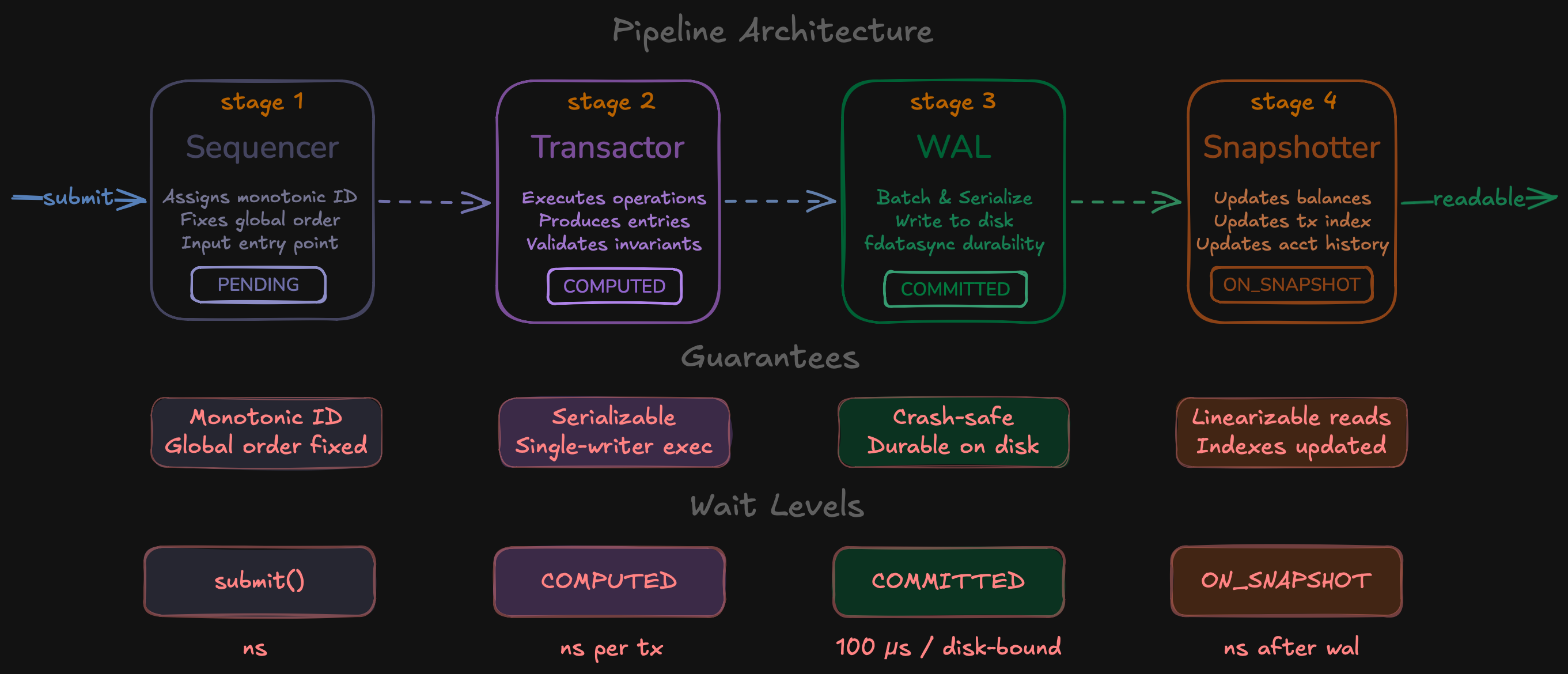
A transaction moves through four stages, each adding a guarantee:
| Stage | Guarantee | Status |
|---|---|---|
| Sequencer | Monotonic ID, permanent global order | PENDING |
| Transactor | Executed, serializable, result known | COMPUTED |
| WAL | Durable on disk, crash-safe | COMMITTED |
| Snapshotter | Balances and indexes visible | ON_SNAPSHOT |
The caller chooses which stage to wait for — see API for wait level details.
Transaction logical view
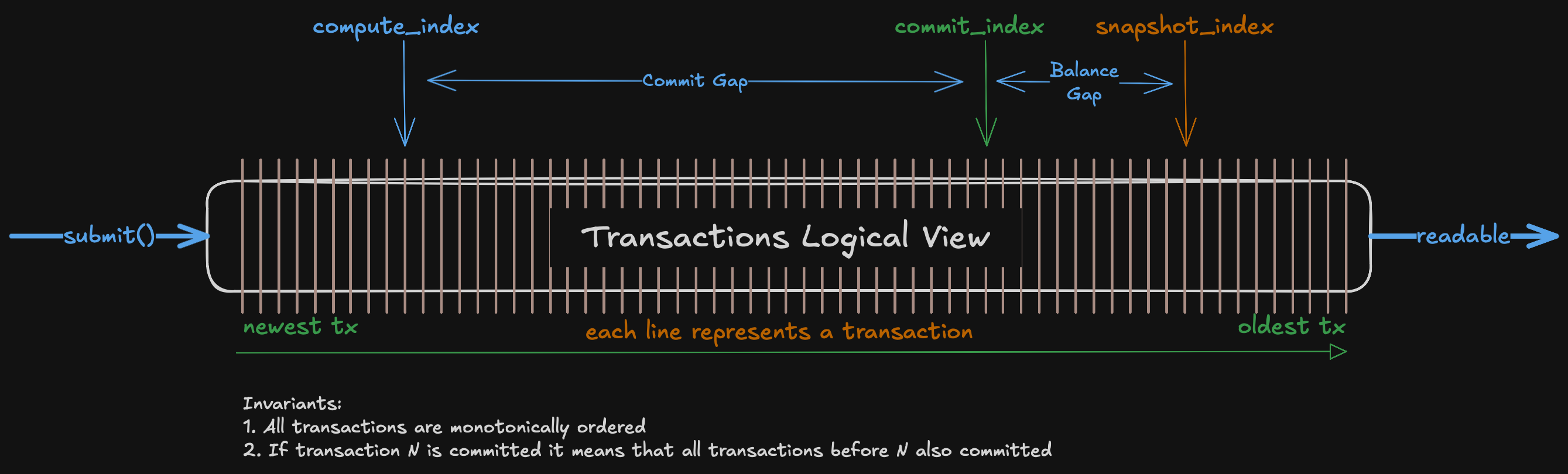
Every transaction occupies a fixed position in a globally ordered sequence. Three pipeline indexes divide that sequence into zones at any given moment:
compute_index— the furthest transaction the Transactor has executed. Everything to its right is accepted, in memory, serializable. Not yet durable.commit_index— the furthest transaction flushed to disk. Everything to its right is durable and crash-safe. The Commit Gap betweencompute_indexandcommit_indexrepresents transactions that would be lost on a crash — bounded by the WAL’s batch flush cycle (~100s µs).snapshot_index— the furthest transaction visible toget_balance. Everything to its right is readable and linearizable. The Balance Gap betweencommit_indexandsnapshot_indexis typically nanoseconds.
Two invariants hold at all times:
- All transactions are monotonically ordered — no gaps, no reordering.
- If transaction N is committed, all transactions before N are also committed. The indexes only move forward.
These invariants are what make per-call wait levels meaningful. When you call submit_wait(wal), you are waiting for commit_index to pass your transaction ID — and you know with certainty that everything before it is also durable.
The Sequencer
The Sequencer is the entry point. It assigns a unique, monotonically increasing ID to every transaction and fixes its position in the global order. This decision is permanent — no later stage can change it.
The Sequencer has no dedicated thread. It runs on the caller’s thread at submit time — nothing more than an atomic increment and a queue push.
The Transactor
The Transactor is a single-threaded, deterministic execution engine. It processes one transaction at a time, in strict sequence order.
Why single-threaded? A single writer eliminates races and conflicts entirely. Correctness is guaranteed by construction, not by coordination.
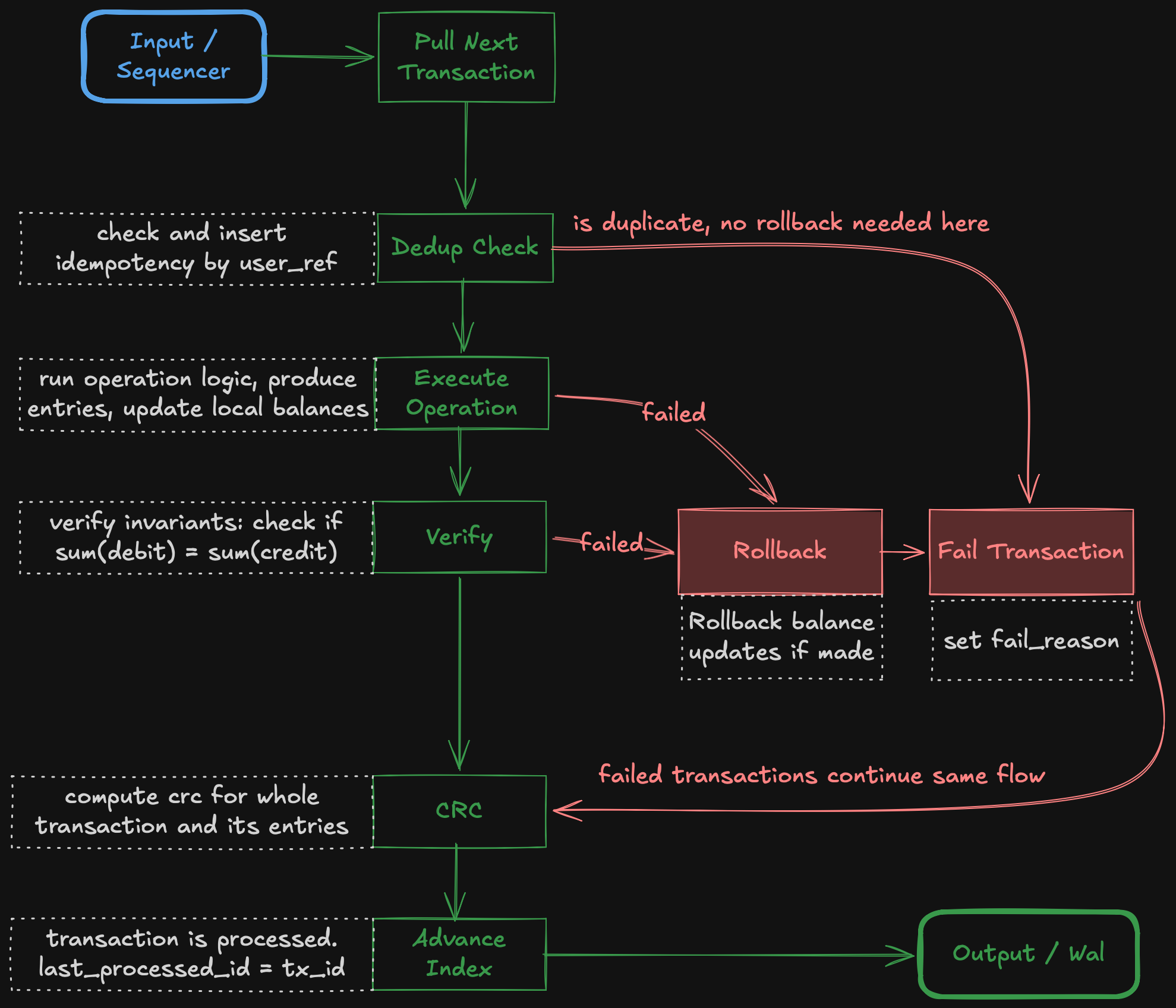
For each transaction the Transactor: checks deduplication by user_ref, executes the operation (producing credit/debit entries and updating the balance cache live), and writes those entries directly into the transaction ring’s uncommitted region — slots it owns exclusively that no reader can see yet. It verifies the zero-sum invariant by walking its own uncommitted slots, folds a running CRC over the entries as they are written, then assembles the transaction’s metadata — its commit record — and publishes the whole transaction atomically by advancing the ring’s write frontier. Failed transactions — duplicates, execution errors, invariant violations — discard the uncommitted entries and publish a lone trailing metadata record, so the audit trail stays complete and readers only ever observe whole, validated transactions.
The balance cache always reflects the latest state. This is why the write path is always linearizable — the Transactor never makes a decision based on stale data.
For built-in operations (Deposit, Withdrawal, Transfer) the Transactor runs native Rust code. For an Operation::Function, the Transactor delegates to the embedded WASM Runtime described below. Either path produces the same TxEntry records, is bounded by the same zero-sum check, and uses the same rollback machinery — there is no second code path for durability or recovery.
The WASM Runtime — programmable execution inside the Transactor
The WASM Runtime is not a separate pipeline stage. It is a component inside the Transactor that handles Operation::Function the same way native code handles Operation::Transfer. This placement is deliberate: a function execution must inherit every guarantee the Transactor already provides — single-writer ordering, zero-sum enforcement, atomic rollback, deduplication — without any new coordination.
Where it sits in the pipeline
Sequencer → Transactor ─┬─ native execution path  ─┐
                        │                          ├─→ TxEntry stream → WAL → Snapshotter
                        └─ WasmRuntime.invoke()   ─┘
A Function operation flows through Sequencer → WAL → Snapshotter exactly like any other operation. The only difference is how the Transactor produces its entries: by calling into a sandboxed WebAssembly handler that issues credit / debit host calls, instead of running a hard-coded Rust branch.
Components
WasmRuntime— one per ledger, wrapping a single sharedwasmtime::EngineandLinker. Lives behind anArc<WasmRuntime>and is cheap to clone.- Per-Transactor caller cache — a
HashMap<name, CachedHandler>owned by the Transactor thread. No locks on the hot path; the cache stores theupdate_seqof the registry it was verified against and revalidates lazily when a registration changes. - Shared registry — a small lock-protected map of
name → (version, crc32c, compiled module). Only touched on registration, unregistration, and cache miss / revalidation — never on every transaction. - Host-side execution context — a per-Transactor
TransactorStatethat captures the host calls a function emits during a singleexecute()invocation. Credits and debits accumulate here, not in WASM-visible globals, so no state leaks across calls.
Atomic execution flow
For an Operation::Function { name, params, user_ref } the Transactor:
- Performs the standard
user_refdeduplication check. - Resolves
nameagainst the caller cache, falling back to the shared registry on miss; verifiesupdate_seqto detect a concurrent registration. - Opens an isolated host-side execution context — credits and debits emitted from now on are recorded against this transaction only.
- Calls
TypedFunc::call(execute, params)on the cached handler. The function may issue any number ofcredit/debit/get_balancehost calls; each is captured into the execution context. - On any trap, host error, or non-zero return code: discards every captured credit/debit, marks the transaction failed with the appropriate status (the user-defined
u8for128..=255, a standard reason otherwise), and writes aTxMetadatarecord so auditors can see exactly which function and which return code rejected the transaction. - On a
0return: verifiessum(credits) == sum(debits). Failure here yieldsZERO_SUM_VIOLATIONand the same rollback. Success commits the captured entries to the live balance cache and emits them as ordinaryTxEntryrecords. - Tags the resulting
TxMetadatawithb"fnw\n" ++ crc32c[0..4]so every committed transaction permanently identifies the exact binary that produced it.
Stages 5–7 are the atomicity boundary. Nothing is published to the transaction ring until the function has either fully succeeded and balanced, or been fully rolled back. The WAL stage and the Snapshotter that follow it are unchanged — they cannot tell a function-produced entry stream from a native one.
Why this fits the pipeline
- Single-writer correctness. A function executes on the Transactor thread, in strict sequence, with the same in-memory balance cache native operations use. Two functions cannot race; a function cannot race with a native operation.
- No new persistence path. Function-produced entries are normal
TxEntryrecords. WAL segmentation, sealing, snapshotting, and replay treat them identically to entries from aTransfer. - No new failure mode. A WASM trap, an unbalanced credit/debit set, or a domain-specific reject all use the existing transaction-rollback machinery.
- Determinism for replication. The host API is intentionally narrow: no clocks, no randomness, no I/O, no atomics, no threads. The leader executes a function; any future Raft follower can apply the resulting WAL entries directly without re-running the WASM code.
Registration as a first-class WAL event
Registering or unregistering a function is itself a durable transaction in the pipeline:
- The submitted binary is validated (signature, size, exports) before any disk write.
- The binary is written atomically (
tmp + rename) todata/functions/{name}_v{N}.wasm. Unregister writes a 0-byte file under the next version — the audit trail is preserved. - A
FunctionRegisteredWAL record (name,version,crc32c) is committed to the active segment. - The handler is compiled and installed in the live
WasmRuntime. - Only after all four steps does
RegisterFunctionreturn.
Periodic snapshots emit a paired function_snapshot_{N}.bin next to the balance snapshot_{N}.bin, on the same snapshot_frequency trigger. Recovery loads the function snapshot first, replays FunctionRegistered records from the WAL after it (crc32c != 0 → load, crc32c == 0 → unload), and only then resumes processing transactions. A missing or corrupted binary aborts startup — the runtime never serves traffic against a registry that diverges from the WAL.
Performance shape
- The hot path adds one
HashMap::get, oneTypedFunc::call, and one host-import crossing percredit/debit. - Compiled modules are cached per
(name, crc); instantiation cost is paid once per registration, not per call. - Cache invalidation is per-name — registering
foodoes not evict the cached entry forbar. - At the Transactor level, WASM execution adds ~200 ns per operation over the native path. At the pipeline level, this is invisible: the WAL
fdatasynccost dominates and end-to-end TPS forFunctionandDepositare within a percent of each other.
Detailed ABI, host API, validation rules, and recovery semantics live in WASM Runtime and ADR-014.
The WAL
The WAL stage makes transactions durable. A transaction executed by the Transactor exists only in memory — the WAL writes it to disk before it can be considered safe.
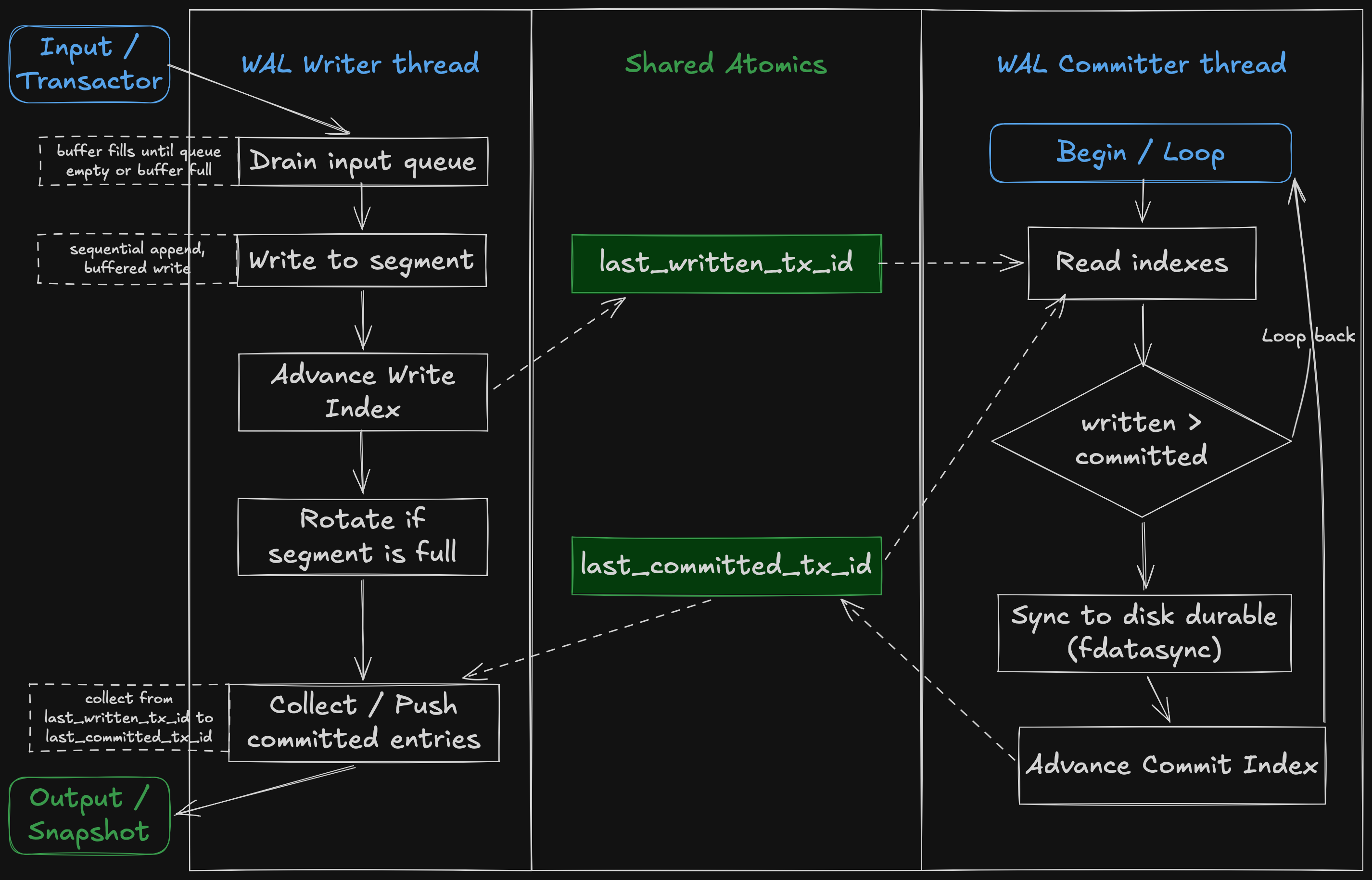
The WAL runs as two concurrent threads communicating through shared atomics:
- WAL Writer — reads published records from the transaction ring, writes them to the active segment file, advances
last_written_tx_id, and rotates segments when full. - WAL Committer — runs independently, calls
fdatasyncwheneverlast_written_tx_id > last_committed_tx_id, then advanceslast_committed_tx_id(which the pipeline exposes ascommit_index).
The Writer never blocks waiting for fdatasync — it continues writing while the Committer syncs. The WAL forwards nothing: the Snapshotter reads the same ring independently and gates itself on commit_index, so a transaction becomes visible to readers only after it is durable. This decoupling is why the WAL sustains high write throughput despite the inherent latency of fdatasync (~100s µs, disk-bound).
The WAL is segmented — divided into files based on transaction count (transaction_count_per_segment). When the transaction count in the active segment reaches the configured limit, the Writer rotates to a new one. Segment files are dynamically sized on disk — a segment with many complex (multi-entry) transactions will be larger than one with simple deposits — but the transaction count per segment is always fixed and predictable. Sealed segments are complete, consistent units used for recovery.
Segment lifecycle
A segment moves through three states:
| State | File on disk | Description |
|---|---|---|
ACTIVE | wal.bin | Currently being written. One at a time. |
CLOSED | wal_NNNNNN.bin | WAL Writer rotated away. Immutable, awaiting Seal. |
SEALED | wal_NNNNNN.bin + .crc + .seal | Verified, safe for recovery. May have snapshot. |
ACTIVE → CLOSED: transaction count threshold hit → WAL Writer fdatasyncs, renames wal.bin to wal_NNNNNN.bin, opens new wal.bin.
CLOSED → SEALED: Seal process picks it up on a timer, computes CRC32, writes .crc and .seal sidecar files.
Segment anatomy
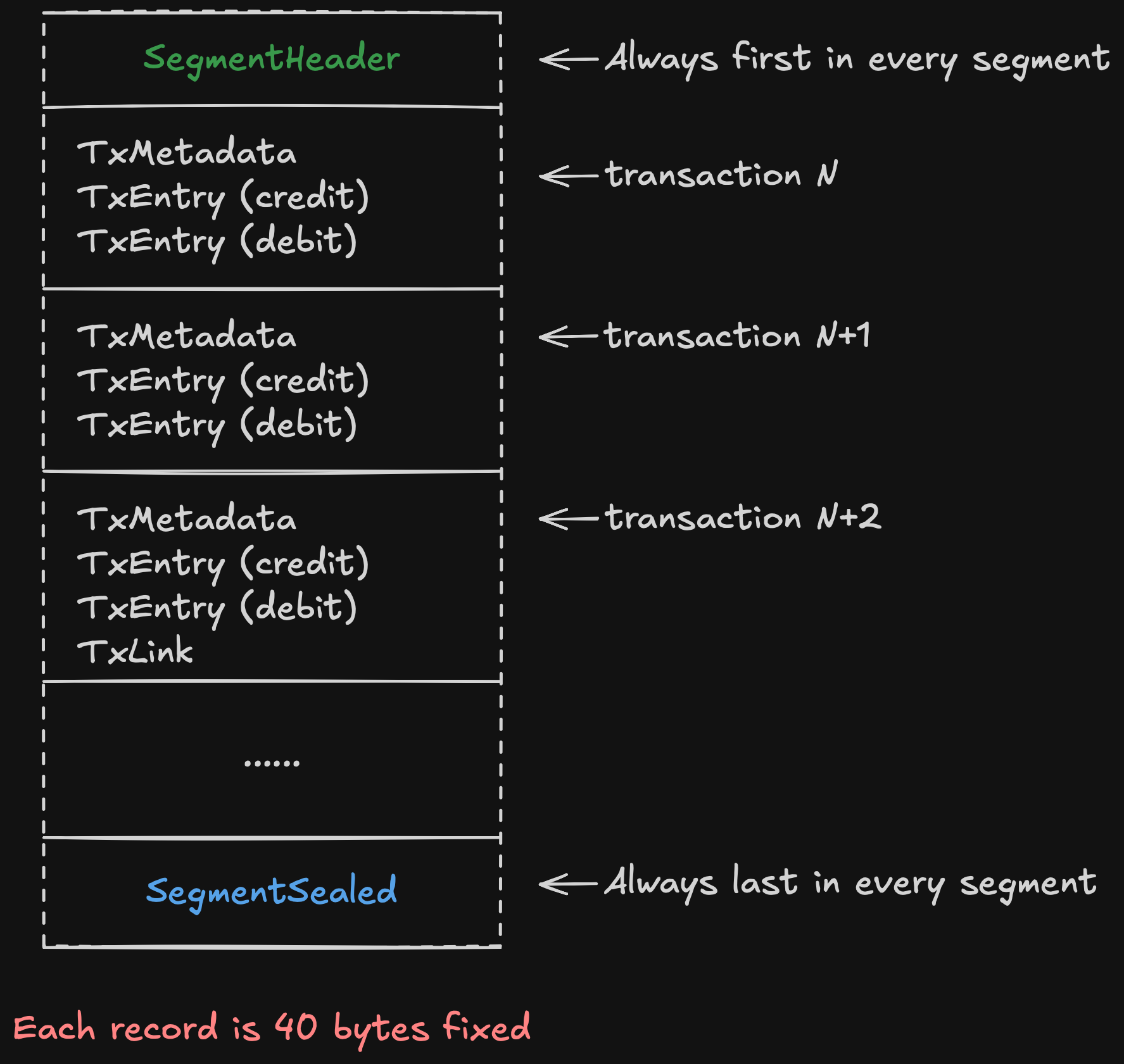
Every WAL record is exactly 40 bytes — fixed size, no variable-length scanning. This makes recovery fast and deterministic. A transaction is a contiguous group of records: its entries followed by a single trailing TxMetadata that acts as the commit record — a transaction exists exactly when its metadata has been written. Segments are a pure physical partition of one logical stream, so a transaction may span a segment boundary (its entries in one segment, the trailing metadata in the next). See ADR-020.
Seal process
The Seal process runs on a configurable timer. For each unsealed segment it: loads the WAL data, seals it (CRC + sidecar files), builds on-disk tx and account indexes, updates its local balance buffer, and conditionally writes a snapshot file.
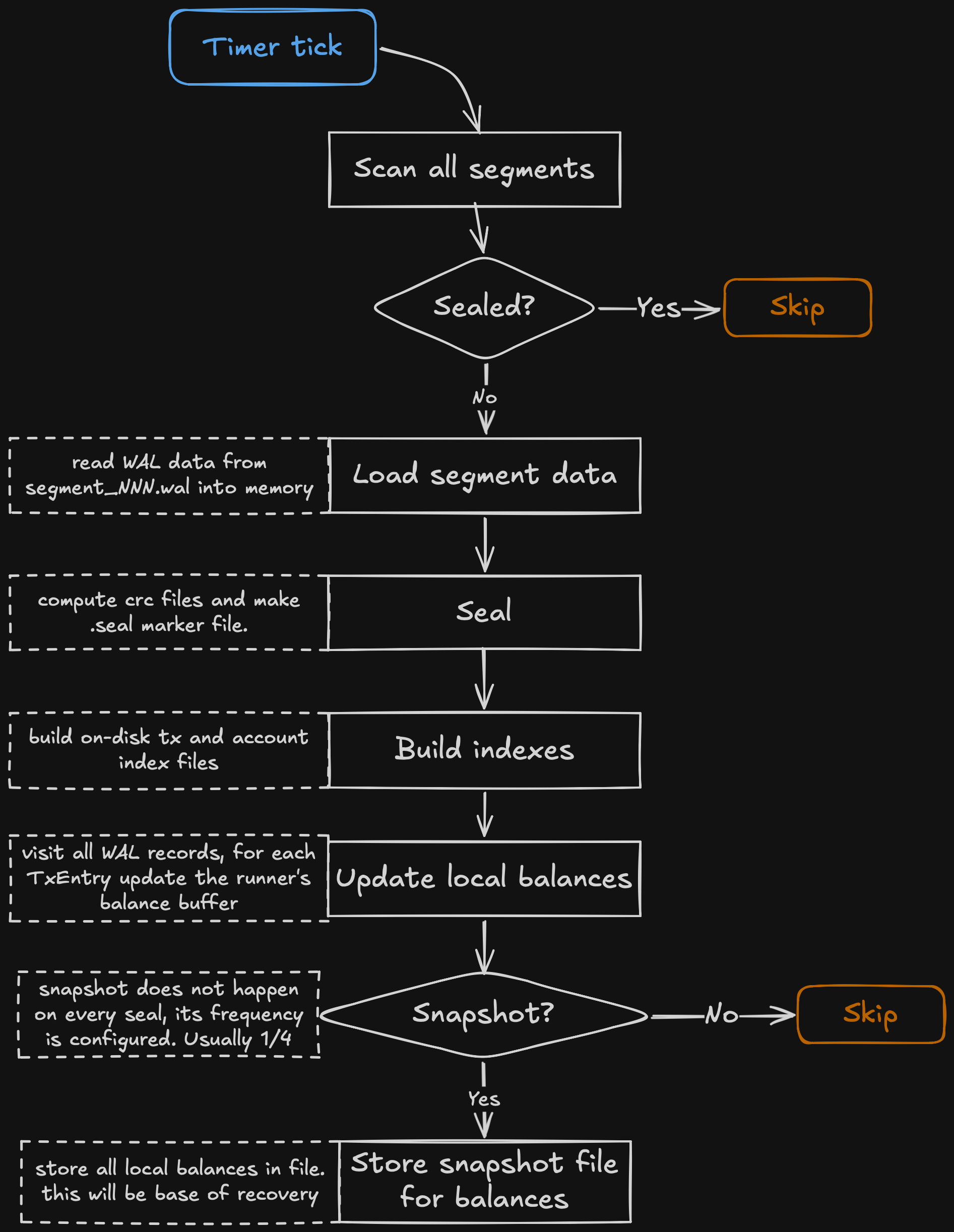
Snapshots are not written on every seal — only every snapshot_frequency segments (default: 2). The snapshot captures all non-zero balances at that point and is the base for recovery.
Active Window, Idempotency, and Hot Indexes
The active window is the central sizing concept in roda-ledger. It is defined as the last N transactions where N = transaction_count_per_segment. Three subsystems are derived from this single value:
Segment rotation
WAL segment rotation triggers when the transaction count in the active segment reaches transaction_count_per_segment. This makes the active window predictable — operators always know exactly how many transactions fit in the active segment, regardless of transaction complexity or entry counts.
Idempotency (deduplication)
The Transactor maintains a flip-flop deduplication cache — two HashMaps (active and previous) mapping user_ref → tx_id. When tx_id crosses a segment boundary, the maps flip: active becomes previous, and a new active begins. This gives an effective deduplication window of N to 2N transactions.
The flip is driven by transaction ID, not wall-clock time. Under a burst of 1M transactions per second the window covers the same number of transactions as under 100 transactions per second. Idempotency guarantees are deterministic.
Deduplication is always on — there is no config toggle. user_ref = 0 skips the check on a per-transaction basis, but the cache is always active.
Hot indexes
The Snapshotter maintains two circular indexes for serving GetTransaction and GetAccountHistory queries on recent data, hot index is keeping last N transactions where N is active window size.
The Snapshotter
The Snapshotter applies committed entries to the readable state — the balance cache, transaction index, and account history index.
Why a separate stage? The Transactor’s balance cache is write-side truth, private and optimized for writes. The Snapshotter maintains read-side truth. Separating them means readers never block writers.
The Snapshotter draws from two independent sources:
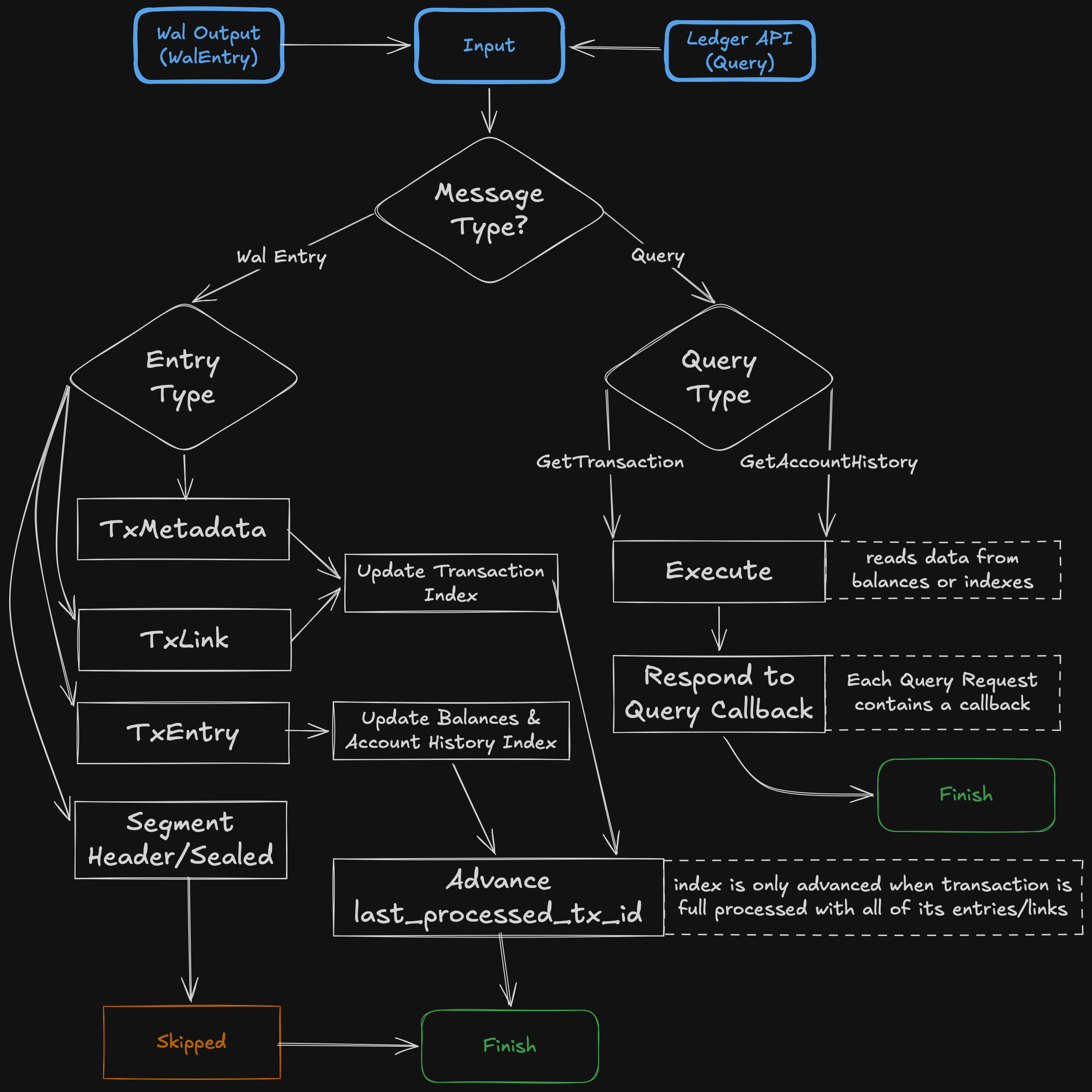
- The transaction ring — it reads published records, buffering a transaction’s entries until the trailing metadata arrives and its
tx_idis at or belowcommit_index(the durability gate). Only then does it apply the entries to the indexes and balance cache together, advancesnapshot_index, and — as the ring’s sole releaser — reclaim the consumed slots. Readers therefore never see a partially-applied or not-yet-durable transaction. - A query-only queue —
GetTransaction/GetAccountHistoryrequests execute inline against current state and call the response callback.
The Snapshotter does no computation — balances are pre-computed by the Transactor and stored in entries. The gap between COMMITTED and ON_SNAPSHOT is typically nanoseconds.
The transaction ring
The Transactor, WAL, and Snapshotter share a single lock-free transaction ring — the one transport for the record stream, replacing the former transactor→WAL and WAL→snapshot queues (ADR-019).
- One producer. The Transactor appends records into ring slots and publishes them. It also builds each transaction in place in the uncommitted region, so the ring doubles as its per-transaction scratch space — no separate staging buffer.
- Independent copy-out readers. The WAL and Snapshotter each track their own absolute cursor and copy records out at their own pace. A slot may be reused once released, so readers copy rather than borrow.
- One releaser, durability-gated. The Snapshotter is the only party that advances the reclamation point, and only up to the durability watermark. A slot is reused only after the record it held is durable on disk and consumed by every reader — making “never overwrite an undurable record” a structural property of the transport.
Positions are absolute, monotonically increasing indices (mapped to physical slots on access), so progress and ordering stay unambiguous across wraps. Because a transaction is published atomically, the ring capacity (ring_size) must be at least the largest possible single transaction.
Inter-stage communication
The record stream rides the transaction ring described above; the submit and query paths use lock-free SPSC queues (sequencer → transactor, and the Snapshotter’s query queue) — one producer, one consumer, no locks. Each stage owns its data completely.
Backpressure propagates naturally. The Snapshotter releases ring slots only up to the durability watermark, so if durability or indexing stalls, the ring fills and the Transactor stops finding free slots; that stalls the Transactor, which fills the sequencer → transactor queue, which eventually stalls submit(). No explicit flow control is needed, and the producer never blocks inside the ring — it retries under the shared wait strategy.
The wait strategy under backpressure is controlled by the wait_strategy config field (see API → Setup): low_latency (spin forever), balanced (spin → yield → park), low_cpu (park quickly).
Recovery
On startup, roda-ledger restores state automatically before accepting transactions:
- Find the latest snapshot — gives all balances at a known transaction ID
- Load those balances
- Replay WAL segments that postdate the snapshot
- Resume from the exact point where the ledger left off
Because every committed transaction is in the WAL, and the WAL is always replayed on recovery, a committed transaction is never lost. Replay buffers a transaction’s entries until its trailing metadata closes and validates the group — carrying the buffer across segment seams for a transaction that spans a boundary — while a torn tail of the active segment is truncated back to its last metadata boundary. Recovery time is bounded by snapshot frequency — more frequent snapshots mean less WAL to replay.
Design boundaries
Single node. All pipeline stages run on one machine. Raft-based multi-node replication is planned — the segmented, append-only WAL is a natural fit for log replication.
Pre-allocated account space. Balances are stored in a structure sized to max_accounts. O(1) reads and writes always, but memory is committed at startup — a capacity planning decision.
Disk-bound durability throughput. fdatasync latency determines COMMITTED throughput. On NVMe this is hundreds of µs per batch. COMPUTED throughput (in-memory only) reaches millions of transactions per second.
Single-writer ceiling. The Transactor is the upper bound on execution throughput. In practice the WAL is almost always the bottleneck — but on fast enough storage, the single-threaded Transactor becomes the limit.